AI Benchmarks
ARC-AGI-2 Leaderboard 2026: Which Score Actually Counts
The ARC-AGI-2 leaderboard tops out at 95% while the Kaggle private set peaked at 24%. Both are real numbers. Here is which one a market would resolve on.
Key takeaways
- ARC-AGI-2 has two live scoreboards that disagree by about 70 points. The ARC Prize public leaderboard tops out at 95.0% for GPT-6 Astra on 2 September 2026; the best score ever recorded on the Kaggle private evaluation set is 24%, set across the 2025 competition by 1,455 teams and 15,154 entries.
- Neither number is wrong. They measure different things: the public leaderboard runs frontier systems with no efficiency cap, and the Kaggle track requires 85% on a fully private holdout inside Kaggle's compute limits, in a notebook with no internet access.
- The $150,000 ARC-AGI-2 Bonus Prize for a solution scoring at least 85% on the private set was not claimed in 2026. ARC Prize's own rules say it rolls forward to 2027, which is the cleanest available evidence that the private set is nowhere near solved.
- ARC-AGI-3 makes the harness effect impossible to miss. On 13 October 2026 Gemini 4 Argon is listed at 49.8% under Standard scoring and 97.5% under the provider adapter, the same model on the same day, a 47.7 point spread. GPT-6 Astra reads 62.7% and 99.9%.
- ARC Prize 2026 closed with results announced on 4 December 2026. Until that date the Kaggle standings in public view are computed on roughly half the test data, so the number most people are quoting is not the number that decides the prizes.
On this page
Somebody will tell you this week that AI has solved ARC-AGI-2, and somebody else will tell you the best anyone has managed is a quarter of it. Both of them will be quoting a real, published, primary-source figure. The gap between those figures is about 70 percentage points, and it sits inside the one benchmark that was explicitly designed to be hard to game, which should tell you something about how much trust a leaderboard number can carry on its own.
That gap is worth money if you price AI benchmark markets, because the only question that matters for a contract is which scoreboard it reads. We pulled all 119 rows of the ARC Prize public leaderboard on 7 November 2026, read the ARC Prize 2026 competition rules for both tracks, and checked the 2025 technical report for the only private-set score that has ever been published. The numbers below are those sources, not a summary of them.
On this page we work through it in order:
1. What ARC-AGI-2 asks, and why the score is so sensitive to setup.
2. The public leaderboard: 119 rows and a 95.0% ceiling.
3. The Kaggle private set: 24%, and a bonus prize that rolled over.
4. The four numbers side by side.
5. ARC-AGI-3, where the harness gap becomes unmissable.
6. What 4 December 2026 actually resolves.
7. How a market would have to word an ARC-AGI question.
8. Reading any benchmark leaderboard as a resolution source.
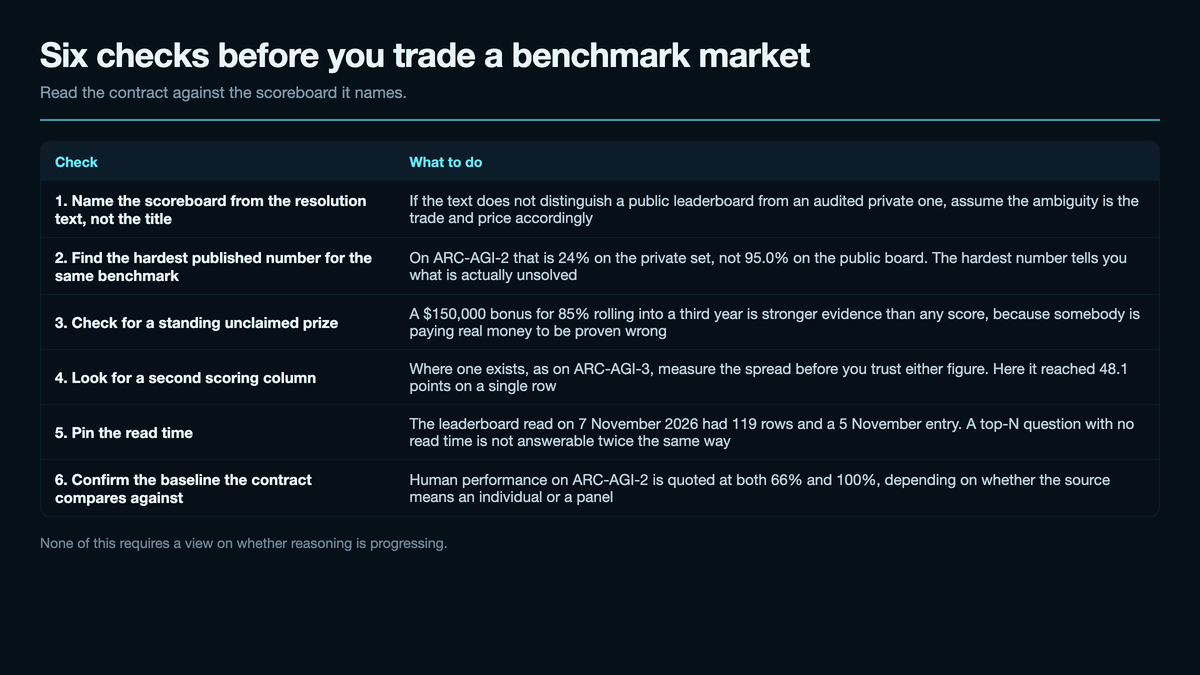
9. Six checks before you trade a benchmark market.
What ARC-AGI-2 asks, and why the score moves so much
ARC-AGI-2 is a set of visual grid puzzles. Each task gives a handful of input-output example pairs, and the system has to infer the transformation rule and apply it to a fresh input. There is no knowledge to retrieve and nothing to look up. The design goal is fluid reasoning on problems the system has never seen, which is why ARC has stayed interesting long after knowledge benchmarks saturated.
Scoring is pass@2. ARC Prize's 2026 competition rules state it plainly: predict exactly two outputs per test input, and a task scores 1 if either prediction matches the ground truth exactly. No partial credit, no fuzzy match. That is an unusually clean resolution rule by benchmark standards, and it is not where the ambiguity comes from.
The ambiguity comes from everything around the model. A reported ARC score is a score for a whole system: the model, plus however much sampling, program search, verification and retry logic has been wrapped around it. Aggregators covering the benchmark note that published figures typically include that scaffolding contribution and that bare-model scores without it are substantially lower. The same weights can therefore produce wildly different public numbers depending on who ran them and how hard they were allowed to try.
Even the human baseline is contested. One aggregator puts average individual human performance at 66% while describing the headline 100% as a panel figure, meaning at least one person in a group solved each task. Those are two different claims about humans, and articles quote them interchangeably. If the reference line is unstable, a market pegged to beating it inherits that instability.
The public leaderboard: 119 rows and a 95.0% ceiling
The ARC Prize leaderboard carried 119 model rows when we read it on 7 November 2026. It reports ARC-AGI-1, ARC-AGI-2 and ARC-AGI-3 in the same table, which is useful, because the spread across those three columns for a single model is the fastest way to see how much a benchmark's difficulty has actually moved.
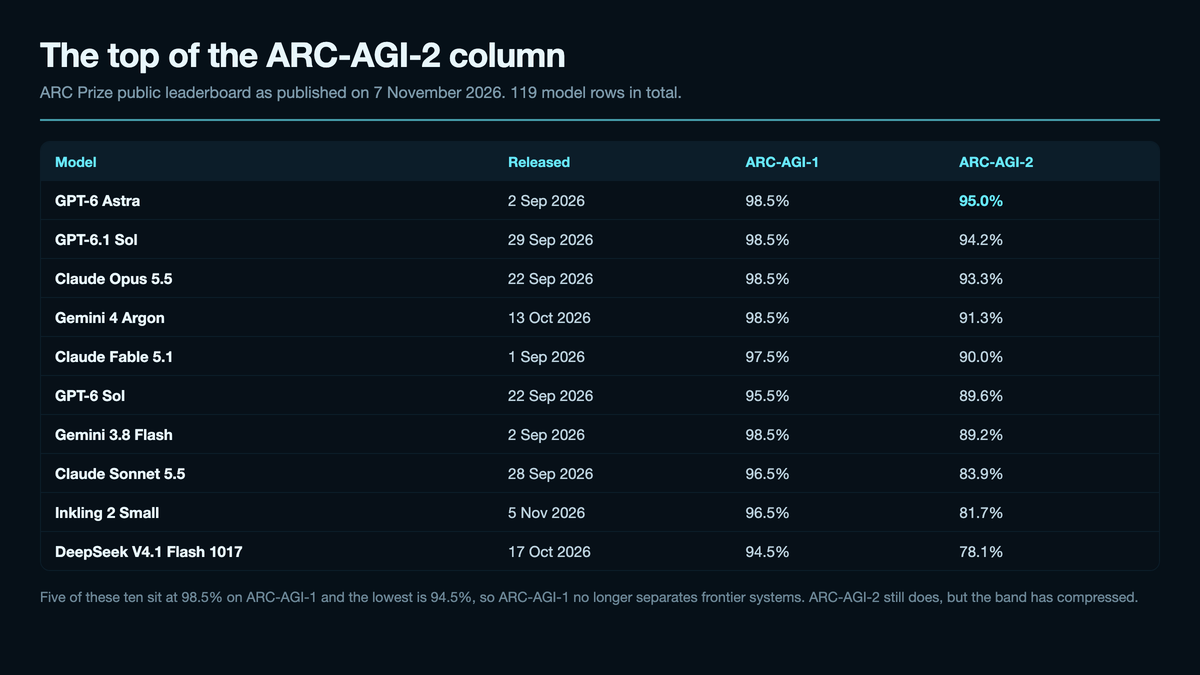
The top of the ARC-AGI-2 column, by score. All figures are the ARC Prize public leaderboard as published on 7 November 2026, with the model's release date and its ARC-AGI-1 score on the same row:
GPT-6 Astra, 2 Sep 2026 - ARC-AGI-1 98.5%, ARC-AGI-2 95.0%
GPT-6.1 Sol, 29 Sep 2026 - ARC-AGI-1 98.5%, ARC-AGI-2 94.2%
Claude Opus 5.5, 22 Sep 2026 - ARC-AGI-1 98.5%, ARC-AGI-2 93.3%
Gemini 4 Argon, 13 Oct 2026 - ARC-AGI-1 98.5%, ARC-AGI-2 91.3%
Claude Fable 5.1, 1 Sep 2026 - ARC-AGI-1 97.5%, ARC-AGI-2 90.0%
GPT-6 Sol, 22 Sep 2026 - ARC-AGI-1 95.5%, ARC-AGI-2 89.6%
Gemini 3.8 Flash, 2 Sep 2026 - ARC-AGI-1 98.5%, ARC-AGI-2 89.2%
Claude Sonnet 5.5, 28 Sep 2026 - ARC-AGI-1 96.5%, ARC-AGI-2 83.9%
Inkling 2 Small, 5 Nov 2026 - ARC-AGI-1 96.5%, ARC-AGI-2 81.7%
DeepSeek V4.1 Flash 1017, 17 Oct 2026 - ARC-AGI-1 94.5%, ARC-AGI-2 78.1%
Read down the ARC-AGI-1 column and it is already over. Five of those ten rows sit at 98.5% and the lowest is 94.5%, so ARC-AGI-1 no longer separates frontier systems from each other. ARC-AGI-2 still does, but the band has compressed hard: in roughly nine weeks the top ten went from a benchmark that nothing cleared to one where the tenth-placed entry is at 78.1%.
The leaderboard also publishes a cost column, with figures ranging from $241.28 for GPT-6 Luna to $26.1K for GPT-6 Astra. We are deliberately not tabling those. The page's own explanatory text describes the scatter plot as showing cost-per-task, but the table column is headed only Cost, and a $26,100 per-task reading is not plausible for a 120-task evaluation. The basis is not stated where the numbers are, so we are leaving the numbers out rather than guessing at their units.
The Kaggle private set: 24%, and a bonus prize that rolled over
Alongside the public leaderboard, ARC Prize runs an annual Kaggle competition against a fully private evaluation set. The stated objective for the 2026 ARC-AGI-2 track is to reach 85% accuracy on the ARC-AGI-2 private evaluation dataset within the Kaggle efficiency limits. Submissions are Kaggle notebooks with no internet access during evaluation, and all code and methods have to be open sourced to be prize-eligible.
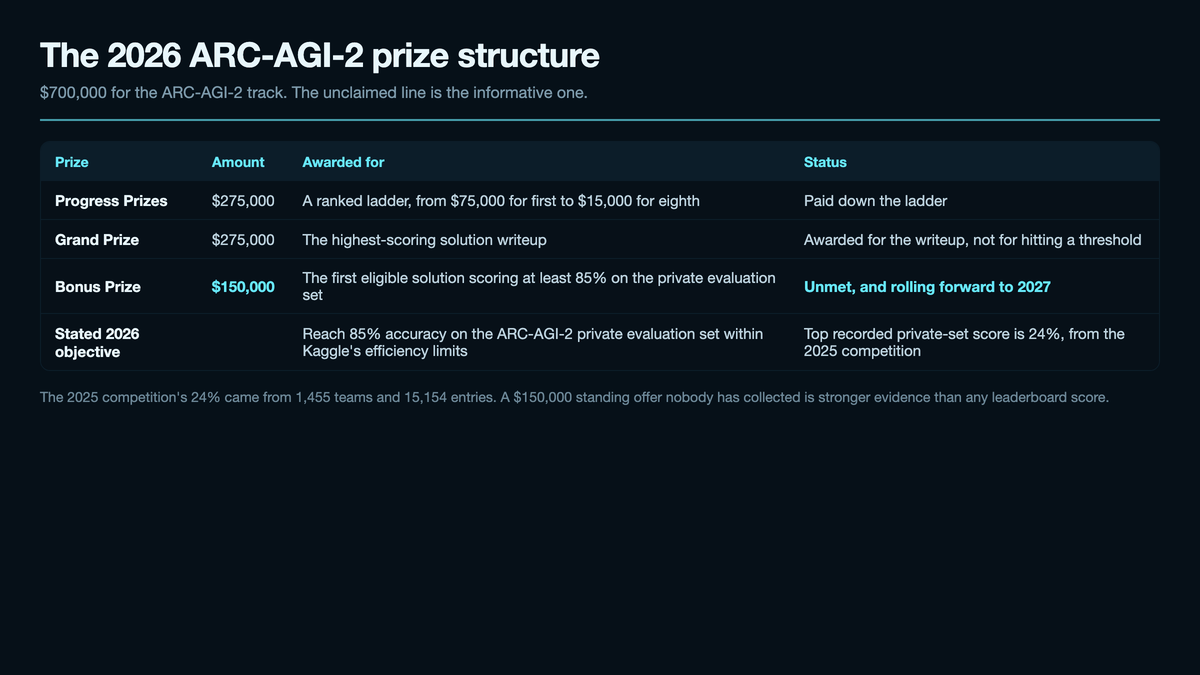
That is a materially harder problem than the one the public leaderboard measures, and the recorded scores show it. The ARC Prize 2025 technical report puts the top score of that competition at 24% on the ARC-AGI-2 private evaluation set, from 1,455 teams and 15,154 entries. Not 24% for one weak entrant. Twenty-four per cent was the ceiling for everybody.
The 2026 prize structure is $700,000 for the ARC-AGI-2 track: $275,000 in Progress Prizes, $275,000 for the Grand Prize, and a $150,000 Bonus Prize. The Progress Prizes pay down a ranked ladder, from $75,000 for first to $15,000 for eighth. The Grand Prize goes to the highest-scoring solution writeup, judged on six criteria scored 0 to 5 and averaged, with artifacts open sourced within seven days of the deadline.
The Bonus Prize is the one that tells you where the frontier really is. ARC Prize awards it to the first eligible solution scoring at least 85% on the private evaluation set, and the rules state that if the threshold is unmet it rolls forward to 2027. It is rolling forward. A $150,000 standing offer for 85% on a benchmark that frontier labs are publicly reporting at 95% went unclaimed through an entire competition cycle, and that single fact does more to locate the real state of the art than any leaderboard row.
The four numbers, side by side
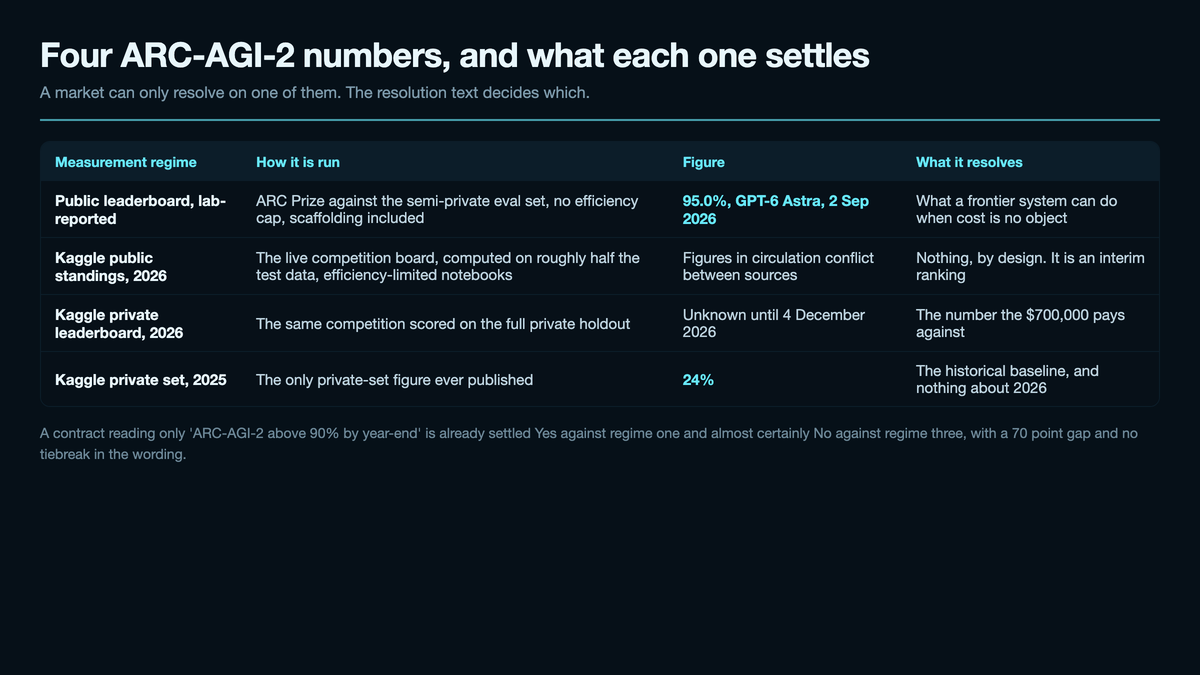
There are four distinct ARC-AGI-2 figures in public circulation right now, and a market can only resolve on one of them. Laid out by measurement regime, with what each one would settle:
Public leaderboard, lab-reported - run by ARC Prize against the semi-private eval set, no efficiency cap, scaffolding included. Latest top figure 95.0%, GPT-6 Astra, 2 Sep 2026. Resolves questions about what a frontier system can do when cost is no object.
Kaggle public standings, 2026 - the live competition leaderboard, computed on roughly half the test data, efficiency-limited notebooks. Figures in circulation conflict between sources. Resolves nothing, by design; it is an interim ranking.
Kaggle private leaderboard, 2026 - the same competition scored on the full private holdout. Unknown until 4 December 2026. This is the number the $700,000 pays against.
Kaggle private set, 2025 - the only private-set figure ever published. Top score 24%. Resolves the historical baseline question, and nothing about 2026.
The practical consequence: a contract reading only ARC-AGI-2 above 90% by year-end is already settled Yes against regime one and almost certainly No against regime three, with a 70 point gap between them and no tiebreak in the wording. That is not a close call that a trader can handicap. It is a contract that pays whoever drafted it.
This is the same defect we have documented on benchmark debut boards elsewhere on Odsage, where a market's wording and its apparent subject came apart. The failure mode travels: whenever a benchmark has more than one scoreboard, the resolution text is the asset and the headline score is decoration.
ARC-AGI-3, where the harness gap becomes unmissable
ARC-AGI-3 launched in March 2026 and is a different kind of test. Instead of static grids it drops an agent into turn-based interactive environments, handcrafted by human game designers, with no instructions, no stated rules and no stated goal. The agent has to explore, build a working model of the environment, set its own goals and correct itself from feedback. At launch, ARC Prize reported that humans solve all of the environments while frontier systems scored below 1%.
The ARC Prize leaderboard scores it in two columns: Standard, and provider adapter. Same model, same evaluation date, two numbers. All figures below are from the ARC Prize public leaderboard on 7 November 2026, and both columns on each line are that one model's single leaderboard row:
GPT-6 Astra, 2 Sep 2026 - Standard 62.7%, provider adapter 99.9%, spread 37.2 points
GPT-6.1 Sol, 29 Sep 2026 - Standard 52.7%, provider adapter 96.4%, spread 43.7 points
Gemini 4 Argon, 13 Oct 2026 - Standard 49.8%, provider adapter 97.5%, spread 47.7 points
Claude Sonnet 5.5, 28 Sep 2026 - Standard 24.3%, provider adapter 72.4%, spread 48.1 points
Gemini 3.8 Flash, 2 Sep 2026 - Standard 10.4%, provider adapter 35.0%, spread 24.6 points
GPT-6 Sol, 22 Sep 2026 - Standard 4.6%, provider adapter 23.0%, spread 18.4 points
Claude Haiku 5.5, 7 Oct 2026 - Standard 0.5%, provider adapter 2.8%, spread 2.3 points
DeepSeek V4.1 Flash 1017, 17 Oct 2026 - Standard 0.2%, provider adapter 5.8%, spread 5.6 points
Nothing about the model changed between those two columns. The harness did. Gemini 4 Argon is either halfway through ARC-AGI-3 or essentially finished with it depending on which column you read, and a headline that says a model scored 97.5% on ARC-AGI-3 is quoting the second one without saying so. The ARC-AGI-2 column has no equivalent split published next to it, which is precisely why the scaffolding question there is harder to see rather than absent.
What 4 December 2026 actually resolves
ARC Prize 2026 has closed. The leaderboard and both competition pages carry the same banner: results will be announced on 4 December 2026. That makes it one of the few genuinely dated, objectively settled events in the AI benchmark calendar, which is exactly the shape a prediction market wants.
What lands that day is the private leaderboard for both tracks, plus the prize allocations. Specifically: whether anyone cleared 85% on the ARC-AGI-2 private set and took the $150,000 Bonus Prize, the ranked Progress Prize ladder, and the Grand Prize writeup award. On the ARC-AGI-3 side, $850,000 is on the table with a $700,000 Grand Prize for the first eligible agent scoring 100%, a threshold nobody has publicly approached.
What does not land that day is any revision to the public leaderboard. The two systems are independent. GPT-6 Astra's 95.0% will still read 95.0% on 5 December whatever the competition result says, which means the apparent contradiction will not resolve itself. Anyone holding a position on a loosely worded ARC question should expect both camps to claim vindication.
One procedural detail worth knowing before you handicap the announcement: prize eligibility requires open sourcing, so the solutions that will define the record have to be published as a condition of being paid. The post-announcement writeups are therefore likely to be the most informative material on where reasoning systems actually stand, and they arrive within days rather than months.
How a market would have to word an ARC-AGI question
No prediction market currently prices ARC-AGI. We searched Polymarket's active events on 7 November 2026 and found nothing on the benchmark; the live AI benchmark boards there are about debut scores on other leaderboards and Millennium Prize claims. The absence is informative rather than an oversight, because an ARC market is unusually awkward to draft.
A workable ARC-AGI-2 contract needs four things nailed down in the text. The scoreboard, named exactly, as public leaderboard or Kaggle private leaderboard, because those have differed by 70 points. The evaluation set, since semi-private and fully private are different data. The harness, or at least a rule for which column counts when a benchmark publishes more than one. And a read time, because leaderboards are edited and the 5 November row that was not there last week changes a top-ten query.
Drop any one of those and the contract becomes a bet on drafting rather than on capability. That is the same failure we have traced through debut boards, where a tier label rather than a score decided the outcome, and through resolution-source disputes on other benchmarks. The benchmark being objective does not make the market objective.
If you want to take a view on reasoning progress in the meantime, the tradeable proxies are the model-quality boards rather than the benchmark itself: which lab holds the best model at a date, and the leaderboard-debut markets. Those at least name a single scoreboard and a single read time, which is more than an ARC contract would manage today.
Reading any benchmark leaderboard as a resolution source
The ARC case is extreme but not special. Every benchmark that matters to AI markets has the same structure underneath: a public number that labs report, a stricter number that somebody audits, and a gap between them that nobody is obliged to reconcile.
Three questions separate a usable resolution source from a decorative one. Who ran the evaluation, the lab or the benchmark owner? What was the cost or compute cap, if any? And is the published figure a bare model score or a system score with scaffolding? If a leaderboard cannot answer all three on the same page as the number, it is not a resolution source, whatever the contract says.
There is a tell that costs nothing to check. When a benchmark publishes two columns for one model, as ARC-AGI-3 does with Standard and provider adapter, it is telling you openly that the harness is worth tens of points. When it publishes one column, the harness effect has not gone away, it has just stopped being visible. Treat a single-column leaderboard as the harder one to interpret, not the easier one.
The same reasoning applies to the human baseline, which is the quiet assumption inside any beats humans contract. If the published baseline shifts between an average individual and a panel, as ARC-AGI-2's does between 66% and 100%, then a question about matching human performance has two answers before anyone runs a model.
Six checks before you trade a benchmark market
1. Name the scoreboard from the resolution text, not the title. If the text does not distinguish a public leaderboard from an audited private one, assume the ambiguity is the trade and price accordingly.
2. Find the hardest published number for the same benchmark. On ARC-AGI-2 that is 24% on the private set, not 95.0% on the public board. The hardest number tells you what is actually unsolved.
3. Check for a standing unclaimed prize. A $150,000 bonus for 85% rolling into a third year is stronger evidence than any score, because somebody is paying real money to be proven wrong.
4. Look for a second scoring column. Where one exists, as on ARC-AGI-3, measure the spread before you trust either figure. Here it reached 48.1 points on a single row.
5. Pin the read time. The leaderboard we read on 7 November 2026 had 119 rows and a 5 November entry. A top-N question with no read time is not answerable twice the same way.
6. Confirm the baseline the contract compares against. Human performance on ARC-AGI-2 is quoted at both 66% and 100% depending on whether the source means an individual or a panel.
None of this requires a view on whether reasoning is progressing. It requires reading the contract against the scoreboard it names, which on current evidence is where most of the mispricing in AI benchmark markets lives.
FAQ
Frequently asked questions
What is the highest ARC-AGI-2 score in 2026?
On the ARC Prize public leaderboard, GPT-6 Astra at 95.0%, recorded on 2 September 2026. GPT-6.1 Sol follows at 94.2% and Claude Opus 5.5 at 93.3%. Those are lab-reported figures against the semi-private evaluation set with no efficiency cap, and they are not the same measurement as the Kaggle competition score.
Why does ARC-AGI-2 show 95% and 24% at the same time?
Because they are two different evaluations. The 95.0% is the ARC Prize public leaderboard, run on the semi-private set with unlimited compute and whatever scaffolding the system uses. The 24% is the top score on the fully private Kaggle evaluation set, achieved in the 2025 competition inside Kaggle's efficiency limits in a notebook with no internet access. Both figures are published by ARC Prize.
Has anyone won the ARC-AGI-2 grand prize?
The $150,000 Bonus Prize for the first eligible solution scoring at least 85% on the private evaluation set was not claimed in the 2026 cycle, and ARC Prize's rules state it rolls forward to 2027 if unmet. The $275,000 Grand Prize is awarded for the highest-scoring solution writeup rather than for hitting a score threshold, and 2026 allocations are announced on 4 December 2026.
When are ARC Prize 2026 results announced?
4 December 2026. The competition has closed and both the ARC-AGI-2 and ARC-AGI-3 competition pages carry that date. The private leaderboards and prize allocations land then. The public model leaderboard is a separate system and is not revised by the announcement.
What is the difference between ARC-AGI-3 Standard and provider adapter scores?
They are two scoring columns for the same model on the same leaderboard row, and they differ by a lot. Gemini 4 Argon reads 49.8% Standard and 97.5% provider adapter on 13 October 2026, a 47.7 point spread; GPT-6 Astra reads 62.7% and 99.9%. The difference comes from the harness around the model rather than the model itself, which is why a quoted ARC-AGI-3 figure means little without the column name.
Can you bet on ARC-AGI scores on Polymarket?
Not as of 7 November 2026. A search of Polymarket's active events returns no ARC-AGI market. The live AI benchmark boards cover leaderboard debut scores and Millennium Prize claims instead. An ARC contract would need to name the scoreboard, the evaluation set, the scoring column and a read time to be tradeable, which is harder to draft than it looks.
Is ARC-AGI-2 harder than ARC-AGI-1?
Substantially, and the leaderboard shows it in one glance. Among the current ARC-AGI-2 top ten, five models sit at 98.5% on ARC-AGI-1 and the lowest is 94.5%, so ARC-AGI-1 no longer separates frontier systems. ARC-AGI-2 still spreads them, from 95.0% down to 78.1% across the same ten rows, and the private-set version of the task remains far from solved.
Sources and methodology
Sources used for this guide
Odsage combines public source links with prediction-market context, related market pages, calculator workflows, and visible FAQ content. Market prices are informational and are not financial advice.