Prediction Markets
Polymarket Resolution Rules 2026: AI Market Guide
Polymarket resolution rules decide what AI market shares pay. We read the rules text on four live 2026 markets, and two of them do not match their titles.

Key takeaways
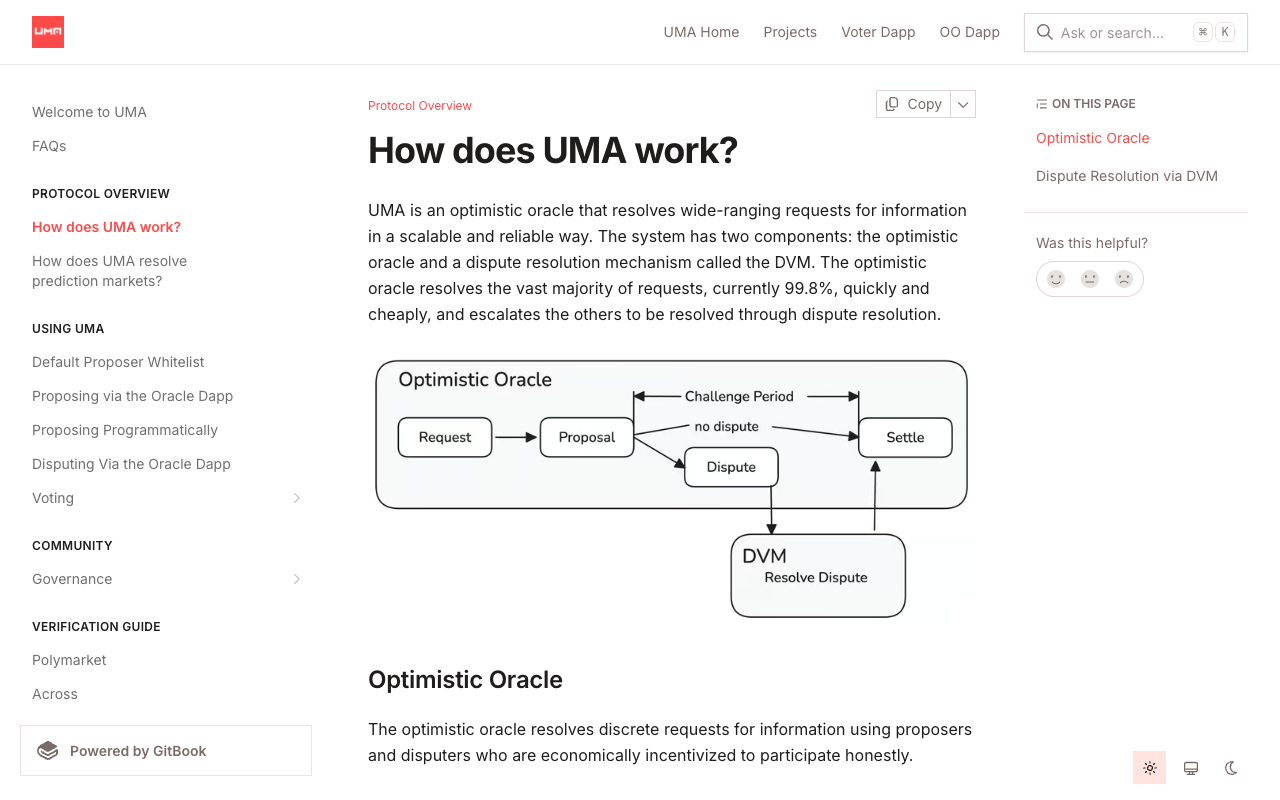
- Polymarket resolution rules are three layers deep: a named resolution source that decides the fact, a bonded proposal with a two-hour challenge window, and a UMA token vote as the final arbiter. Only the first layer is written per market, and it is the one traders skip.
- The 'Gemini 4.0 released by...?' market carries $603,715 of volume and its rules resolve on Gemini 4.0 Flash specifically. Its sibling market on the next Gemini Pro model states that Flash and Flash-Lite do not qualify. Two live Gemini release markets, opposite treatment of the same model, and neither title says so.
- The two 'best AI model' markets name different URLs for the same leaderboard. The September market points at arena.ai with style control off; the December market, carrying $1,416,478 of volume, still names lmarena.ai, which has 301-redirected since the January 2026 rebrand. Its structured resolutionSource field is empty.
- A disputed market costs $750 to challenge and can take days: two hours to dispute, 24 to 48 hours of debate, then roughly 48 hours of UMA voting. Positions stay frozen throughout, which is a real cost nobody prices at entry.
- Managed proposers cut the problem down rather than solving it. UMA restricted proposing to a whitelist in November 2025, and incorrect proposals fell 59% while total disputes fell 68%. Disputing stayed permissionless and the token vote is still the last word.
On this page
Polymarket resolution rules are the part of an AI market that decides whether your shares pay a dollar or nothing, and they are the part almost nobody reads. Traders argue about whether Gemini 4.0 ships in October while the contract they hold quietly specifies a different model variant than the one in its own title. That is not a hypothetical: on the four live markets we read this afternoon, two resolve on criteria their headline does not mention, and one names a resolution URL that has been redirecting elsewhere since January.
Every price, volume and liquidity figure below was read from the Polymarket Gamma API at 16:20 UTC on 26 September 2026, and every rules quotation is from the market's own description field on the same call rather than a summary of it. We also fetched the leaderboards and the vendor pages the rules point at, to check they still resolve where the rules say they do. One of them does not.
1. How a Polymarket market actually resolves, in three layers.
2. Layer one: the named resolution source, and why it is the whole market.
3. The Gemini 4.0 market is a Flash market, and its sibling excludes Flash.
4. When the rules hand the decision to a private data vendor.
5. Layer two: the dispute ladder, $750 bonds and two-hour windows.
6. What changed in 2025: managed proposers, and the 68% drop in disputes.
7. Layer three: when the token vote itself is the risk.
8. Five checks to run before you trade an AI market.
How a Polymarket market resolves, in three layers
Most explainers of Polymarket resolution rules start and finish with UMA's optimistic oracle. That is the plumbing, and it is genuinely well documented, but describing it alone gives traders the wrong mental model. It suggests the hard question is who adjudicates. On AI markets the hard question is almost always what the contract asked in the first place.
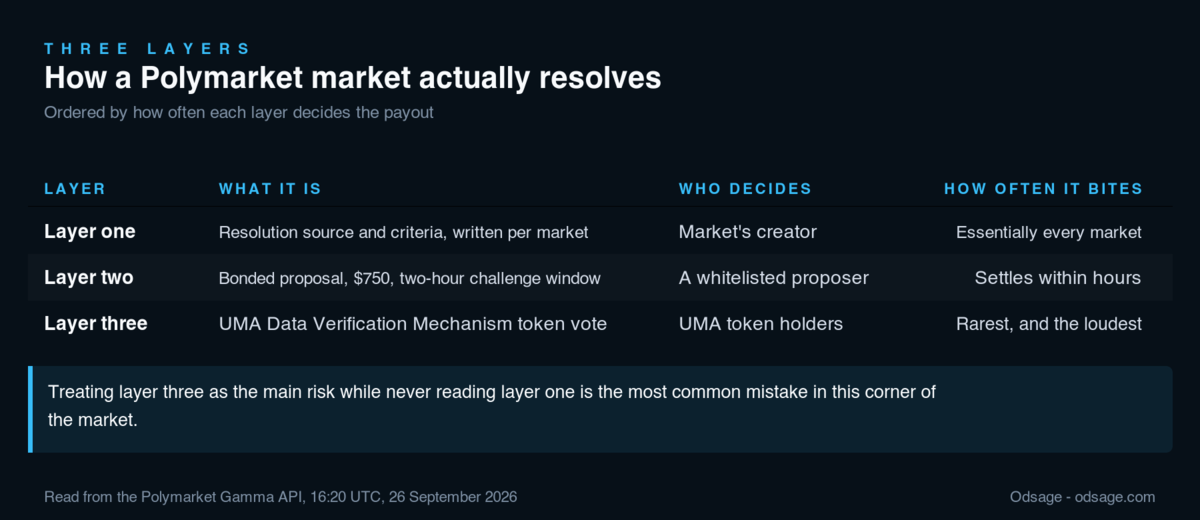
Think of it as three layers stacked in order of how often they bite. Layer one is the resolution source and criteria, written into each individual market by whoever created it. This is where a market says which leaderboard it checks, at what time, with which settings, and what counts as a release. Layer one decides essentially every market, and it is bespoke text, so it is the layer that can surprise you.
Layer two is the bonded proposal. Once the event window closes, a proposer posts an outcome with a bond, typically $750, and a two-hour clock starts in which anyone can dispute it. Per Polymarket's own documentation, the overwhelming majority of markets die right here, undisputed, and settle within hours.
Layer three is UMA's Data Verification Mechanism, the token-holder vote that only gets invoked when a dispute survives layer two. It is the layer that generates headlines, and it is the rarest. Treating layer three as the main risk while never reading layer one is the single most common mistake in this corner of the market, and the rest of this guide is mostly about layer one, because that is where the money actually goes.
Layer one: the resolution source is the market
Take the two markets on which company has the best AI model. They look like the same question asked over two horizons, and they are priced as though they were. They do not cite the same source.
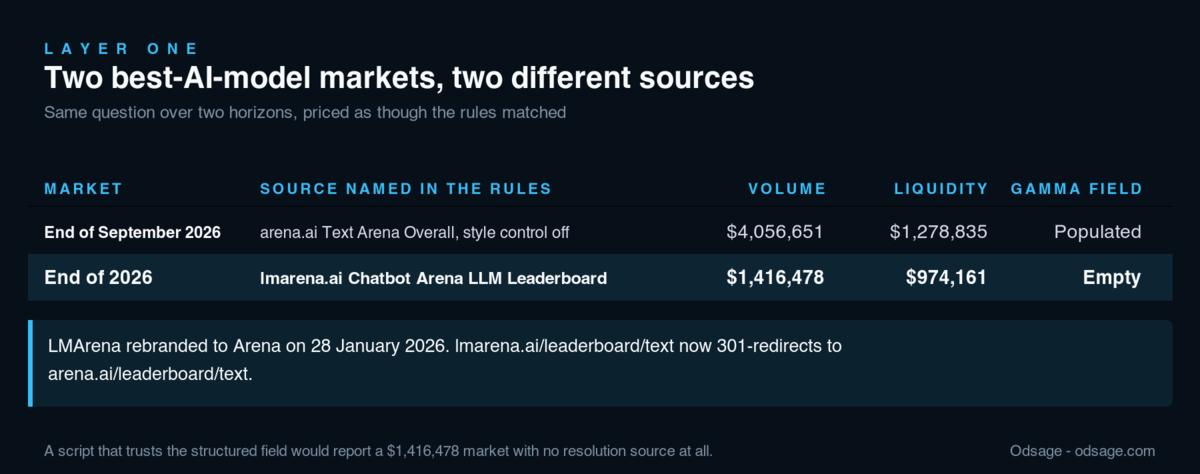
Market: Which company has the best AI model end of September? Anthropic Yes 99.85%, with a 99.8 bid against a 99.9 ask. Event volume $4,056,651, book liquidity $1,278,835, closes 30 September 2026 at 16:00 UTC. Resolution source: arena.ai Text Arena Overall, style control off, checked at 12:00 PM ET.
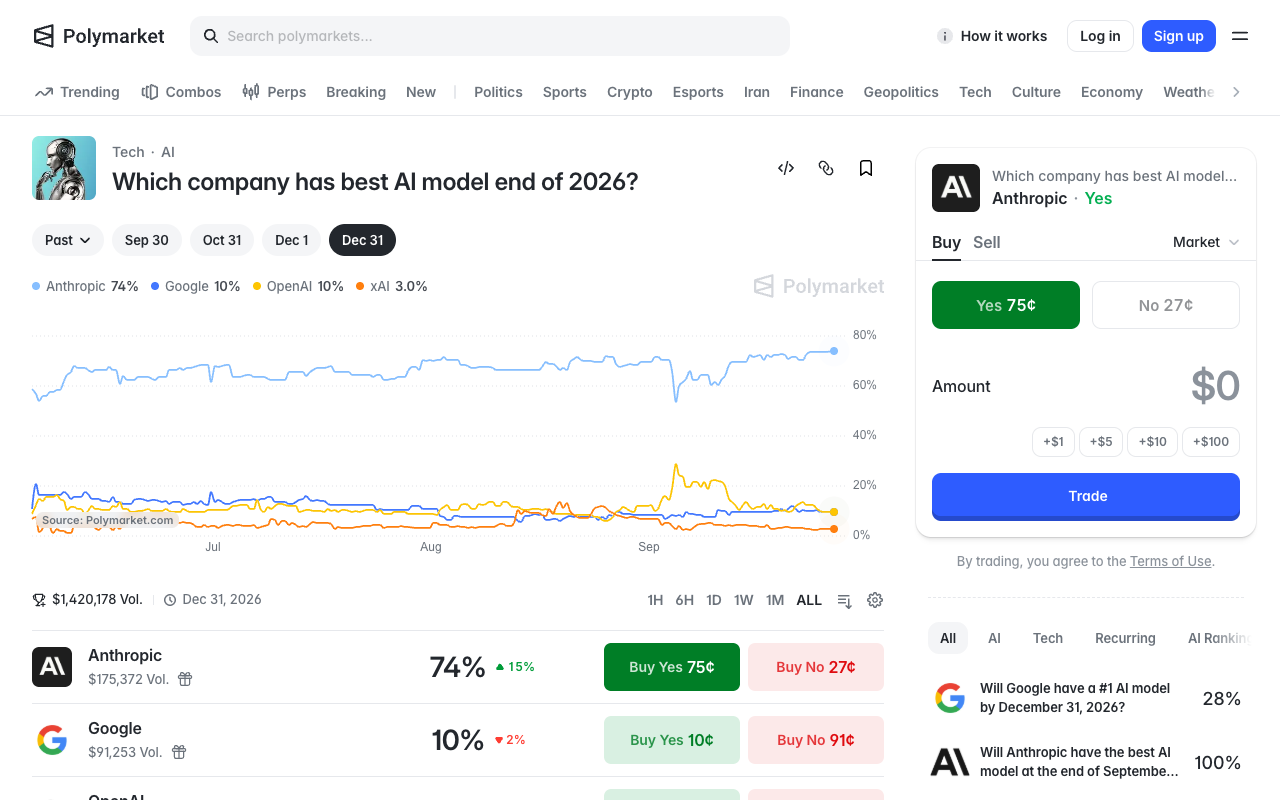
Market: Which company has best AI model end of 2026? Anthropic Yes 74.0% (73 bid / 75 ask), Google 9.5%, OpenAI 9.5% (8 bid / 11 ask), xAI 3.05%, Meta 1.9%. Event volume $1,416,478, book liquidity $974,161, closes 31 December 2026 at 17:00 UTC. Resolution source named in the rules text: lmarena.ai Chatbot Arena LLM Leaderboard, style control off, checked at 12:00 PM ET.
Both point at the same underlying leaderboard, which is the reassuring part. The awkward part is that LMArena rebranded to Arena on 28 January 2026 and moved to arena.ai. We checked: lmarena.ai/leaderboard/text now returns a 301 redirect to arena.ai/leaderboard/text. A live market carrying $1.4M of volume names, as its determining source, a URL that no longer belongs to the domain in its own rules.
In practice a proposer will follow the redirect and nobody will care. But the September market pins the exact view in its path, including the no-style-control setting, while the December market describes the setting in prose against a stale domain. That asymmetry is exactly the raw material a dispute is built from, and it costs nothing to notice before you size a position.
There is a second, more practical wrinkle for anyone reading these markets programmatically. The September market populates Gamma's structured resolutionSource field. The December market leaves it empty: the leaderboard URL exists only inside the prose description. A script that trusts the field would report that a $1.4M market has no resolution source at all.
The Gemini 4.0 market is a Flash market
This is the one worth stopping on, because it is the cleanest example of a title and a contract disagreeing on a market with real money in it.
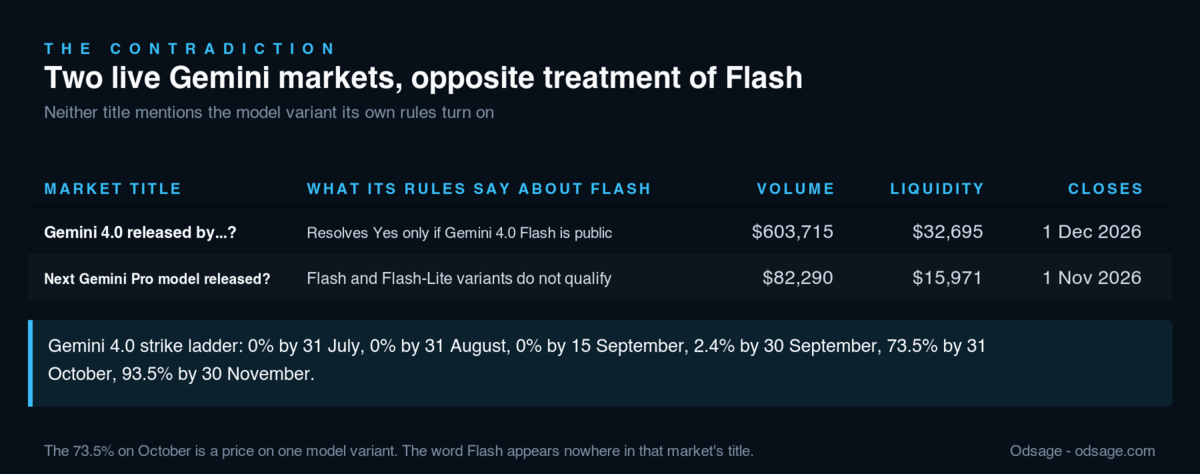
The market is titled 'Gemini 4.0 released by...?'. It carries $603,715 of volume and $32,695 of liquidity and runs to 1 December 2026. Its strikes read: released by 31 July 2026, 0%; by 31 August, 0%; by 15 September, 0%; by 30 September, 2.4% (21 bid / 27 ask in tenths of a cent terms, 2.1% against 2.7%); by 31 October, 73.5% (73 / 74); by 30 November, 93.5%.
Now the rules text, quoted from the market's own description: 'This market will resolve to Yes if Google's Gemini 4.0 Flash model is made available to the general public by the listed date.' Flash. Not Pro, not Ultra, not whatever Google leads the keynote with. The 73.5% on October is a price on a specific model variant, and the word Flash appears nowhere in the market's title.
The contrast with its sibling is what makes this more than pedantry. The market titled 'When will the next Google Gemini Pro model be released?' ($82,290 volume, $15,971 liquidity, closes 1 November 2026) says the opposite in its rules: 'Gemini models labeled only as Flash, Flash-Lite, or another non-Pro variant will not qualify.' It adds that a GA promotion of an existing preview model may qualify, and that labelling errors or placeholder version names on Google's site will not.
So two live Gemini release markets sit on the same platform with mirror-image treatment of the same model family. One pays only on Flash. The other explicitly refuses to pay on Flash. A trader who reads 'Gemini 4.0' and 'next Gemini Pro' as two framings of one release event has misread both contracts, and the error is invisible from the titles, the prices and the category pages.
Both markets do define public availability carefully, and credit where it is due: open beta and open rolling waitlists count, closed or private access does not. That is a better-drafted criterion than most release markets manage. It just sits underneath a headline that contradicts it.
When the rules hand the decision to a private data vendor
Release markets at least resolve on something you can see. The valuation markets hand the decision to a subscription data product, which is a different shape of risk.
The Anthropic valuation market ($5,146,614 volume, $331,038 liquidity, closes 5 January 2027) resolves on the NPM Price reported by Nasdaq Private Market, LLC. Its strike ladder at our read: $1.25T at 100% (99.9 bid), $1.5T at 91.5%, $1.75T at 81.5%, $2.0T at 68.5%, $2.5T at 41.5%, $3.0T at 23.5%.
The rules are unusually careful about the mechanics of that dependency, and they repay reading. NPM Prices publish for trading days only and update once daily at 1:00 PM ET on the following calendar day, so there is a built-in one-day lag between the fact and the observable number. If NPM has not published for all business dates by 1:00 PM ET on 1 January 2027, the market may stay open until 11:59 PM ET on 4 January. If NPM stops covering the company altogether, the market resolves on the data published before coverage ceased, plus public market capitalisation if an IPO or direct listing has happened.
That is three contingency branches for one number, and it tells you something useful about how to read these contracts. Well-drafted AI markets are not the ones with simple rules. They are the ones that have thought about what happens when the source goes quiet. The markets to be wary of are those naming a source with no fallback clause at all, because that is the gap a dispute walks into.
It also means the tradeable question is not only 'will Anthropic be worth $2.5T'. It is 'will a specific Nasdaq Private Market print, on a trading day before 31 December, cross $2.5T'. Those are not the same bet, and the 41.5% is a price on the second one.
Layer two: the dispute ladder, $750 and two hours
When the window closes, someone has to assert what happened. Polymarket's documentation and help centre give the same figures, and they are worth committing to memory because they set the clock on your capital.
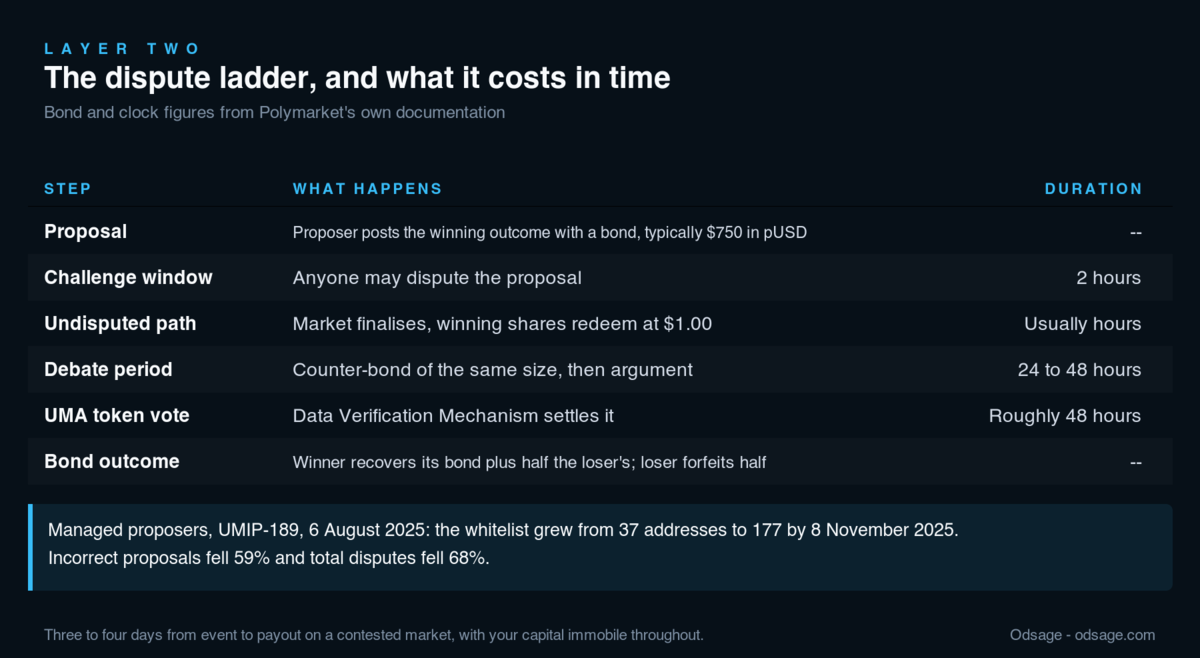
Proposal: a proposer selects the winning outcome and posts a bond, typically $750 in pUSD. Challenge window: two hours, during which anyone may dispute. Undisputed path: the market finalises and winning shares redeem at $1.00, usually within hours of the proposal. Disputed path: a counter-bond of the same size, then a debate period of 24 to 48 hours, then UMA token-holder voting of roughly 48 hours. Bond outcomes: the winning side recovers its bond plus half the loser's; the losing side forfeits half its bond.
Polymarket's help centre adds a wrinkle worth knowing for the ambiguous cases that AI markets produce more often than sports ones. Where a market resolves as 'Too Early' or as an unknown 50-50, the proposer loses their bond and the disputer gets their bond back plus half the proposer's as a bounty. The asymmetry is deliberate: it pays people to catch a premature proposal on a market whose event has not really happened yet, which is precisely the failure mode of a release-date contract.
The number that matters for position sizing is not the bond, because you are probably not the proposer. It is the elapsed time. Two hours plus 24 to 48 hours plus roughly 48 hours is a realistic three to four days from event to payout on a contested market, and your capital is immobile for all of it. On a market you entered at 73.5% expecting a clean October settlement, several days of frozen collateral is a genuine cost, and it never appears in the implied probability.
What changed in 2025: managed proposers
The dispute ladder above is the current design, and it is meaningfully tighter than the one that produced the horror stories. The change is worth knowing, because a lot of writing about Polymarket resolution rules still describes the older, fully permissionless system.
UMA governance passed UMIP-189 on 6 August 2025, and Polymarket moved from the Optimistic Oracle V2 to the Managed Optimistic Oracle V2. The effect was to restrict who may propose a resolution. The whitelist launched with 37 addresses, covering Risk Labs and Polymarket staff plus users with a track record of proposals at high accuracy, and had grown to 177 addresses by UMA's 8 November 2025 update. Maintaining a place requires at least five proposals at 95% accuracy or better across a rolling six-month window, with a snapshot taken on the second of each month and updates applied within a week.
The results UMA published are substantial. Comparing an August baseline against 5 September to 8 October, incorrect proposals fell 59% and total disputes fell 68%. Restricting the proposal step to people with a measured accuracy record removed most of the careless assertions that used to trigger disputes in the first place.
Two things did not change, and both matter. Disputing remained permissionless, so anyone can still challenge a proposal, and non-whitelisted users can flag a market for an approved proposer to pick up. And the Data Verification Mechanism is still the final arbiter. Managed proposers made the first layer of the ladder more reliable; they did not alter what happens at the top of it.
Layer three: when the token vote is the risk
The reason layer three gets the attention it does is a market from March 2025 that had nothing to do with AI, and every AI trader should still know it.
The market asked whether Ukraine would agree to a minerals deal with Trump before April. It carried around $7 million of volume and ran at roughly 9% until it moved to 100% across 24 and 25 March 2025. It resolved Yes. Ukraine had not officially agreed to the deal. Traders alleged that a large UMA holder had voted the outcome through the DVM, and Polymarket, while calling the episode unprecedented and saying it had spent the day in war rooms with the UMA team, declined to issue refunds on the grounds that it was not a market failure.
The structural point survives the specifics. The final arbiter is a token-weighted vote, and token weight can be bought and concentrated. The design assumes that being right is more profitable than being wrong for a majority of stakeholders, which holds while no single holder's position in the market outweighs their stake in the oracle's reputation.
For AI markets the practical read is narrow and useful. Vote risk scales with how subjective layer one is. A market that resolves on a named leaderboard row at a stated time, with style control specified, gives a disputing whale almost nothing to argue. A market that asks whether a model counts as a successor to Gemini 3, or whether a lab has achieved something, is doing the arguing for them. Prefer the contracts whose rules leave nothing to interpret.
Five checks before you trade an AI market
None of this requires a subscription or a script. It is five minutes of reading, and on the evidence above it is five minutes that changes what you think you are holding.
One: read the rules text, not the title. Open the market and read its description in full before the price. The Gemini 4.0 market above is a Flash contract with no hint of it in the headline, and that is a $603,715 market, not an obscure one.
Two: fetch the resolution source. Actually click it. If it redirects, if the named view does not exist, or if the leaderboard has been rebranded since the market was written, you have found ambiguity before it costs you. lmarena.ai took one curl to catch.
Three: find the fallback clause. Ask what the rules say happens if the source stops publishing, ties, or goes dark. The Anthropic valuation market has three branches for that. A market with none is not simpler; it is undrafted.
Four: check the sibling markets. Where a platform runs several contracts on one event, read all of them together. The Gemini pair only reveals its contradiction side by side, and the same trap applies to any release event with both a version market and a variant market.
Five: price the delay, not just the odds. If the outcome is arguable, assume three to four days of frozen capital from event to payout, and decide whether the edge survives it. On a two-cent spread it frequently does not.
The uncomfortable summary is that the resolution text is the product, and the price is a comment on it. Everything Odsage publishes about AI odds rests on that order: read the contract, then the number. Market prices are informational and nothing here is financial advice.
FAQ
Frequently asked questions
How do Polymarket resolution rules actually work?
Three layers. Each market names its own resolution source and criteria, which decides almost every outcome. When the window closes a proposer posts an outcome with a bond, typically $750, and anyone may dispute it within two hours. If a dispute survives, UMA's Data Verification Mechanism settles it by token-holder vote after a debate period of 24 to 48 hours and roughly 48 hours of voting.
What is the resolution source on a Polymarket AI market?
It is the specific place the rules say will be checked. The market on which company has the best AI model at the end of September 2026 names the arena.ai Text Arena Overall leaderboard with style control off, read at 12:00 PM ET on 30 September. The December 2026 version names lmarena.ai instead, which has redirected to arena.ai since the January 2026 rebrand, and leaves Gamma's structured resolutionSource field empty.
Does the Gemini 4.0 market resolve on any Gemini 4 model?
No. Its rules, read from the market description on 26 September 2026, resolve Yes only if Google's Gemini 4.0 Flash model is publicly available by the listed date. The separate market on the next Gemini Pro model states that Flash and Flash-Lite variants do not qualify. The two contracts treat the same model family in opposite ways and neither title says so.
How long does a disputed Polymarket market take to pay out?
Realistically three to four days. Two hours for the challenge window, 24 to 48 hours of debate, then approximately 48 hours of UMA voting. Your position is immobile for that whole period, which is a cost worth pricing at entry on any market whose resolution criteria leave room for argument.
How much does it cost to dispute a market resolution?
A counter-bond matching the proposer's, typically $750. The winning side recovers its bond plus half the loser's, and the losing side forfeits half of theirs. Where a market settles as Too Early or an unknown 50-50, the proposer loses their bond and the disputer receives their bond back plus half the proposer's as a bounty.
Can anyone still propose a resolution on Polymarket?
Not since November 2025. Following UMIP-189, which passed on 6 August 2025, proposing moved to a whitelist under the Managed Optimistic Oracle V2. It launched at 37 addresses and reached 177 by UMA's 8 November 2025 update, with eligibility resting on proposal accuracy over a rolling six-month window. Disputing remained open to anyone, and UMA reported incorrect proposals down 59% and total disputes down 68%.
Can a large UMA holder decide how a market resolves?
The final arbiter is a token-weighted vote, so concentration is a genuine structural risk. In March 2025 a roughly $7 million market on a Ukraine minerals deal resolved Yes before any deal was announced, traders alleged a large holder had voted it through, and Polymarket declined refunds while calling the episode unprecedented. The exposure shrinks the less interpretive a market's criteria are, which is the practical case for preferring contracts that name a specific source and time.
Sources and methodology
Sources used for this guide
Odsage combines public source links with prediction-market context, related market pages, calculator workflows, and visible FAQ content. Market prices are informational and are not financial advice.