AI Benchmarks
Humanity's Last Exam Odds 2026: A 26-Point Gap
Five live Polymarket markets on Humanity's Last Exam settle on one leaderboard that tops out at 38.3%. The trackers traders price off say 65%.
Key takeaways
- Five live Polymarket markets on Humanity's Last Exam carry $416,995 of volume between them, and every one of them names the same resolution source: the official leaderboard at agi.safe.ai.
- That board's top score is Gemini 3 Pro at 38.3%. Its newest entry is a model released on 18 November 2025. Two independent trackers, both updated on 30 September 2026, put the frontier at 65.0% and 59.1%. The resolving source sits 20.8 to 26.7 points below the numbers traders are reading.
- The best Claude on the resolving board is Claude 4.5 Sonnet at 13.7%, and Moonshot's Kimi does not appear on it at all. Yet 'Highest Claude score in 2026: 55%+' trades at 84.6% and 'Highest Kimi score in 2026: 45%+' trades at 71.4%. Both are pricing a publication event, not a capability event, and almost nobody is separating the two.
- Three of the five strike ladders price a higher bar above a lower one, which is arithmetically impossible. On the Gemini Pro debut market you can sell 50%+ at 0.710 and buy 45%+ at 0.640 for a 7-cent credit that cannot lose. The catch is $93 of book liquidity behind it.
- The two coherent ladders are the two deepest. The $135,344 Claude market and the $102,624 Opus market are perfectly monotonic; the ladders that break are the ones with three-figure books. On these markets, depth is the error-correction mechanism.
On this page
Humanity's Last Exam odds are the strangest thing on Polymarket's AI board right now, because the number the contracts settle on and the number the traders are reading are not the same number, and the distance between them is 26 points. Five live markets carry $416,995 between them. All five resolve on one URL. That URL currently shows a frontier of 38.3%, while two leaderboards updated this morning show 65.0% and 59.1%.
That is not a rounding disagreement. It is the difference between a contract that is nearly settled and one that has never been close, and it is sitting under six-figure volume without, as far as we can find, a single editorial page pointing at it.
Every price, spread, volume and liquidity figure below was read from the Polymarket Gamma API at 21:18 UTC on 30 September 2026. The leaderboard figures were read from the resolution source itself the same evening, twice, once rendered and once by parsing the raw HTML table, because the claim is unusual enough to check two ways.
1. The five live markets, and what each one is actually asking.
2. Why all five settle on a single URL.
3. The resolving leaderboard, which tops out at 38.3%.
4. Two trackers, updated today, that say 65.0% and 59.1%.
5. What a 26-point gap does to the Claude and Kimi contracts.
6. The Opus debut market, which cannot see the model in front.
7. Three strike ladders that break their own arithmetic.
8. The answer key, which is part of the contract whether you like it or not.
9. Six checks to run before you trade any of this.
The five live markets on Humanity's Last Exam
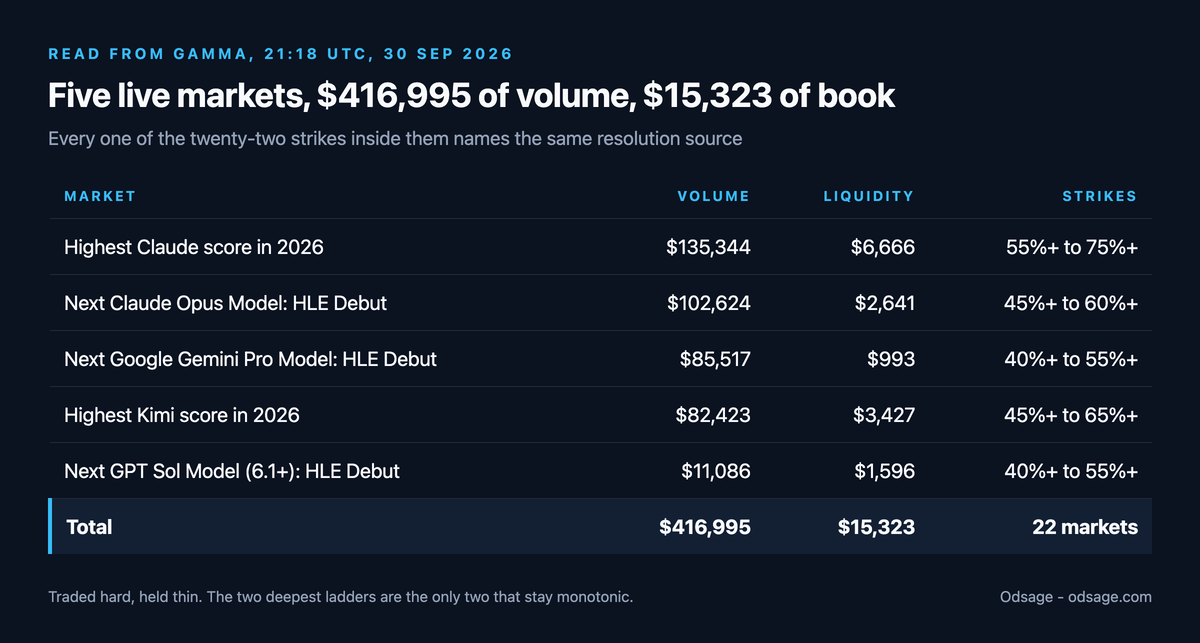
Polymarket runs two shapes of contract on this benchmark, and conflating them is the first way people lose money here. The 'highest score in 2026' markets ask whether any model from one lab clears a bar by 31 December. The 'debut' markets ask what the next model from one family scores when it first appears, measured at noon Eastern on the following day. Same benchmark, very different questions.
Read from Gamma at 21:18 UTC on 30 September 2026, the five open events look like this.
Highest Claude score on Humanity's Last Exam in 2026. Volume $135,344, book liquidity $6,666, closes 1 January 2027. Five strikes from 55%+ to 75%+. The deepest market in the group.
Next Claude Opus Model: HLE Debut. Volume $102,624, liquidity $2,641, closes 1 January 2027. Four strikes, 45%+ to 60%+.
Next Google Gemini Pro Model: HLE Debut. Volume $85,517, liquidity $993, closes 1 January 2027. Four strikes, 40%+ to 55%+. Note the liquidity figure against the volume figure.
Highest Kimi score on Humanity's Last Exam in 2026. Volume $82,423, liquidity $3,427, closes 1 January 2027. Five strikes, 45%+ to 65%+.
Next GPT Sol Model (6.1+): HLE Debut. Volume $11,086, liquidity $1,596, and the only one that runs to 30 June 2027. Four strikes, 40%+ to 55%+.
Total across the five: $416,995 of volume against $15,323 of resting book. These contracts have been traded hard and are held thin, which is the condition under which the pricing errors in section seven survive instead of being arbitraged away in an afternoon.
All five settle on the same single URL
We pulled the full rules text for each of the five events and read the structured resolutionSource field on every strike inside them. Across all twenty-two individual markets, the answer is identical: https://agi.safe.ai/. Not Artificial Analysis. Not a self-reported figure from a model card. Not a consensus of trackers. One board.
The wording is tighter than most AI markets manage. The two 'highest score' markets say accuracy 'refers solely to the value labeled HLE Accuracy or a clear equivalent metric if the data's presentation or terminology is restructured, regardless of the model's Calibration Error or any other displayed metric.' The debut markets pin the reading time: the HLE Accuracy shown 'at 12:00 PM ET on the calendar date following the date on which it first appears on the site.'
Credit where it is due. The source is named, the metric is named, the reading time is named, and a variant clause tells you which models qualify. Compared with the best-AI-model markets we read on 26 September, which pointed at a domain redirecting since January, this is careful drafting.
There is one clause worth reading slowly. If the source 'becomes unavailable' during the window, the market stays open, and only if it is 'confirmed to be permanently unavailable' may results published elsewhere be used. Unavailable means down. It does not mean stale. A leaderboard that is up, loading, and simply has not added a model in ten months is available in every sense the contract cares about, and the fallback clause never fires.
That distinction is the whole article. Everything below follows from it.
The resolving leaderboard tops out at 38.3%
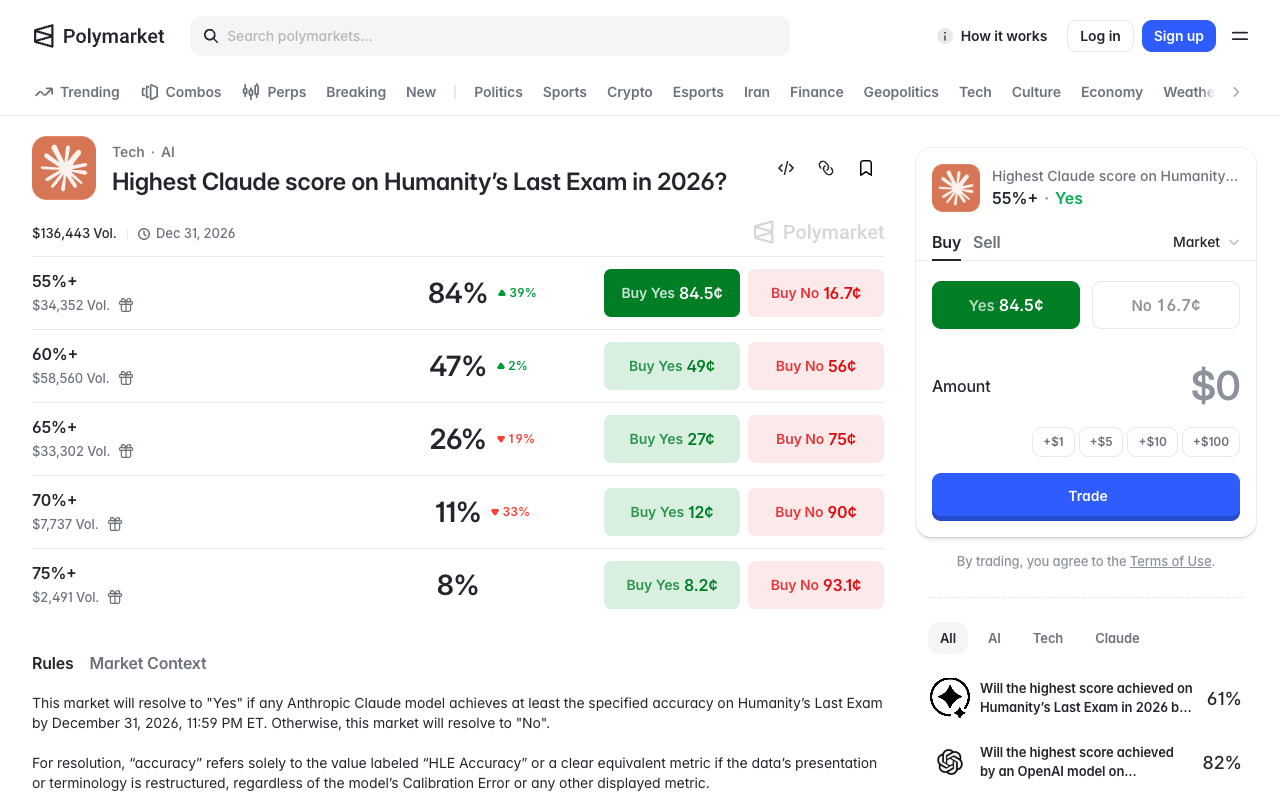
So we opened it. The official Humanity's Last Exam results at agi.safe.ai, fetched at 21:15 UTC on 30 September 2026, list ten models. Here is the full board, accuracy then calibration error, exactly as the table renders.
Gemini 3 Pro, 38.3% accuracy, 57.2% calibration error. GPT-5, 25.3% and 50.0%. Grok 4, 24.5% and 56.4%. Gemini 2.5 Pro, 21.6% and 72.0%. GPT-5-mini, 19.4% and 65.0%. Claude 4.5 Sonnet, 13.7% and 65.0%. Gemini 2.5 Flash, 12.1% and 80.0%. DeepSeek-R1, 8.5% and 73.0%. o1, 8.0% and 83.0%. GPT-4o, 2.7% and 89.0%.
Ten models. Top score 38.3%. Best Anthropic model on the board: Claude 4.5 Sonnet at 13.7%. Moonshot's Kimi: absent, no entry of any kind.
Because this is a load-bearing claim we checked it twice. A rendered fetch returned those ten rows. Parsing the raw HTML of the leaderboard table returns the same ordering and values, and a scan of the full document finds no Claude beyond 4.5 Sonnet, no Opus, no Fable, no Kimi and no Grok beyond Grok 4.
Now date the board. Its newest model is Gemini 3 Pro, which Google announced on 18 November 2025, and which Google itself reported at 37.5% on this benchmark against the 38.3% the board's own evaluation shows. That is ten months and twelve days ago. In an area where the tracked frontier has moved roughly thirty points in that window, the settlement source has added nothing.
This is not an accusation of negligence. Evaluating an expert-level benchmark carefully is slow, expensive work, and a research board owes nothing to a betting market that adopted it without asking. But it is the fact that decides these contracts.
Two trackers, updated today, say 65.0% and 59.1%
Meanwhile, the numbers a trader is most likely to meet come from third-party trackers, and both of the ones we checked were updated on 30 September 2026, the same day we read them.
llm-stats.com puts Claude Fable 5.1 top at 65.0%, followed by Claude Mythos Preview at 64.7%, Claude Opus 5 at 64.7%, Claude Fable 5 at 64.5%, GLM-5.3 at 62.5%, Muse Spark 1.1 at 62.1%, DeepSeek-V4-Pro-0813 at 60.0% and Muse Spark at 58.4%. Eight models above 58%.
pricepertoken.com puts the same model, Claude Fable 5.1, top at 59.1%, then Claude Fable 5 at 55.5%, Claude Sonnet 5.5 at 55.0%, Claude Opus 5 at 54.9% and GPT-6 Astra at 54.7%. It also lists three Moonshot models: Kimi K3 at 46.9%, Kimi K2.6 at 37.5% and Kimi K2 0711 at 23.8%.
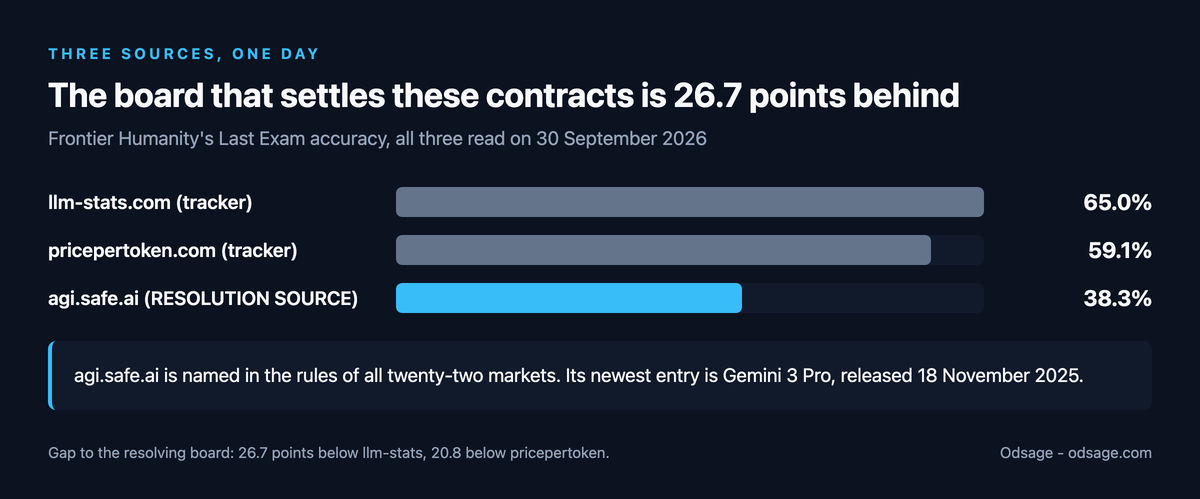
Line the three sources up on the same day and the picture is stark. agi.safe.ai, the resolution source: frontier 38.3%, held by Gemini 3 Pro, no Claude above 13.7%, no Kimi listed. llm-stats.com: frontier 65.0%, Claude Fable 5.1. pricepertoken.com: frontier 59.1%, Claude Fable 5.1, best Kimi 46.9%.
The two trackers do not even agree with each other. They report the same model 5.9 points apart, because one scores the text-only subset and the other the fuller public set, with different tool and reasoning settings. That spread is a known, documented feature of this benchmark rather than a bug in anyone's arithmetic.
But the gap that matters is the one to the resolving board: 26.7 points below llm-stats, 20.8 points below pricepertoken. If you price a strike ladder off a tracker and the contract settles off agi.safe.ai, you are not slightly wrong about a benchmark. You are answering a different question from the one you are being paid on.
What the gap does to the Claude and Kimi markets
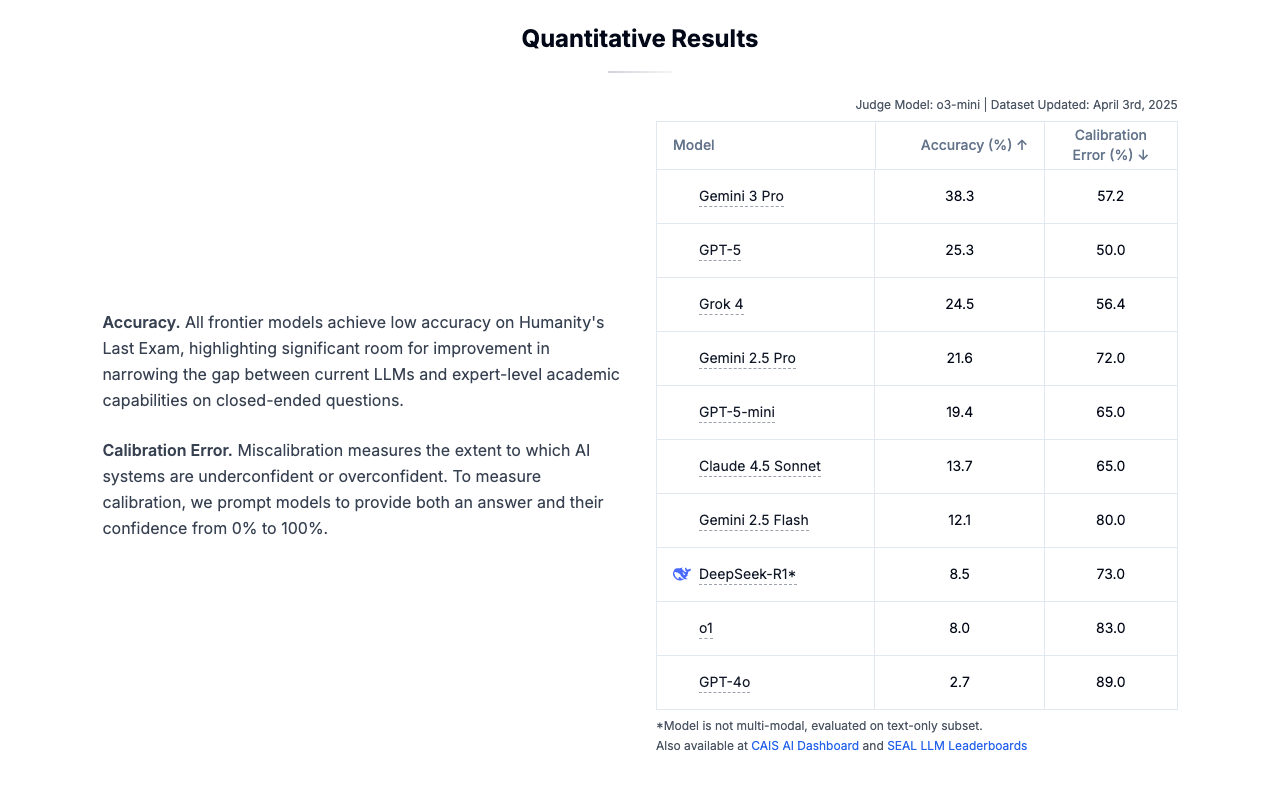
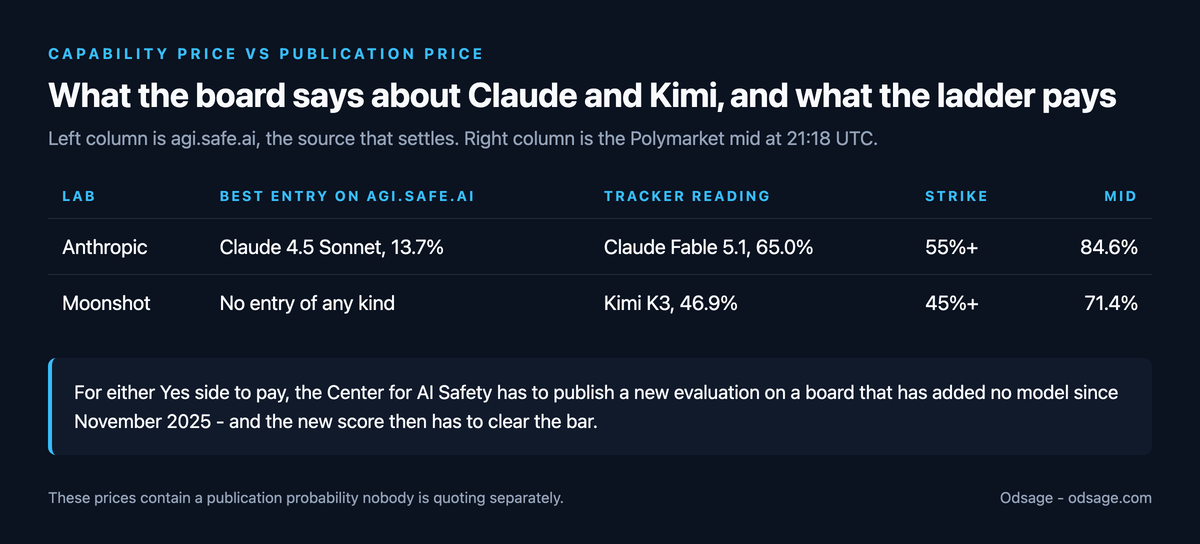
Take the deepest contract in the group. Highest Claude score on Humanity's Last Exam in 2026, $135,344 of volume, and its ladder at 21:18 UTC reads: 55%+ at 84.6% (83.1 bid / 86.1 ask), 60%+ at 44.5% (44.0 / 45.0), 65%+ at 28.5% (28.0 / 29.0), 70%+ at 10.5% (9.0 / 12.0) and 75%+ at 7.5% (6.9 / 8.1).
Read against llm-stats it looks almost lazy: Claude Fable 5.1 already reads 65.0% there, so a trader glancing at that tracker sees the 65%+ strike at 28.5 cents and thinks the market has not caught up.
Read it against the contract and it is a completely different trade. For 55%+ to resolve Yes, the Center for AI Safety has to evaluate a Claude model and publish it on a board whose best Claude is 13.7%, which has added no model since November 2025, and it has to land above 55% when it gets there. The 84.6 cents is not paying for Anthropic's capability. It is paying for a publication that has not happened in ten months.
The Kimi market makes the same point with no ambiguity at all. Highest Kimi score in 2026 prices 45%+ at 71.4%, with an 18-cent-wide 55%+ strike above it. On pricepertoken, Kimi K3 already reads 46.9%, comfortably clear of that first bar. On agi.safe.ai, Moonshot has never appeared. Not at a low score, not at any score. For that 71.4 cents to pay, a lab with no history on this board has to be added to it, and then clear 45%, inside three months.
We are not claiming either price is wrong. A holder of the Yes side may have good reason to expect a refresh, and a board that adds one lab tends to add several. The narrower claim is harder to argue with: these prices contain a publication probability nobody is quoting separately, and you cannot size the trade until you do.
The Opus market cannot see the model in front
Next Claude Opus Model: HLE Debut carries $102,624 and prices 45%+ at 95.2%, 50%+ at 93.25%, 55%+ at 55.5% and 60%+ at 3.15%. It is the second-deepest contract here, and its rules contain a restriction that changes what it is.
Quoted from the market's own description: 'Any Anthropic Claude model newly added to the Humanity's Last Exam results and labeled as Opus may qualify (e.g., claude-opus-5.1, claude-opus-5.5-thinking, claude-opus-6-preview, or similar). Claude models labeled only as Sonnet, Haiku, Fable, Mythos, or another non-Opus variant will not qualify.'
Set that against the trackers. On llm-stats the top four are Claude Fable 5.1, Claude Mythos Preview, Claude Opus 5 and Claude Fable 5. Two of those four are named in the exclusion list. The model actually leading the benchmark on the tracker most people read, Fable 5.1, is explicitly disqualified from the contract that looks like it is about Anthropic's HLE performance.
Nor does the phrase 'the next Opus model added' mean what a quick read suggests. There is no Opus model on agi.safe.ai now. The only Anthropic entry is Claude 4.5 Sonnet. So 'the next Opus model added' is really 'the first Opus model ever added', which is a materially bigger ask than a routine refresh of a board that already tracks the family.
The same structure applies to the Gemini Pro market, which excludes Flash and Flash-Lite, and to the GPT Sol market, which requires a name containing both 'GPT' and 'Sol' at version 6.1 or higher. Each is a well-drafted contract about a narrow event. None is a bet on which lab is best at this benchmark, which is what the ladder shapes make them look like.
Three ladders that break their own arithmetic
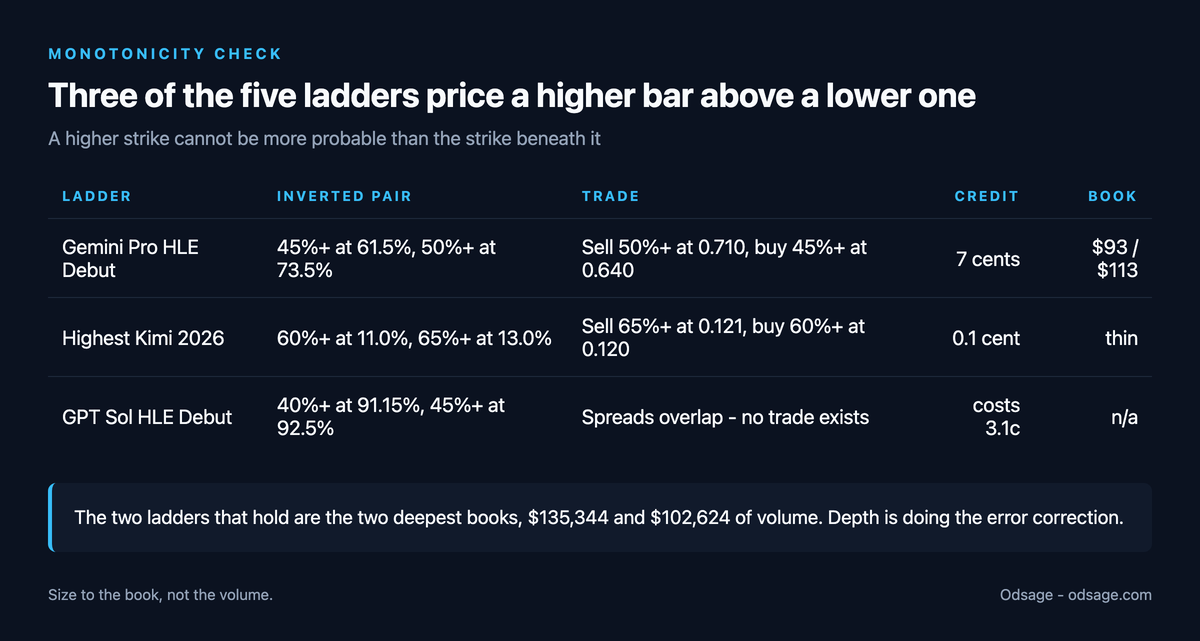
A strike ladder has one rule that needs no view on AI at all. The probability of scoring at least 50% cannot exceed the probability of scoring at least 45%, because every world in the first set is also in the second. Price a higher bar above a lower one and the ladder is contradicting itself. Three of these five do.
Next Google Gemini Pro Model: HLE Debut. 40%+ at 93.45%, 45%+ at 61.5%, then 50%+ back up at 73.5%, then 55%+ at 37.5%. The 50%+ strike sits twelve points above the easier bar beneath it. This one is executable: sell 50%+ at its 0.710 bid, buy 45%+ at its 0.640 ask, and you take a 7-cent credit on a position that pays nothing if Gemini clears 50, pays a dollar if it lands between 45 and 50, and pays nothing if it misses 45. No state loses money. The book behind it is $93 on one leg and $113 on the other.
Highest Kimi score in 2026. 55%+ at 18.0%, 60%+ at 11.0%, 65%+ at 13.0%. The top strike is priced two points above the one below it. Executable, just barely: sell 65%+ at 0.121, buy 60%+ at 0.120, and the credit is a tenth of a cent. Free, and not worth the gas.
Next GPT Sol Model (6.1+): HLE Debut. 40%+ at 91.15%, 45%+ at 92.5%. The mids are inverted, but the spreads overlap, so the trade does not exist: selling 45%+ at 0.910 against buying 40%+ at 0.941 costs 3.1 cents rather than paying you. That is a cheap option on a narrow band, not an arbitrage, and the distinction is the difference between a strategy and a screenshot.
The two ladders that hold are the two deepest books, $135,344 and $102,624 of volume. The three-figure books are where the arithmetic fails. Depth is doing the error correction, and there is not much of it about.
The answer key is part of the contract
One more layer, because it sits underneath everything above. The benchmark these contracts settle on has a documented accuracy problem in its own answer key.
FutureHouse reviewed the text-only chemistry and biology questions and reported that 29% of them, plus or minus 3.7 points at 95% confidence, had reference answers that directly conflict with peer-reviewed literature. The Humanity's Last Exam team ran their own follow-up on a subset and put the figure nearer 18%, while noting that at least one reviewer disagreed on about 25% of cases. The diagnosis in both cases is the same: question authors spent a few minutes each and full accuracy checking was not required, so the bottleneck is key maintenance rather than question difficulty.
The responses have been constructive. FutureHouse published a vetted subset, HLE Bio/Chem Gold, and the benchmark team launched HLE-Rolling, updated regularly to absorb corrections and new questions.
For a trader that last item is the awkward one. A contract that resolves on 'the value labeled HLE Accuracy' at a fixed URL inherits whatever question set that page is reporting on the day it is read. If a corrected or rolling set replaces the original, scores move for reasons that have nothing to do with any model improving, and the contract follows. The rules anticipate a terminology restructure and say so. They do not say which question set is authoritative.
That is not a reason to avoid these markets. It is a reason to treat a published HLE number as a measurement with a method attached rather than a fact, and to want a wider edge on any strike near a boundary.
Six checks before you trade an HLE market
None of this needs a subscription or a script. It is about ten minutes, and on the evidence above it changes what you think you are holding.
One: open the resolution source before the price chart. Every one of these twenty-two markets names agi.safe.ai. Look at it, count the models, and find the newest one. Ten months without an addition is a fact you can establish in thirty seconds and it reframes every strike on the board.
Two: never price off a tracker the contract does not name. llm-stats and pricepertoken are current and useful, and they sit 20.8 to 26.7 points from the number that settles your position. Use them to form a capability view, then convert it separately.
Three: separate the publication probability from the capability probability. 'Will Kimi score 45%+' and 'will Kimi be added to this board and then score 45%+' are different questions with different answers, and only the second one pays.
Four: read the variant exclusions. The Opus market disqualifies Fable and Mythos, two of the four top Claude entries on llm-stats. The Gemini market disqualifies Flash. A ladder that looks like a lab bet is usually a model-family bet.
Five: check the ladder for monotonicity before anything else. It takes one pass down the strikes. A higher bar priced above a lower one is either free money or a warning that the book is too thin to trust, and both are worth knowing.
Six: size to the book, not the volume. $416,995 of lifetime volume sits on $15,323 of resting orders. The 7-cent Gemini credit is real and it is $93 deep, which makes it a curiosity for most readers rather than a trade.
The uncomfortable summary is that these are well-drafted contracts on a stale source, which is harder than a badly drafted one because nothing in the rules text is wrong. Read the board, then the ladder, then the price. Market prices are informational and nothing here is financial advice.
FAQ
Frequently asked questions
What are Humanity's Last Exam odds on Polymarket?
As of 21:18 UTC on 30 September 2026, five live events carry $416,995 of volume. Highest Claude score in 2026 prices 55%+ at 84.6% and 65%+ at 28.5%. Highest Kimi score in 2026 prices 45%+ at 71.4%. The Opus debut market prices 45%+ at 95.2%, the Gemini Pro debut market 40%+ at 93.45%, and the GPT Sol debut market 40%+ at 91.15%.
Which leaderboard do the Polymarket HLE markets resolve on?
All twenty-two individual markets across the five events name the same resolution source: the official Humanity's Last Exam results at https://agi.safe.ai/. The rules specify the value labelled HLE Accuracy, explicitly excluding calibration error, and the debut markets read it at 12:00 PM ET on the day after a model first appears.
What is the highest score on the official HLE leaderboard?
Gemini 3 Pro at 38.3%, read from agi.safe.ai on 30 September 2026 and verified twice, once rendered and once by parsing the raw HTML table. The board lists ten models. The highest Anthropic entry is Claude 4.5 Sonnet at 13.7%, and no Kimi model appears at all.
Why do HLE leaderboards disagree with each other?
Protocol, mostly. Trackers differ on whether they score the text-only subset or the fuller public set, whether tools are allowed, and which reasoning settings are used. llm-stats.com and pricepertoken.com both put Claude Fable 5.1 on top on 30 September 2026 and still report it 5.9 points apart, at 65.0% and 59.1%. The larger gap is to the resolution source at 38.3%.
Does a stale leaderboard trigger Polymarket's fallback clause?
No, and this detail decides these markets. The rules allow results published elsewhere only if the named source becomes unavailable and is confirmed permanently unavailable. A board that loads normally and has simply not added a model is available under that wording. Staleness and unavailability are different conditions, and only one opens the fallback.
Does the Claude Opus HLE market include Claude Fable?
No. The rules state that Claude models labelled only as Sonnet, Haiku, Fable, Mythos or another non-Opus variant do not qualify. Two of the four highest-scoring Claude entries on llm-stats.com on 30 September 2026 are Fable 5.1 and Mythos Preview, so the contract excludes the model leading the tracker most traders read.
Are there mispriced strikes in the HLE ladders right now?
Three of the five ladders price a higher strike above a lower one, which is arithmetically impossible. On the Gemini Pro debut market, selling 50%+ at its 0.710 bid against buying 45%+ at its 0.640 ask takes a 7-cent credit that cannot lose in any outcome. On the Kimi market the same trade nets a tenth of a cent, and on the GPT Sol market the inversion sits inside the spread so no trade exists. Book depth behind the Gemini legs is $93 and $113.
How reliable are the Humanity's Last Exam answers themselves?
FutureHouse reported that 29% of text-only chemistry and biology questions, plus or minus 3.7 points, carry reference answers conflicting with peer-reviewed literature; the benchmark team's own follow-up put a subset nearer 18%. FutureHouse published a vetted subset, HLE Bio/Chem Gold, and the team launched the updating HLE-Rolling. A contract pinned to a fixed URL inherits whichever question set that page reports.
Sources and methodology
Sources used for this guide
Odsage combines public source links with prediction-market context, related market pages, calculator workflows, and visible FAQ content. Market prices are informational and are not financial advice.