AI IPOs
Anthropic IPO Valuation Odds 2026: 81% Under $1.5T
Anthropic IPO valuation odds put 80.7% on a day-one close under $1.5T. The contract resolves on share count, and three conventions give three answers.
Key takeaways
- Polymarket's Anthropic IPO closing market cap ladder prices $1.25T-$1.5T as the favourite at 42.95% and under $1.25T at 37.75%, read from the Gamma API at 21:00 UTC on 18 November 2026. Together that is 80.7% on a day-one close under $1.5T, against 21.2% at or above it.
- The contract resolves on "the number of shares outstanding multiplied by the closing share price on the first trading day", and Anthropic has five share classes. Only Class A is listed. Class A alone is 7,427,991,791 shares, all classes together are 13,086,672,593, and the fully diluted count behind every "$1.4 trillion" headline is about 18.01 billion.
- Those three conventions put the same closing price in three different brackets. At a $100 close, Class A alone is $0.74T, all classes are $1.31T and fully diluted is $1.80T. Only the all-classes reading makes the current prices coherent.
- The filed $70-$78 range reset the whole ladder. On 10 November the modal bracket was $1.5T-$1.75T at 32.65%; by 18 November it was 13.95%, while under $1.25T went from 13.25% to 37.75%, a 24.5-point move in eight days.
- The ten legs sum to 101.95% at last price and 101.4% at the best bid, so the ladder carries a real overround. It is not free money: every short leg must be fully collateralised, which turns a 1.4-point edge into roughly 0.18% on capital before fees.
On this page
Anthropic prices its IPO tonight and starts trading tomorrow as ANT, and every headline you have read puts the company somewhere between $1 trillion and $1.4 trillion. Those are two different numbers for the same deal, which is a clue. The anthropic ipo valuation odds on Polymarket now have $11.2 million of volume riding on which bracket the first day's close lands in, and the gap between those two headline figures is wide enough to move the answer by three brackets.
That is not a rounding problem. It is a resolution problem, and almost nobody quoting these odds has worked out which share count the contract points at. We pulled the event from Polymarket's Gamma API at 21:00 UTC on 18 November 2026, rebuilt all ten legs from the CLOB daily series, and read the share counts out of the 17 November S-1/A rather than off a news summary. The filing gives five share classes and three defensible ways to multiply.
What came out of that is a market whose prices only make sense under one of the three, a ladder that has walked down by roughly a trillion dollars in eight days, and an overround that looks tradeable until you price the collateral. The order below:
1. What the closing market cap contract measures.
2. The ten legs, their prices, spreads and liquidity.
3. The share-count problem, and which convention the prices imply.
4. What each bracket needs the stock to close at.
5. How the filed price range reset the ladder.
6. Why the overround is not free money.
7. What the S-1/A says about the business.
8. Five checks before you take a side.
What the closing market cap contract measures
The resolution text is short, and every word in it is load-bearing. The market resolves on Anthropic's market capitalisation at the closing price on its first day of trading, and it defines that as "the number of shares outstanding multiplied by the closing share price on the first trading day". Resolution is based on the primary exchange's official listing page, with another reliable source used if that figure is not displayed.
Three details are worth pulling out. First, the measurement is the close, not the open and not the intraday high. A stock that opens at $140 and closes at $96 resolves in a lower bracket than its own headline.
Second, if the value lands exactly on a boundary the market resolves to the higher bracket. That matters more than it sounds here, because the boundaries are round trillions and the share counts are fixed, so an exact boundary is a specific share price rather than a freak coincidence.
Third, there is a plumbing clause for a broken session: if trading is cut short by a circuit breaker or a half day, the market resolves on that abbreviated session's official close, rolling forward to the next day that publishes one if none is. A tenth leg covers no IPO by 31 December 2027, priced at 0.05%, which is the market saying this is happening.
The Anthropic IPO valuation odds, leg by leg
Ten legs, all read at 21:00 UTC on 18 November 2026. Prices are last trade, with the best bid and ask beside them, and volume is lifetime followed by the trailing 30 days.
Under $1.25T: 37.75% last, 37.7c bid against 37.8c ask, $2,480,269 lifetime volume and $2,322,542 in 30 days, $79,692 of liquidity.
$1.25T to $1.5T: 42.95% last, 42.9c bid against 43.0c ask, $910,826 lifetime and $757,488 in 30 days, $37,297 of liquidity. This is the favourite and the thinnest book on the ladder.
$1.5T to $1.75T: 13.95% last, 13.9c against 14.0c, $1,355,415 lifetime and $1,148,167 in 30 days, $67,822 of liquidity.
$1.75T to $2.0T: 4.05% last, 4.0c against 4.1c, $1,561,342 lifetime and $1,253,342 in 30 days, $103,451 of liquidity.
$2.0T to $2.25T: 1.95% last, 1.9c against 2.0c, $1,624,685 lifetime and $1,220,744 in 30 days, $202,997 of liquidity.
$2.25T to $2.5T: 0.50%. $2.5T to $2.75T: 0.35%. $2.75T to $3.0T: 0.15%. $3.0T or more: 0.25%. No IPO by 31 December 2027: 0.05%, and that leg has no bid at all.
Read cumulatively, the market puts 80.70% on a close under $1.5T, 94.65% on a close under $1.75T, and 21.20% at or above $1.5T. The whole top half of the ladder, every bracket from $1.75T upward, is 7.25% combined.
One structural oddity is worth naming. The smallest legs carry the deepest books: $504,495 of liquidity sits on the $2.5T-$2.75T bracket priced at 0.35%, against $37,297 on the favourite. Market makers will quote size on outcomes that should expire worthless, and not on the one that decides the event.
The share-count problem that decides this market
Here is the part no other page covering these odds has worked through. "Shares outstanding" sounds like one number. In Anthropic's filing it is five.
The 17 November S-1/A lists, after the offering and the concurrent private placement: 7,427,991,791 shares of Class A common stock, 5,658,680,800 shares of Class N, one share of Class T, one share of Class E and zero shares of Class F. Total across all classes, 13,086,672,593 shares, or 13,210,422,593 if the underwriters take their full option on 123,750,000 extra Class A shares.
Only Class A is listed. The filing says Anthropic has been approved to list its Class A common stock on the Nasdaq Global Select Market under ANT. Class N carries no voting rights, is held primarily by strategic business partners, and converts to Class A only on a sale or transfer to an unaffiliated third party. Those partners are named in the filing: Google, NVIDIA, AMD, Broadcom, Micron and Microsoft among them.
So Class N is 43.2% of the company's shares and none of it trades. Meanwhile the fully diluted count behind the "$1.4 trillion" figure in nearly every news story is higher again, about 18.01 billion shares, which is what CNBC's reported $1.405 trillion at the $78 top of the range implies. That number is not in the S-1/A, and the filing's own share table does not produce it.
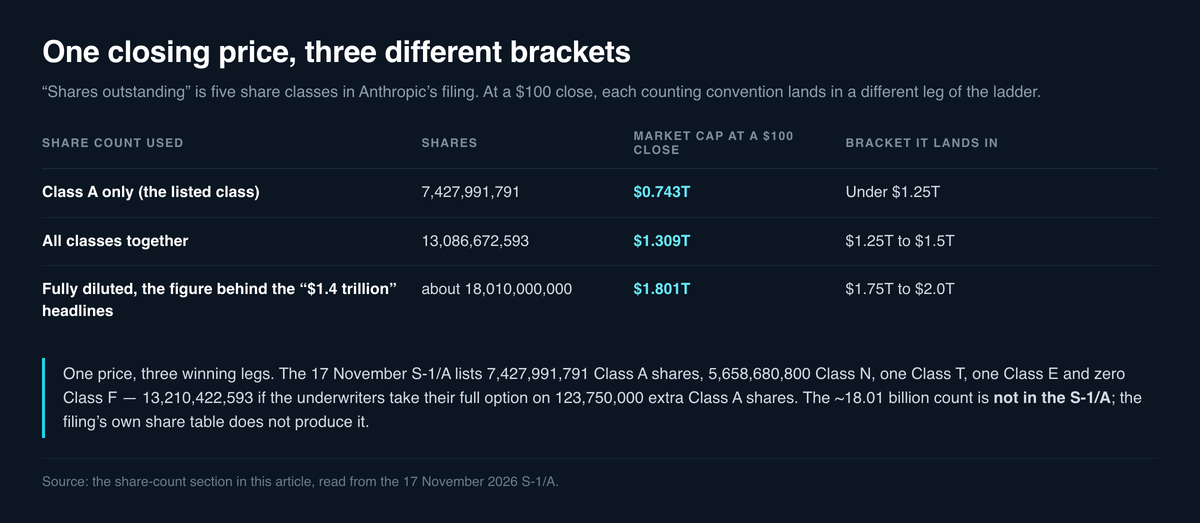
One closing price, three different brackets
Multiply a single closing price by each of those three counts and you do not get three similar answers. At a $100 close, Class A alone is $0.743T, all classes together are $1.309T, and fully diluted is $1.801T. Those sit in the under-$1.25T bracket, the $1.25T-$1.5T bracket and the $1.75T-$2.0T bracket respectively. One price, three winning legs.
The prices themselves tell you which convention traders are using. Under a Class-A-only reading, the stock would have to close at $168.28 just to reach $1.25T, a 116% first-day gain off a $78 offer, and the market's 37.75% on under-$1.25T would be absurdly low. Under a fully diluted reading, the $70 bottom of the range already clears $1.25T, so 37.75% would be absurdly high. Only the all-classes count of 13.09 billion makes the ladder internally coherent, and it is also the reading the contract's plain words support.
That is the right answer and it is still an unhedged risk, because the contract defers to the exchange's listing page rather than to the filing. If Nasdaq's ANT page displays a market cap built on listed Class A shares only, a resolver following the contract's own instruction lands on a different bracket from the one the prices assume. I would not trade this ladder in size without checking what that page shows on day one.
What each bracket needs the stock to close at
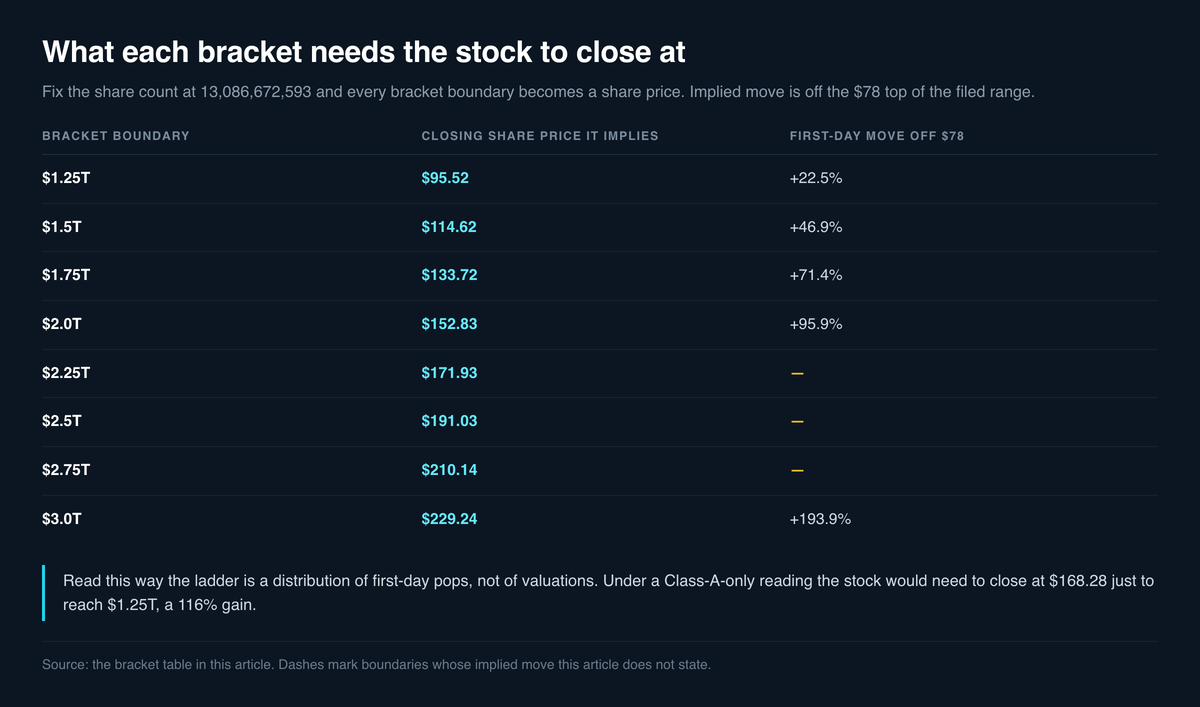
Once you fix the share count at 13,086,672,593, every bracket boundary becomes a share price. This is the table the market should publish and does not, so here it is, with the implied first-day move off the $78 top of the filed range.
$1.25T is a $95.52 close, a 22.5% gain. $1.5T is $114.62, a 46.9% gain. $1.75T is $133.72, up 71.4%. $2.0T is $152.83, up 95.9%. $2.25T is $171.93, $2.5T is $191.03, $2.75T is $210.14, and $3.0T is a $229.24 close, which would be a 193.9% first-day gain.
Now the ladder reads like a distribution of first-day pops rather than a wall of trillions. The favourite at 42.95% is the market saying the stock closes somewhere between 22.5% and 46.9% above the top of its range. The 37.75% on under-$1.25T covers everything below a 22.5% pop, which includes a modest gain, a flat tape and a broken deal.
Reports on 18 November said the book was strong enough to price above the $70-$78 range. Run the same arithmetic off an $85 print and the boundaries move but the shape does not: $1.25T becomes a 12.4% pop and $1.5T a 34.8% pop. An above-range price makes the favourite bracket easier to reach, not harder, which is worth holding in mind against a ladder that has spent a week drifting the other way.
The discipline is to form a view on the close as a share price, the quantity you have intuition about, and only then convert. Reasoning directly in trillions means reasoning in a unit that depends on a share count you have probably not looked up.
How the filed price range reset the whole ladder
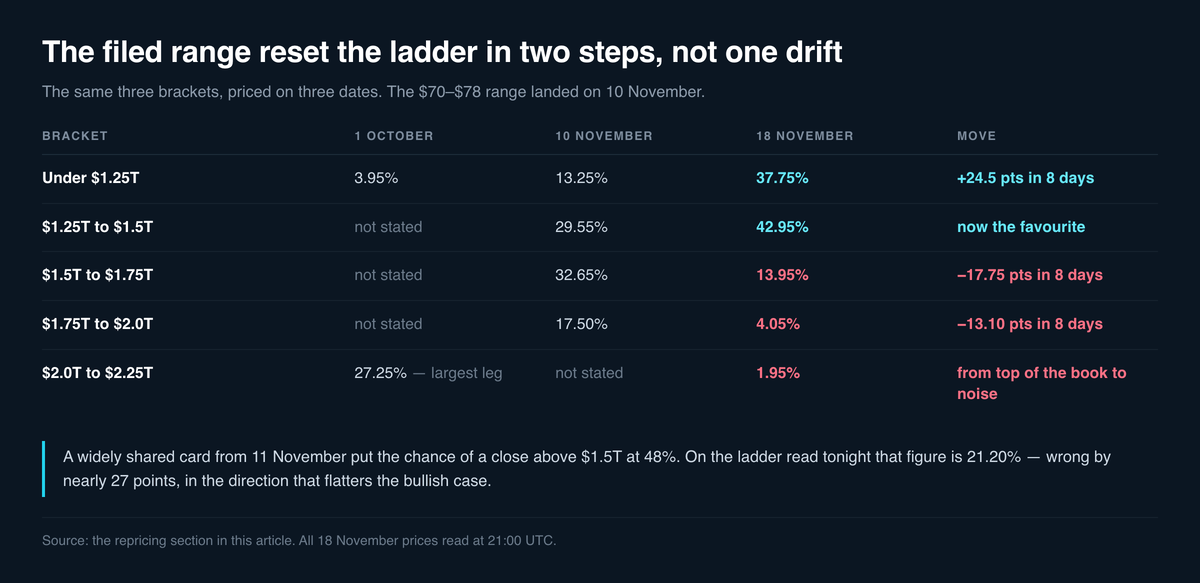
This event opened on 1 June 2026, and for most of its life it was priced off rumour. Through September and October the centre of mass sat high: on 1 October the $2.0T-$2.25T bracket was the single largest leg at 27.25%, and under-$1.25T was 3.95%. That is a market pricing the $1.8 trillion to $2 trillion valuations then circulating in the press.
Then the numbers arrived. The amended filing with a $70-$78 range landed on 10 November, and on that day the ladder still had $1.5T-$1.75T as the favourite at 32.65%, with $1.25T-$1.5T at 29.55% and under-$1.25T at just 13.25%. The repricing took one day: by 11 November $1.25T-$1.5T was 41.85% and $1.5T-$1.75T had dropped 11.25 points to 21.40%, while $1.75T-$2.0T fell from 17.50% to 7.50%.
The second move was slower and larger. Across the roadshow week the whole distribution kept sliding down. Under-$1.25T went 22.85% on 16 November, 36.75% on 17 November, 37.75% on 18 November, a 13.9-point jump in a single day and 24.5 points in eight. Over the same eight days $1.5T-$1.75T lost 18.70 points and $1.75T-$2.0T lost 13.45.
Put plainly, the market has marked down its expected day-one valuation for Anthropic by roughly a trillion dollars since the range was filed, and it did it in two distinct steps rather than one slow drift. Anyone quoting a figure from before 11 November is quoting a different market.
That is also where the stale numbers in circulation come from. A widely shared card from 11 November put the chance of a close above $1.5T at 48%. On the ladder we read tonight that figure is 21.20%, so it is wrong by nearly 27 points, and it is wrong in the direction that flatters the bullish case.
The ladder sums to more than 100%, and that is not free money
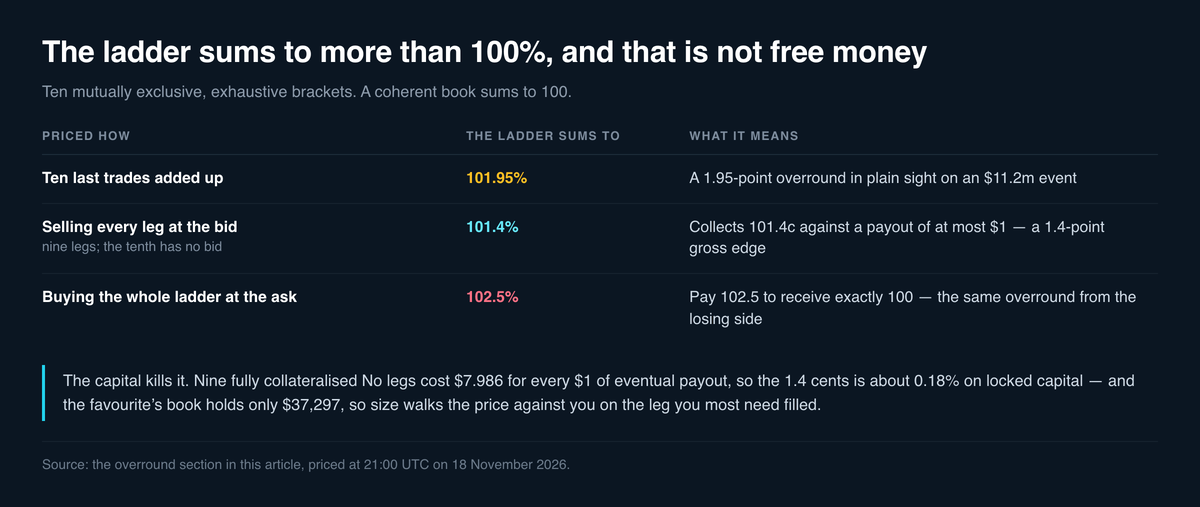
Add the ten last prices and you get 101.95%. The brackets are mutually exclusive and exhaustive, so a coherent book sums to 100%, and the extra 1.95 points is an overround sitting in plain sight on an $11.2 million event.
Use tradeable prices rather than last trades and it survives, just smaller. Selling every leg means hitting each bid, and the nine legs with a bid sum to 101.4%. Buying the whole ladder at the ask costs 102.5%, which is the same overround seen from the losing side: pay 102.5 to receive exactly 100.
So selling the ladder collects 101.4 cents against a payout of at most one dollar. That is a 1.4-point gross edge, and the tenth leg having no bid is harmless, because if no IPO happens by the end of 2027 every leg you sold expires worthless and you keep the premium.
The problem is capital. Selling Yes on Polymarket means buying No, fully collateralised, so the nine No legs cost 9 minus 1.014, which is $7.986 for every $1 of eventual payout. Exactly one leg resolves Yes, so eight of your nine No positions pay out $8.00. Profit is 1.4 cents on $7.986 of locked capital, about 0.18%, held until a resolution that could be days away or could be 2027.
Then subtract reality. The favourite's book holds $37,297, so size walks the price against you on the leg you most need filled, and the four legs at or under 0.50% cannot be sold without crossing a spread worth a large fraction of their value. A 1.4-point edge does not survive that. The overround is real, measurable and not worth trading, which is more useful than pretending it is an arbitrage.
What the S-1/A says about the business under the price
A valuation bracket is a claim about what public investors will pay, so the filing's own numbers are worth reading rather than inferring from the headlines.
Quarterly revenue in the S-1/A runs $4,731 million for the three months to 31 March 2026, $11,555 million to 30 June and $16,956 million to 30 September. The four quarters of 2025 were $376 million, $787 million, $1,382 million and $2,040 million, so revenue is roughly 8 times its year-ago quarter.
Profitability is close but not there. Operating income was positive at $974 million in the June quarter and back to a $567 million loss in September, a negative 3% operating margin. On the company's adjusted measure, which strips out stock-based compensation and non-cash charitable contributions, the September quarter shows $2,463 million of adjusted operating income and a 15% adjusted operating margin.
The offering itself is 825,000,000 Class A shares, 801,351,354 from the company and 23,648,646 from selling stockholders, with a 123,750,000 share underwriters' option on top. At the $74 midpoint the company estimated net proceeds of about $84.6 billion including the concurrent Class N private placement, or about $93.7 billion if the option is exercised in full.
Two governance facts belong in any valuation view. Anthropic is a Delaware public benefit corporation required to balance stockholder interests against those affected by its conduct and its stated public benefit purpose, and it is a controlled company under Nasdaq rules. Neither changes the arithmetic, but both are reasons a first-day buyer might demand a discount.
Five checks before you trade the Anthropic IPO valuation odds
First, fix your share count and write it down. If your thesis is in trillions, convert it to a closing share price using 13,086,672,593 and check that the bracket you are buying is the one you meant. Three quarters of the confusion in this market is unit error.
Second, look at the Nasdaq ANT page on day one before you size up. The contract defers to the exchange's listing page, and if that page shows a Class-A-only market cap the resolution could differ from what every price on the ladder assumes.
Third, price off the actual IPO price, not the filed range. Pricing was expected on the evening of 18 November; once it is set, every boundary in the table above becomes a fixed percentage move rather than a range of them, and legs will reprice quickly.
Fourth, read the close, not the pop. Headlines on listing day quote the open and the intraday high. This market pays on the official closing price of the first session, and the two can be far apart on a heavily oversubscribed debut.
Fifth, check the book before the thesis. The favourite leg has under $40,000 of liquidity against an event that has traded $11.2 million, so your own order is a meaningful share of the depth. Size for the spread you will actually pay, and treat the four sub-1% legs as unsellable rather than cheap.
None of this is financial advice, and a prediction-market price is a crowd's opinion rather than a forecast you can lean on. What it does give you, on this market more than most, is a precise question: at what price does ANT close on Thursday, and whose share count is counting.
FAQ
Frequently asked questions
What are the Anthropic IPO valuation odds right now?
Read from Polymarket's Gamma API at 21:00 UTC on 18 November 2026: $1.25T-$1.5T at 42.95%, under $1.25T at 37.75%, $1.5T-$1.75T at 13.95% and $1.75T-$2.0T at 4.05%. Everything from $2.0T upward adds to 3.20%. Cumulatively, 80.7% on a close under $1.5T.
What share price does each market cap bracket correspond to?
Using the 13,086,672,593 shares outstanding across all classes from the 17 November S-1/A, $1.25T is a $95.52 close, $1.5T is $114.62, $1.75T is $133.72 and $2.0T is $152.83. Against the $78 top of the filed range those are first-day gains of 22.5%, 46.9%, 71.4% and 95.9% respectively.
Does the market use Class A shares or all share classes?
The contract says market cap is shares outstanding multiplied by the first day's closing price, which points at all classes, 13.09 billion shares, and the prices agree: no other convention makes the ladder coherent. But resolution defers to the exchange's official listing page, so if Nasdaq displays a Class-A-only figure on 7,427,991,791 shares, the resolved bracket could differ from what traders are pricing.
Why do news stories say $1.4 trillion when the market is pricing under $1.5 trillion?
Because they are different measures. The $1.405 trillion reported at the top of the range is fully diluted, on roughly 18.01 billion shares, a count that does not appear in Anthropic's own share table. On the 13.09 billion shares outstanding the filing does give, $78 is about $1.02 trillion. Only one of those is what this market multiplies.
When does the Anthropic IPO market resolve?
On the official closing price of Anthropic's first day of trading, expected Thursday 19 November 2026 on the Nasdaq Global Select Market under the ticker ANT. If that session is cut short by a circuit breaker or half day, it resolves on the abbreviated session's official close, rolling to the next day that publishes one if none is.
Why did the odds move so much in November?
The amended filing put a real price range on the deal. On 10 November the favourite was $1.5T-$1.75T at 32.65% and under-$1.25T was 13.25%; by 18 November those were 13.95% and 37.75%. The ladder had been priced off rumoured $1.8 trillion to $2 trillion valuations and spent eight days walking down to meet a filed range implying just over $1 trillion.
Is the ladder summing to 101.95% an arbitrage?
Not a usable one. Selling the nine legs that have a bid collects 101.4 cents against a maximum $1 payout, a 1.4-point gross edge, but Polymarket requires full collateral on shorts, so it ties up $7.986 to make 1.4 cents, roughly 0.18%. Spreads and slippage erase that.
How much money is in the Anthropic IPO market cap market?
The event has traded $11,222,925 since it opened on 1 June 2026, $9,305,669 of that in the last 30 days, and holds $2,299,014 of liquidity across ten legs. The depth is distributed oddly: $504,495 sits on a bracket priced at 0.35% while the 42.95% favourite has $37,297.
Sources and methodology
Sources used for this guide
Odsage combines public source links with prediction-market context, related market pages, calculator workflows, and visible FAQ content. Market prices are informational and are not financial advice.