AI Releases
AGI Odds 2026: Polymarket Says 25%, Altman Says Year-End
AGI odds sit at 25.5% on Polymarket and 22% on Kalshi while Sam Altman points to year-end. Here is what the AGI announcement markets really price.
Key takeaways
- Polymarket prices OpenAI announcing AGI before 2027 at 25.5% Yes, up 16 points in a month and 6 points in the week after GPT-6 Astra shipped.
- Kalshi asks the broader question, whether any company announces AGI, and still prices the same deadline lower at a 22% mid (21c bid, 23c ask).
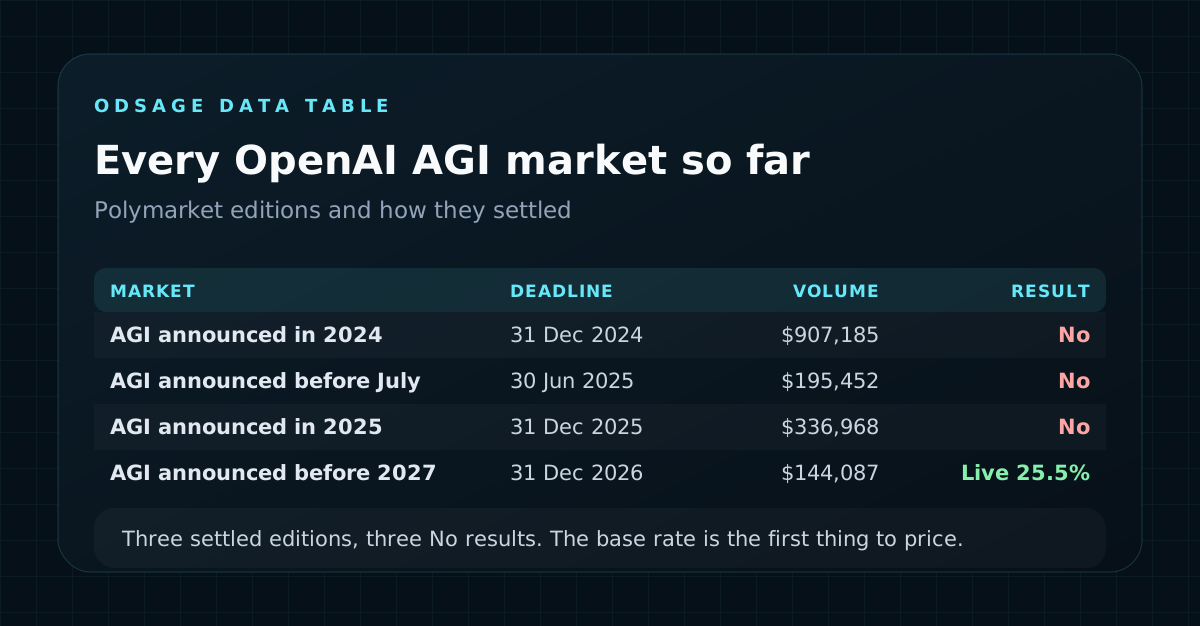
- Three earlier editions of the OpenAI AGI market have settled, in 2024, mid-2025 and end-2025, and all three resolved No on a combined $1.44m of volume.
- Sam Altman told TIME on 26 August 2026 he expects an internal system he would call AGI by year-end, which is not the same event these contracts resolve on.
- The Microsoft AGI clause that once made a declaration a contractual event was dismantled across two amendments and effectively died on 27 April 2026, removing one reason to declare early and one reason not to.
AGI odds price an announcement, not an achievement
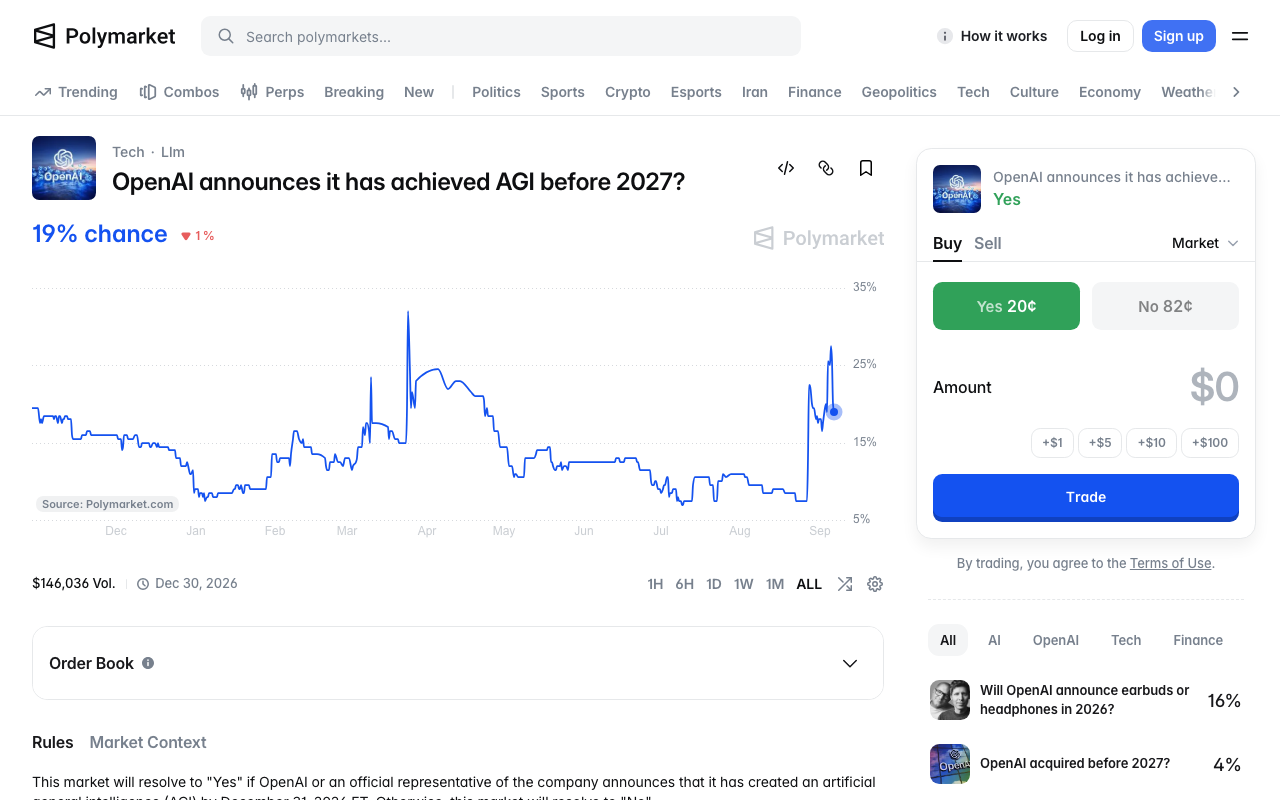
Most people searching for AGI odds want a number for when machines get smart enough. The live contracts do not answer that question, and traders who miss the distinction lose money on the wording rather than on the forecast. Polymarket currently prices OpenAI announcing AGI before 2027 at 25.5% Yes on $144,087 of lifetime volume, while Kalshi's equivalent rung sits at a 22% mid. We read both books directly from the Polymarket Gamma API and the Kalshi trade API at 15:10 UTC on 5 September 2026, and this guide walks through what each rule set actually pays out on.
The Polymarket contract resolves Yes only if OpenAI or an official representative of the company announces that it has created an artificial general intelligence by 31 December 2026 ET. The primary resolution source is official information from OpenAI, with a consensus of credible reporting used as a backstop. Nothing in that sentence mentions a capability threshold, a benchmark, or an independent assessment.
Kalshi is stricter still. Its rules say the announcement must explicitly state that the company has achieved, attained, reached or developed AGI. Statements describing systems as AGI-like, AGI-level, near-AGI or moving toward AGI do not qualify. That single paragraph is why a lab can ship the strongest model anyone has seen and the market can stay flat.
So the honest framing is this: these are corporate communications markets wearing a technology costume. The forecast you need is not about intelligence. It is about whether a specific company says a specific word before a specific date.
The two live AGI markets, side by side
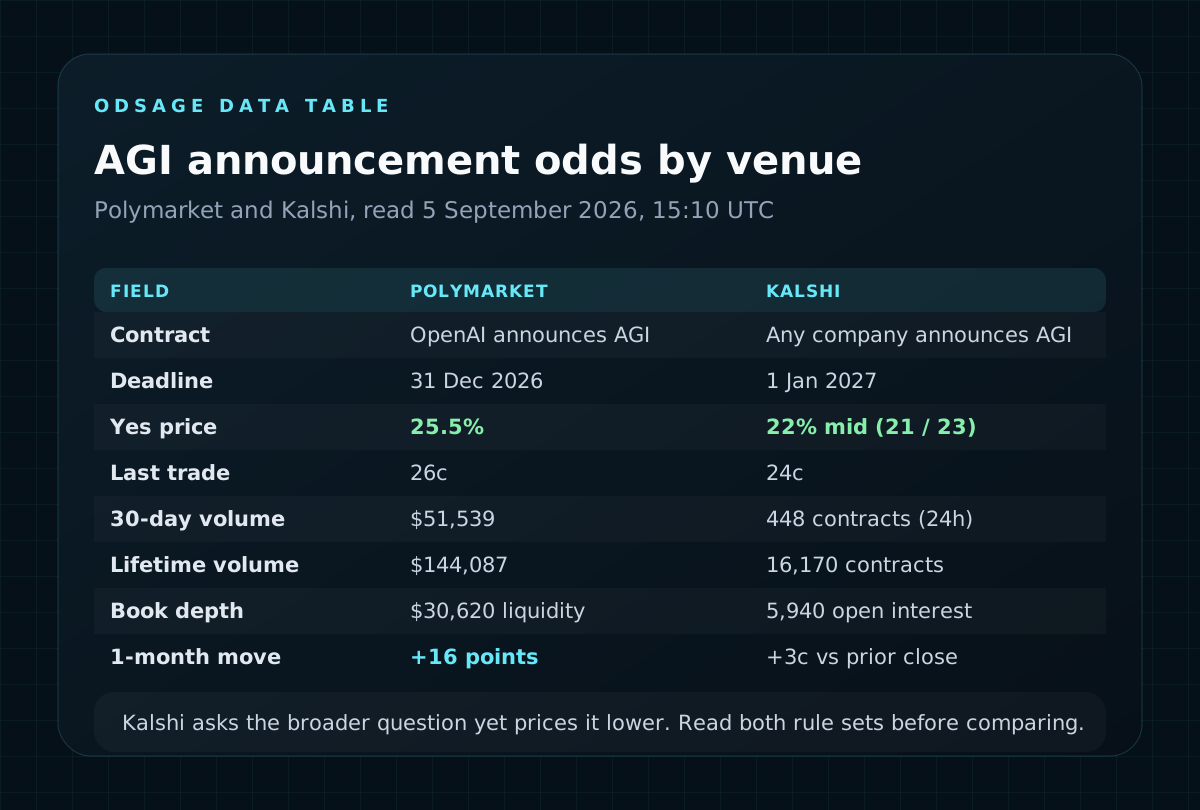
There are exactly two venues quoting this event with real money behind them, and they disagree in an interesting direction. Polymarket asks the narrow question, OpenAI specifically, and prices it at 25.5%. Kalshi asks the broad question, any verifiable company, and prices the same window at 22%.
That ordering should be impossible if both books were efficient. Any-company is a superset of OpenAI-only: every world where OpenAI declares AGI before 2027 is also a world where some company did. The broader contract should trade at or above the narrow one, and instead it trades three and a half points below.
The gap is not a free lunch. The two venues have different deadlines by a matter of hours, different fee structures, different user bases, and very different depth. Polymarket shows $30,620 of book liquidity against Kalshi's 5,940 contracts of open interest on the 2027 rung. The cheapest explanation is that Kalshi's AI complex is thin and slow to reprice, not that anyone is handing out edge.
Still, the direction of the discrepancy tells you where attention is. Polymarket took $41,293 of volume in the last seven days out of $51,539 for the month. Four-fifths of a month's trading happened in one week, and that week began with a model launch.
Why 25% and Altman's year-end claim both make sense
In a TIME report published on 26 August 2026, Sam Altman said he expects OpenAI to have an internal system by the end of the year that he would call AGI, while adding the company is not quite there yet. On the Sources podcast around the same period he called AGI, at best, a very poorly defined term. A reader could look at the CEO predicting year-end and a market at 25% and conclude one of them is badly wrong.
They are answering different questions. An internal system that Altman would personally call AGI is a private judgment. The contract needs a public, attributable, unhedged company statement. OpenAI has a strong commercial reason to describe Astra as a step toward general intelligence and a strong legal and reputational reason not to plant a flag on the word itself.
Note also which definition is in play. OpenAI's own charter language describes AGI as highly autonomous systems that outperform humans at most economically valuable work. That is an economic test, not a benchmark test, and it is the kind of claim that invites immediate scrutiny of revenue, labour data and deployment rather than leaderboard positions.
Read that way, 25% looks less like scepticism about capability and more like a reasonable estimate of corporate willingness. The market is pricing whether a communications team signs off on a sentence, in a quarter where the same company is raising capital and negotiating enterprise contracts.
Kalshi's AGI ladder runs all the way to 2031
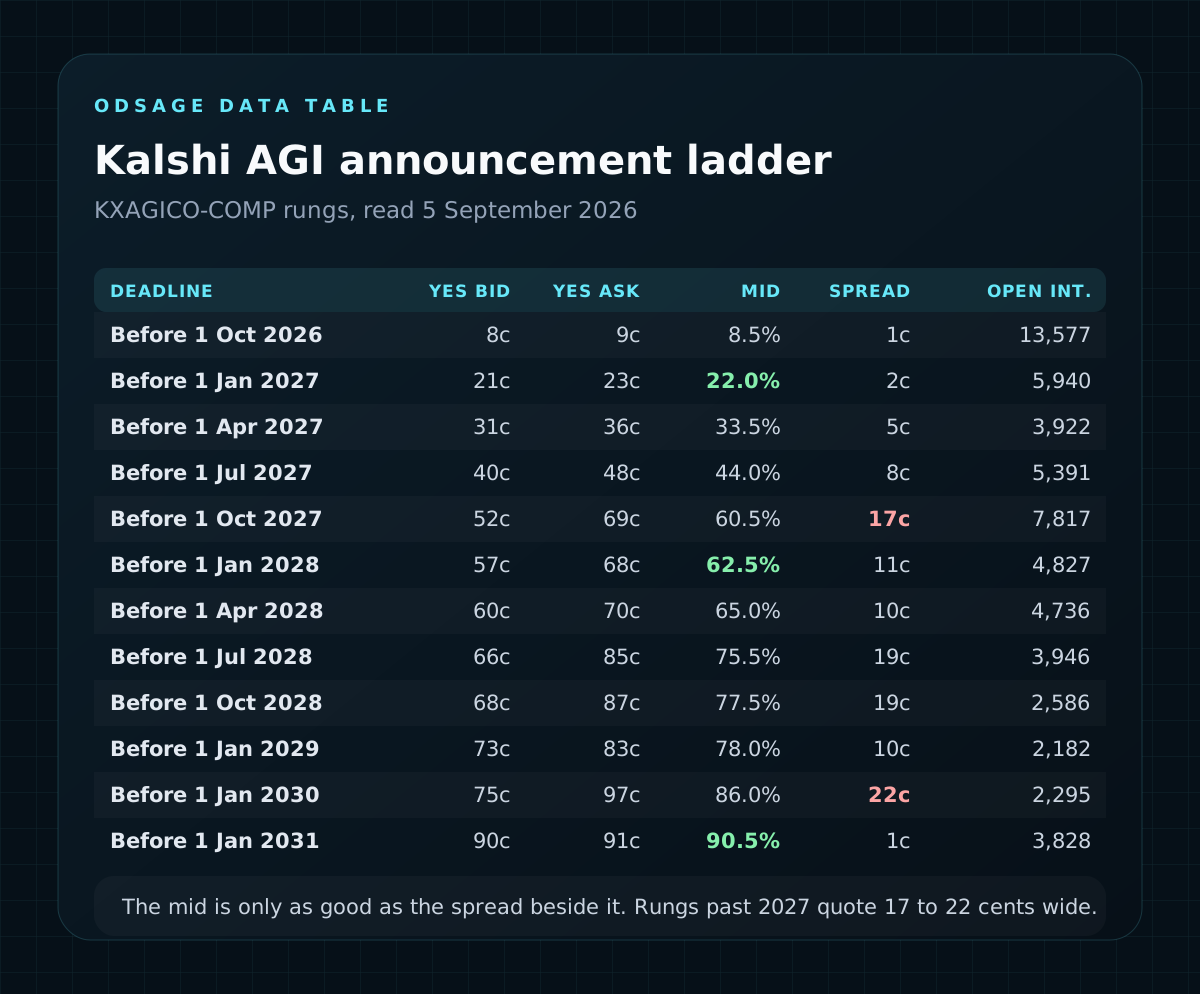
Kalshi lists the same question as a dated ladder, which is more useful than a single binary because it shows the whole implied curve rather than one point on it. Twelve rungs are open, from before 1 October 2026 out to before 1 January 2031, and the mid prices trace a survival curve for the phrase itself.
The near rungs are tight and cheap: 8.5% by October, 22% by January 2027. The curve then climbs steeply through 2027 to roughly 44% by July and about 62% by January 2028, before flattening into the high seventies across 2028 and reaching a 90.5% mid by 2031. Traders are collectively saying that some company almost certainly says the word within five years, and that the interesting uncertainty is concentrated in the next eighteen months.
The spread column is the part worth respecting. The January 2027 rung quotes two cents wide and the 2031 rung one cent, but the October 2027 rung quotes 52 bid against 69 offered and the 2030 rung quotes 75 against 97. A 17 to 22 cent spread means the mid is a convenient fiction. If you would not happily buy at the ask and sell at the bid, you do not really have a price, you have a range.
Open interest tells the same story from a different angle. The October 2026 rung carries 13,577 contracts of open interest, nearly twice the 7,817 on the next largest rung, because it is the one that resolves soonest and can be traded with a real view. The far rungs carry two to four thousand and move on very little flow.
Three settled editions, three No results
This market has run before, and its history is the single most useful prior available. Polymarket has listed an OpenAI AGI announcement contract four times. The 2024 edition traded $907,185 and resolved No. The before-July edition traded $195,452 and resolved No. The 2025 edition traded $336,968 and resolved No. The current edition, before 2027, has traded $144,087 and sits at 25.5%.
Kalshi's ladder has one settled rung with the same shape. The before-1-July-2026 contract finalised with a No result earlier this year.
Four consecutive windows, four No outcomes, across a period in which model capability improved enormously by every published measure. That is the base rate an announcement market has to beat, and it is a strong one: the industry keeps shipping and nobody keeps declaring.
The counter-argument is that base rates decay when the underlying process changes. If the reason for the past Nos was that models genuinely were not close, then rising capability erodes the prior. If the reason was that no lab wants to own the claim, the prior holds regardless of how good the models get. The evidence from Astra week leans toward the second explanation, which is why a 25% price after a record-setting launch is more defensible than it first looks.
What GPT-6 Astra changed, and what it did not
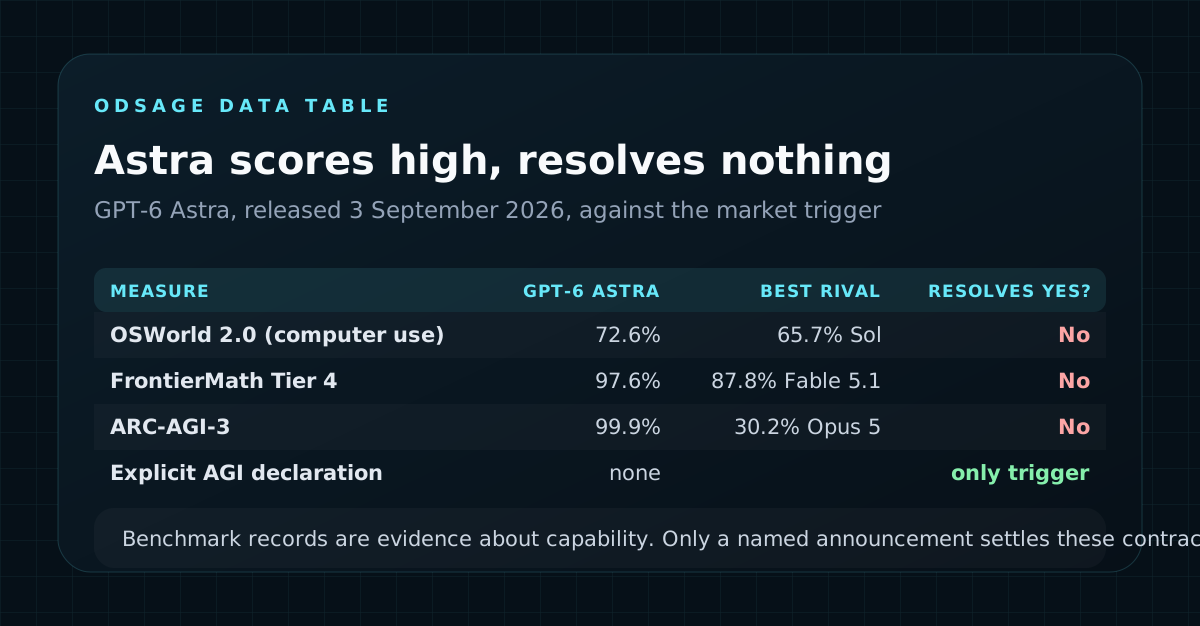
OpenAI released GPT-6 Astra on 3 September 2026 at $10 per million input tokens and $50 per million output tokens. The reported numbers are strong: 72.6% on OSWorld 2.0 against 65.7% for GPT-5.6 Sol, 97.6% on FrontierMath Tier 4, and 99.9% on ARC-AGI-3 against 30.2% for the best rival score published on that benchmark. Astra also operates software through screens rather than through APIs, which is the capability people usually gesture at when they describe general competence.
The odds responded. The Polymarket contract is up 16 points over the month and 6 points over the week, and the week's volume dominated the month's. That is a textbook information-driven repricing rather than drift.
What did not happen is the thing the contract needs. OpenAI's launch materials position Astra on capability, cost and safety classification. Coverage of the launch does not report OpenAI stating that it has achieved AGI. Under Kalshi's wording, describing a system as AGI-like would fail outright, and under Polymarket's wording an ambiguous phrase would land in the contested space where resolution disputes live.
There is a second-order point here worth holding onto. A benchmark named ARC-AGI can be saturated without the AGI market moving to 99%, because the benchmark measures a construct and the market measures a press release. Anyone reading benchmark results as direct market signal will systematically overpay.
The Microsoft clause that used to make AGI a legal event
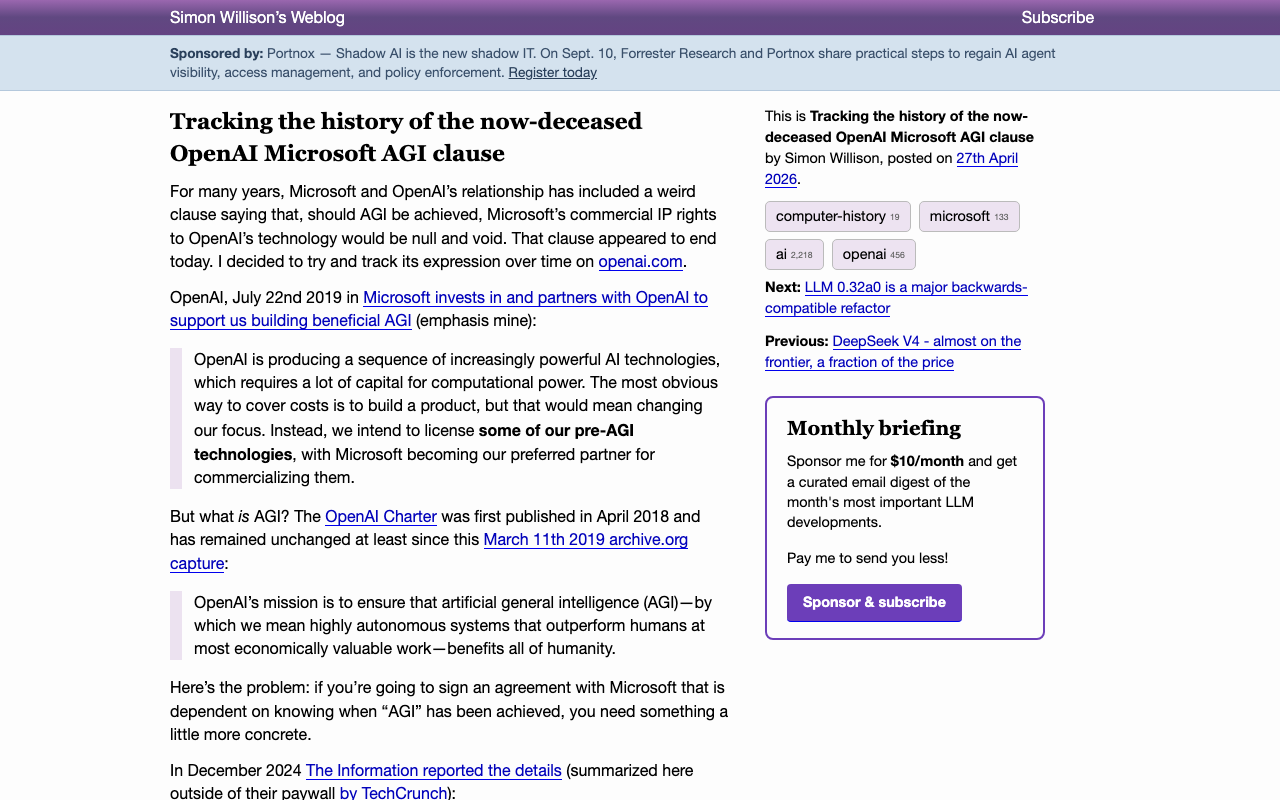
Until recently there was a concrete, non-rhetorical reason for OpenAI to declare AGI, and an equally concrete reason for it not to. The 2019 Microsoft agreement contained a clause under which Microsoft's commercial rights fell away once OpenAI achieved AGI, using the charter's economically-valuable-work definition. Reporting in December 2024 described an accompanying financial trigger tied to $100bn of profits.
That clause was taken apart in two steps. The October 2025 amendment replaced unilateral declaration with verification by an independent expert panel, so OpenAI could no longer flip the switch by itself. The 27 April 2026 amendment finished the job: revenue share continues through 2030 independent of technology progress, Microsoft's licence became non-exclusive, and the AGI trigger effectively ceased to operate.
For anyone pricing this market, that history cuts both ways and the net effect is genuinely ambiguous. A declaration no longer detonates a commercial relationship, which lowers the cost of saying it. But it also no longer wins anything, which removes the incentive to say it early. What remains is reputational: a lab that declares AGI and is then argued down in public has spent credibility for nothing.
The practical takeaway is to stop treating the clause as a hidden catalyst. It was a live consideration in 2024 and 2025. In September 2026 it is history, and a model that still leans on it is pricing a mechanism that no longer exists.
How to read an announcement market without getting caught
Announcement markets have a distinct failure mode. The event is verbal, so the resolution surface is a set of sentences that may or may not have been said, and reasonable people can disagree about whether a given quote qualifies. Four habits keep you out of trouble.
First, read the resolution text before the price, every time, and note who counts as a speaker. Polymarket accepts OpenAI or an official representative. A researcher posting a personal opinion is not that, however senior.
Second, price the spread rather than the mid. On a rung quoting 52 bid at 69 offered, your entry cost swamps most of the analytical edge you think you have. Odsage's EV and Kelly calculators are built to take a bid, an ask and a fair estimate rather than a single number, which is the honest way to run this arithmetic.
Third, separate capability evidence from communication evidence. Benchmark records, model cards and pricing pages move your view of the world. Only company statements move this contract. Keeping two mental columns stops you double-counting a launch.
Fourth, watch the deadline mechanics. This Polymarket contract closes on 31 December 2026 ET, and the Kalshi rung closes at 04:59 UTC on 1 January 2027. A declaration in the first week of January pays nothing on either.
What would actually move AGI odds before December
Four categories of news matter for the rest of 2026, in descending order of impact. A direct, quotable OpenAI statement using the word achieved is the only thing that resolves the market, and it would take the price to the boundary in minutes. Nothing else comes close.
Next, a definitional announcement: OpenAI publishing criteria it says it has now met, or restating the charter test in a way that implies the bar has been cleared. This is the most likely path to a genuine resolution dispute, and disputes are where holders of both sides lose time and money.
Third, a rival declaration. Kalshi's contract pays on any company, so a smaller lab making an aggressive claim could resolve the Kalshi rung Yes while leaving Polymarket untouched. That is precisely the scenario the current three-and-a-half-point inversion between the two venues fails to respect.
Fourth, capability releases. Another Astra-scale launch would likely add points the way the last one did, without changing the underlying question at all. If you are trading this, the useful discipline is to decide in advance how many points a launch is worth to you, then compare that with what the market actually pays after the news lands.
Related reading and tools on Odsage
If you are working through the AI odds complex, these pages are the natural next steps. The release-odds cluster covers the contracts that resolve on shipping rather than on saying, the benchmark cluster covers the evidence layer underneath, and the calculators turn a price and a fair estimate into expected value.
Odsage is an information site. Everything here is market data and context, not financial advice, and Odsage is not affiliated with Polymarket or Kalshi. Prices quoted in this article were read on 5 September 2026 and will have moved since.
FAQ
Frequently asked questions
What are the current AGI odds on prediction markets?
Read on 5 September 2026, Polymarket priced OpenAI announcing AGI before 2027 at 25.5% Yes, with a 25c bid and 26c ask. Kalshi's equivalent rung, covering any company before 1 January 2027, quoted 21c bid and 23c ask for a 22% mid. Both contracts move continuously, so check the live price before acting on these numbers.
Do AGI markets resolve on capability or on an announcement?
On an announcement. Polymarket resolves Yes only if OpenAI or an official representative says the company has created an AGI before the deadline. Kalshi requires an explicit statement that a company has achieved, attained, reached or developed AGI. Benchmark records, model launches and third-party assessments do not resolve either contract on their own.
Why is Kalshi's broader AGI market cheaper than Polymarket's narrower one?
It should not be, in theory: any company announcing AGI is a superset of OpenAI announcing it. In practice Kalshi's AI complex is thinner, with 5,940 contracts of open interest on the 2027 rung against $30,620 of Polymarket book liquidity, so it reprices more slowly after news. Treat the three-and-a-half-point gap as a liquidity artefact rather than as free money.
Has an OpenAI AGI market ever resolved Yes?
No. Polymarket has listed the contract four times. The 2024, mid-2025 and end-2025 editions all resolved No on a combined $1.44m of volume, and the before-2027 edition is still live. Kalshi's before-1-July-2026 rung also finalised as No.
Did GPT-6 Astra move the AGI odds?
Yes, substantially. The Polymarket contract is up 16 points over the past month and 6 points over the past week, with $41,293 of the month's $51,539 volume trading in the seven days around the 3 September 2026 launch. The price moved on capability news even though the launch did not include an AGI declaration.
Does Sam Altman's year-end AGI comment mean the market is mispriced?
Not necessarily. In a TIME report published 26 August 2026 he said he expects an internal system he would call AGI by year-end, while noting OpenAI is not quite there. A private judgment about an internal system is not the public company announcement these contracts require, so the two statements can both be true.
Does the Microsoft AGI clause still affect these odds?
No. The clause that voided Microsoft's rights on an AGI declaration was replaced by independent expert-panel verification in October 2025 and then effectively terminated by the 27 April 2026 amendment, which continued revenue share through 2030 regardless of technology progress. Any model still treating the clause as a catalyst is pricing a mechanism that no longer exists.
How should I handle the wide spreads on the long-dated AGI rungs?
Price the spread, not the mid. The October 2027 rung quotes 52c bid against 69c offered and the 2030 rung quotes 75c against 97c, so the executable cost can be 17 to 22 cents away from the headline mid. Run the expected-value maths on your actual entry price using the Odsage calculators before treating any long-dated mid as a real probability.
Sources and methodology
Sources used for this guide
Odsage combines public source links with prediction-market context, related market pages, calculator workflows, and visible FAQ content. Market prices are informational and are not financial advice.