Prediction Markets
OpenAI Bankruptcy Odds 2026: Polymarket Says 7.5%
OpenAI bankruptcy odds are 7.5% by 2027, 16.5% by 2028 and 21% by 2029 on Polymarket. The contract excludes default and out-of-court restructuring.
Key takeaways
- Polymarket prices OpenAI bankruptcy odds at 7.5% by 31 December 2027, 16.5% by 31 December 2028 and 21% by 31 December 2029, read from the Gamma API on 14 November 2026. The event has traded $556,914 since it opened on 17 September 2026, $232,657 of it in the last 30 days.
- The ladder matters more than the headline. Read as conditionals, the rungs put 7.5 points on a filing before 2028, add 9 points for calendar 2028, add 4.5 for 2029, and leave 79% on no qualifying announcement at all.
- Both far rungs printed 49.5% on their first day and are widely quoted as having collapsed since. That print is a seeding artifact: the 2028 rung repriced to 15.5% the next morning and has never traded above 23%, and the 2029 rung repriced to 19.5% and has never traded above 28%.
- What the contract excludes matters more than what it triggers. A missed payment, a covenant breach, a downgrade, foreclosure, a receiver and any debt restructuring agreed outside court all resolve No on their own. So does a rescue acquisition that leaves no covered entity standing.
- The market did not react to the loss headline. The Wall Street Journal's reported Q3 2026 adjusted operating loss of roughly $10.9 billion was published on 10 November 2026; the 2028 rung went from 17.5% to 16.5% across that week and the 2029 rung from 22% to 21%.
On this page
Search for OpenAI bankruptcy odds and you will find a 14 billion dollar loss projection, a 1.4 trillion dollar compute bill, and at least four pages telling you the company runs out of cash by mid-2027. Then you look at the market that actually takes money on the question and it says 7.5% by the end of 2027. The gap is not optimism. It is that almost nobody quoting these odds has read the clause that decides them.
A number this far from the commentary is either a mispricing or a misreading, and the difference is worth money. We pulled the event from Polymarket's Gamma API on 14 November 2026, read the full 3,235-character resolution text, and rebuilt all three rungs from the CLOB daily series: 46 daily points for the 2027 rung and 53 each for 2028 and 2029. Every price below is from that read, not from a screenshot of someone else's. What we found is that the most quoted fact about this market, the collapse from 49.5%, never happened, and that the distress scenarios people argue about in public mostly resolve No.
On this page we work through it in order:
1. What the contract actually requires, clause by clause.
2. The three rungs, their prices, spreads and liquidity.
3. Why the 49.5% opening print is not evidence of anything.
4. What the ladder implies year by year.
5. The exclusion list, which is longer than the trigger list.
6. The week the market shrugged at an 11 billion dollar loss.
7. Whether the spreads let you trade it at all.
8. Five checks to run before you take a side.
What the contract actually requires
All three rungs share one resolution text, and for a market about a privately held company it is unusually careful. Read it as five tests, because a candidate event has to clear all of them.
Test one, the entity test. The contract covers OpenAI Group PBC, the public benefit corporation that holds the business, its subsidiary OpenAI OpCo LLC, and any common-control entity holding all or substantially all of OpenAI's business and assets. It excludes, by name, foreign entities, financing entities, special purpose vehicles and entities used to separate specific liabilities. Given how much of the compute build-out sits in financing vehicles, that exclusion is doing real work.
Test two, the proceeding test. A filing means a petition under Chapter 7 or Chapter 11 of the US Bankruptcy Code, or a non-US bankruptcy or insolvency case including a court-appointed administration. A petition filed against a covered entity by its creditors counts only if the court enters an order for relief on it by the rung's date, which is a meaningfully higher bar than the filing itself.
Test three, the announcement test. An announcement is enough on its own, regardless of whether or when a filing follows, but it has to come through an official or verified channel, from the CEO, legal representation or someone who officially represents OpenAI. A definitive consensus of credible reporting also qualifies.
Test four, the definiteness test, and this is the one that kills most of the headlines. The statement must say that a covered entity has decided to file or has filed. Saying the company is considering bankruptcy, exploring it, or open to it does not qualify. Nor do reports citing unnamed sources that a covered entity plans or is preparing to file.
Test five, the timing test. A filing occurs when the court records it, an announcement when it is first published, and resolution runs to 11:59 PM ET on the rung's date. One useful asymmetry: once a qualifying event happens the market resolves Yes even if the petition is later withdrawn, dismissed or converted.
OpenAI bankruptcy odds, rung by rung
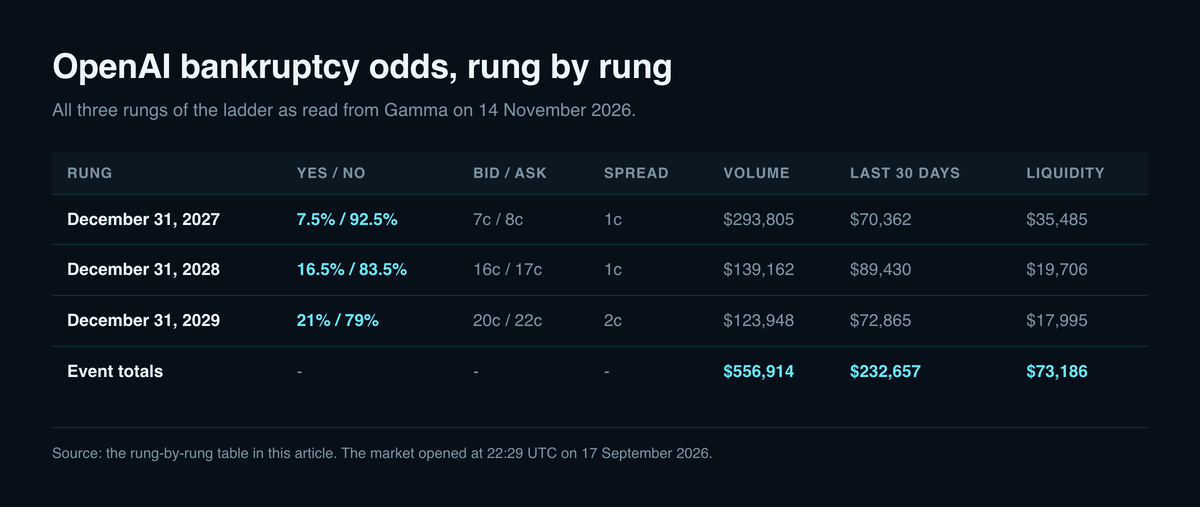
The event is a three-rung ladder rather than one yes-or-no question, which makes it far more informative than a single probability. Here is the full state of all three rungs as read from Gamma on 14 November 2026:
December 31, 2027 rung - 7.5% Yes, 92.5% No. Best bid 7c, best ask 8c, spread 1c. Volume $293,805, of which $70,362 in the last 30 days. Liquidity $35,485. Resolves 1 January 2028 at 04:59 UTC.
December 31, 2028 rung - 16.5% Yes, 83.5% No. Best bid 16c, best ask 17c, spread 1c. Volume $139,162, of which $89,430 in the last 30 days. Liquidity $19,706. Resolves 1 January 2029 at 04:59 UTC.
December 31, 2029 rung - 21% Yes, 79% No. Best bid 20c, best ask 22c, spread 2c. Volume $123,948, of which $72,865 in the last 30 days. Liquidity $17,995. Resolves 1 January 2030 at 04:59 UTC.
Event totals - $556,914 traded since the market opened at 22:29 UTC on 17 September 2026, $232,657 of that in the last 30 days, and $73,186 of liquidity across all three rungs.
Two features matter more than the percentages. First, the near rung holds more than half the lifetime volume but the recent money went to the far rungs: 70% of the last 30 days' turnover sits on 2028 and 2029. Traders are arguing about timing, not about whether the question is live. Second, the rungs are properly ordered with narrow gaps, which is what a ladder looks like when someone is arbitraging it rather than leaving stale quotes up.
The 49.5% opening print is not evidence of anything
Here is the claim you will meet everywhere, and it is wrong. Both far rungs show a first print of 49.5% on 18 September 2026, so the story writes itself: the market thought OpenAI was a coin flip, then confidence recovered, or collapsed, depending on which direction the writer needed.
Pull the daily series and the story dissolves. The 2028 rung printed 49.5% once, on 18 September, then opened at 15.5% on 19 September and stayed at 15.5% to 16.5% for the next three weeks. The 2029 rung did exactly the same thing, 49.5% once and then 19.5% the following morning. A single print at almost exactly the midpoint, on day one, that never recurs is the signature of a seeded book before real two-sided flow arrives, not of a belief anyone held.
The honest version of the price history is narrower and more useful. Since 19 September 2026, the first day of real trading, the 2027 rung has traded between 6.5% and 10.5%, the 2028 rung between 14.5% and 23%, and the 2029 rung between 17.5% and 28%. All three are near the lower half of those ranges today. Both far rungs peaked on the same day, 30 October 2026, at 23% and 28%.
This matters beyond pedantry. If you believe the market has fallen 33 points you will read today's 16.5% as a trend to extrapolate. If you know it has oscillated in a nine-point band for two months, you will read it as a range, and size differently.
What the ladder implies, year by year
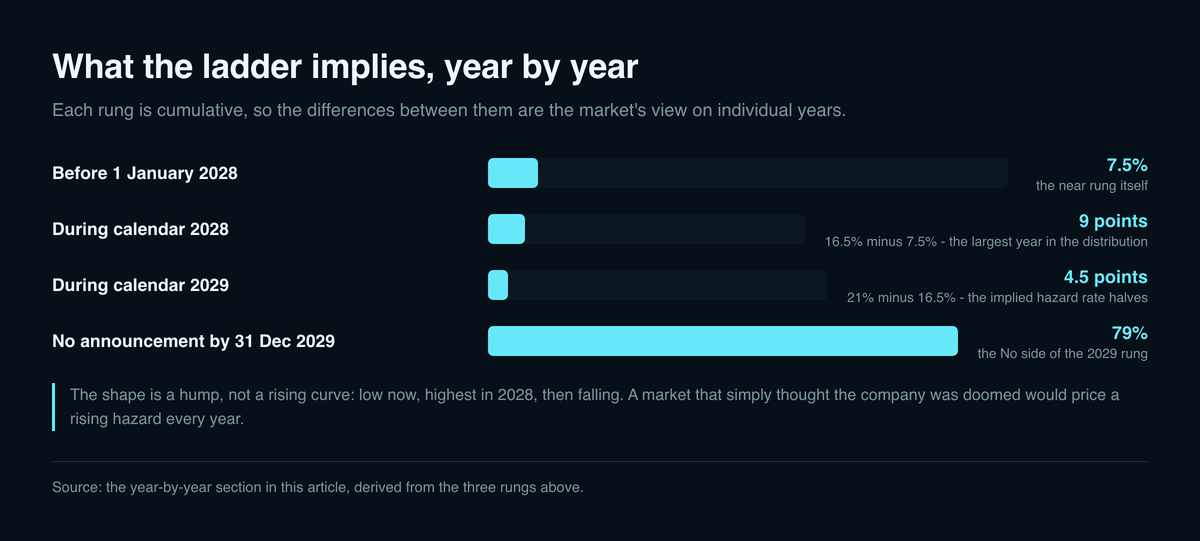
Each rung is cumulative: it asks whether a qualifying announcement happens by its date, so the differences between them are the market's view on individual years. Subtract them and you get a distribution rather than a headline.
Before 1 January 2028 - 7.5%. That is roughly 13 and a half months from today, and it is the only window where OpenAI's current cash position and committed capital are more or less known quantities.
During calendar 2028 - 9 points, the difference between 16.5% and 7.5%. This is the single largest year in the distribution and it is where the market puts the peak of the risk.
During calendar 2029 - 4.5 points, the difference between 21% and 16.5%. The hazard rate the market implies falls by half after 2028.
No qualifying announcement by 31 December 2029 - 79%.
That shape is a specific claim, and not the one the commentary makes. A market that simply thought the company was doomed would price a rising hazard every year as the compute bills compound. This one prices a hump: low now, highest in 2028, then falling. The reading that fits is a financing cliff, where risk concentrates around the point at which committed capital is spent and the next raise has to clear at a size nobody has done before.
CNBC reported in February 2026 that OpenAI had told investors it planned roughly $600 billion of total compute spending through 2030, against the $1.4 trillion of commitments Altman had touted months earlier, with revenue projected above $280 billion by 2030 and 2025 revenue of $13.1 billion. The gap between those two spending figures is itself the financing cliff the ladder is pricing.
The exclusion list is longer than the trigger list
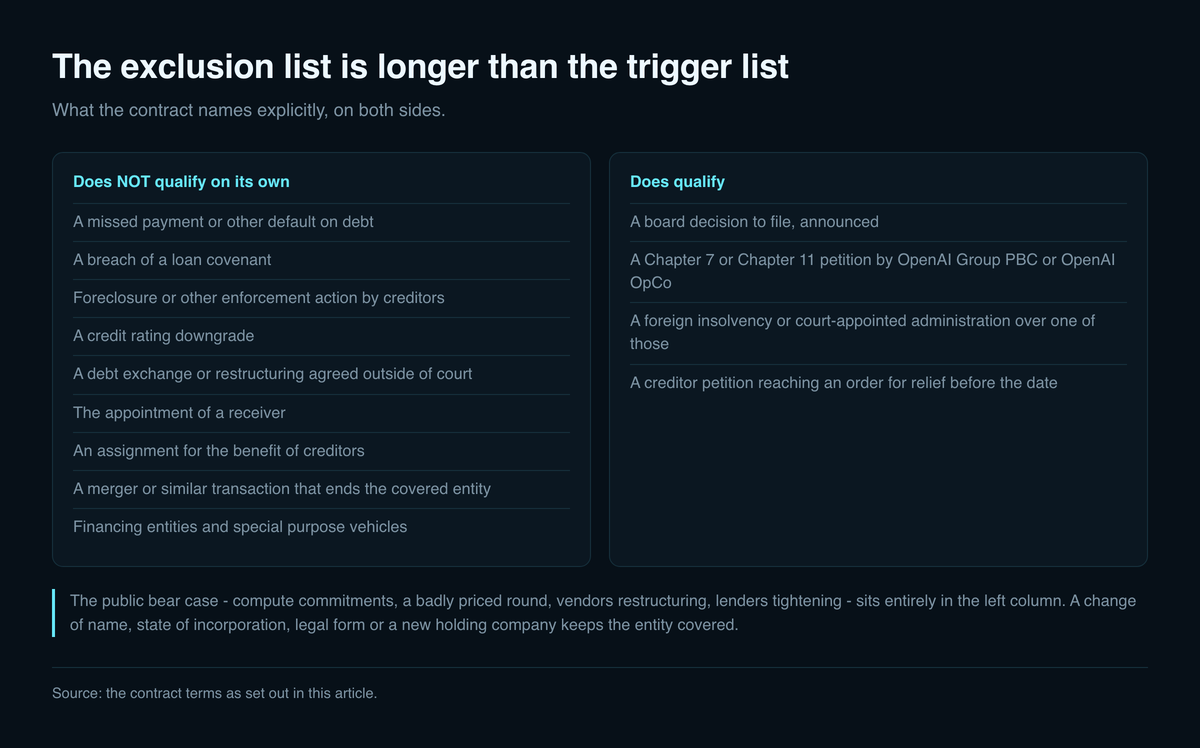
This is the section we would read first if we were pricing the market, and it is the section no competitor covers. The contract names, explicitly, eight things that will not qualify on their own:
A missed payment or other default on debt. A breach of a loan covenant. Foreclosure or other enforcement action by creditors. A credit rating downgrade. A debt exchange or other restructuring agreed outside of court. The appointment of a receiver. An assignment for the benefit of creditors.
Read that list against the arguments people actually make about OpenAI and the mismatch is the whole trade. The public bear case is about compute commitments the company cannot service, a round that prices badly, vendors restructuring terms, lenders tightening. Every one of those paths, on its own, resolves this market No.
There is a ninth exclusion, in a separate clause, and it is the sharpest. If a covered entity stops existing because of a merger or similar transaction, it is no longer covered, and if no covered entity remains the market resolves No. So the single most plausible bad ending for a company with this cost base, an acquisition or absorption by a larger balance sheet, pays Yes holders nothing. The clause does close the obvious loophole: a change of name, state of incorporation or legal form, or a new holding company placed over the same business, keeps the entity covered.
The entity exclusions narrow it further. Financing entities and special purpose vehicles are out, which is where a great deal of data-centre debt customarily sits: a Chapter 11 of a Stargate-style financing vehicle would be enormous news and would not, by itself, move this contract.
So what does pay? A board decision to file, announced; a Chapter 7 or Chapter 11 petition by OpenAI Group PBC or OpenAI OpCo; a foreign insolvency or court-appointed administration over one of those; or a creditor petition that reaches an order for relief before the date. That is a narrow set of outcomes, and 7.5% for 13 months is not obviously wrong for it.
The week the market shrugged at an $11 billion loss
If you want one episode that shows what this market is and is not pricing, take the second week of November 2026.
On 10 November 2026, reporting on Wall Street Journal figures put OpenAI's Q3 adjusted operating loss at roughly $10.9 billion on about $10 billion of quarterly revenue, with revenue up around 50%. By any ordinary reading that is a large number, and it was covered as one. Related reporting the same week noted the operating margin loss narrowing from about -150% to -109%.
The market's response was nothing. The 2028 rung sat at 17.5% from 2 to 8 November, moved to 16.5% on 9 November and has stayed there every day since, including through the loss coverage. The 2029 rung went from 22% on 6 November to 21% on 14 November, and the 2027 rung held 8.5% from 9 November before printing 7.5% today. Three rungs, a week of eleven-figure loss headlines, and every move was downward and inside a point.
There are two readings and the data does not settle between them. One is that the loss was already priced, which the margin figure supports: a loss growing more slowly than revenue is, mechanically, a company getting closer to covering its costs. The other is that traders judged the headline irrelevant to this contract, because a quarterly operating loss is not in the trigger list.
Either way, the lesson is the one these markets keep teaching. The contract is the asset, and a headline that does not touch a named trigger is not information about the price, however big its number is.
Can you actually trade it? The spreads say be careful
Liquidity is where this event stops being an interesting read and starts being a problem. $73,186 of total liquidity against $556,914 of lifetime volume is thin for a market that gets this much attention, and the cost of a round trip is not where you would expect it.
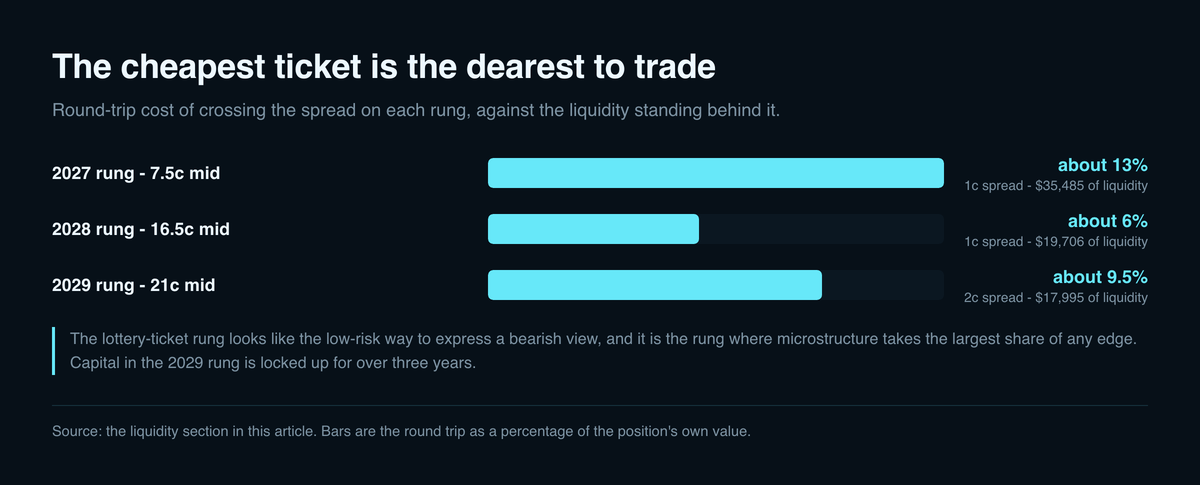
The 2027 rung is the cheapest ticket and by far the most expensive to trade. A 1c spread on a 7.5c mid is about a 13% round trip, so a position has to be right by thirteen percent of its own value before it covers the crossing. The 2028 rung, at 1c on a 16.5c mid, costs about 6%. The 2029 rung, at 2c on a 21c mid, costs about 9.5%.
That inverts the usual intuition about cheap tails. The lottery-ticket rung looks like the low-risk way to express a bearish view because the ticket costs seven cents, and it is the rung where microstructure takes the largest share of any edge. If your thesis is about timing, the 2028 rung is both the busiest on recent flow and the cheapest to get into and out of.
Size against the liquidity figures, not the percentages. $35,485 on the near rung and under $20,000 on each far rung means a few thousand dollars of market order moves your own fill. These are also long-dated contracts: capital in the 2029 rung is locked up for over three years, a real cost the implied probability does not show you. Our calculators take the spread and the hold period as inputs rather than pretending they are zero.
Five checks before you take a side
First, re-read the trigger list before you react to any headline. If the news is a default, a downgrade, a covenant breach, a receiver or an out-of-court restructuring, the contract has already told you it does not count on its own. This is the check that would have saved anyone who traded the November loss coverage.
Second, confirm the entity. A filing by a financing vehicle, an SPV or a foreign subsidiary is excluded unless it holds substantially all of the business. OpenAI's restructuring, reported on 28 October 2025, left the nonprofit OpenAI Foundation controlling OpenAI Group PBC, with Microsoft holding about 27%, and the contract is written against that structure.
Third, price the ladder, not the rung. If you think the risk is real but later than the market does, the trade is the spread between two rungs, not a directional bet on one. The 9-point gap between 2027 and 2028 is the market's single biggest year-specific claim and the easiest one to disagree with precisely.
Fourth, check the spread against your edge before you check your thesis again. A 13% round trip on the 2027 rung eats most views that are only slightly contrarian.
Fifth, treat secondary financial figures as secondary. The loss and revenue numbers circulating for a private company come from reporting on leaked internals, they disagree with each other, and we have flagged the date and outlet for each one we used. The numbers we stand behind unconditionally are the prices, spreads, volumes and resolution text, read from Polymarket's own API on 14 November 2026.
A note on how we are paid: outbound Polymarket links on Odsage carry our referral code, so we earn a share of revenue if you sign up through one. It does not change the numbers above, and nothing here is financial advice or a recommendation to take either side of a market about a real company's solvency.
FAQ
Frequently asked questions
What are the odds OpenAI goes bankrupt?
Polymarket prices a qualifying bankruptcy announcement at 7.5% by 31 December 2027, 16.5% by 2028 and 21% by 2029, read from the Gamma API on 14 November 2026. All three rungs share one resolution text requiring either a Chapter 7 or Chapter 11 petition, or an official announcement that a covered entity has decided to file.
Did OpenAI's bankruptcy odds really fall from 49.5%?
No. Both far rungs printed 49.5% once, on 18 September 2026, their first day. The 2028 rung opened at 15.5% the next morning and the 2029 rung at 19.5%, and neither has traded above 23% or 28% since. A day-one print at the midpoint that never recurs is a seeded book, not a price anyone traded on.
Would a debt restructuring or a missed payment resolve this market Yes?
No. The resolution text names things that do not qualify on their own: a missed payment or default, a covenant breach, foreclosure or creditor enforcement, a credit downgrade, a restructuring agreed outside court, a court-appointed receiver, and an assignment for the benefit of creditors. Most of the public bear case runs through one of those paths.
What happens to the market if OpenAI is acquired?
It resolves No, provided no covered entity remains afterwards. The contract says that if a covered entity stops existing through a merger or similar transaction it is no longer covered. A change of name, state of incorporation or legal form, or a new holding company placed over the same business, does keep the entity covered.
Why didn't the odds move on OpenAI's $11 billion quarterly loss?
Reporting on Wall Street Journal figures put the Q3 2026 adjusted operating loss at roughly $10.9 billion on about $10 billion of revenue, published 10 November 2026. Across that week the 2028 rung went from 17.5% to 16.5% and the 2029 rung from 22% to 21%. A quarterly operating loss is not in the trigger list, and related reporting noted the margin loss narrowing from about -150% to -109%.
Which rung is the best one to trade?
On microstructure, the 2028 rung. Its 1c spread on a 16.5c mid is about a 6% round trip, against roughly 13% for 2027 and 9.5% for 2029, and it took the largest share of the last 30 days' volume at $89,430. The 2027 rung looks cheap at 7.5c and is the most expensive to get in and out of.
How much money is in the OpenAI bankruptcy market?
The event has traded $556,914 since it opened on 17 September 2026, with $232,657 of that in the last 30 days, and holds $73,186 of liquidity across the three rungs. That is thin: $35,485 sits on the 2027 rung and under $20,000 on each of the far rungs, so a few thousand dollars of market order will move your own fill.
Has OpenAI said anything about filing for bankruptcy?
No. There is no filing and no official statement of an intention to file, which is what the contract requires. Altman has publicly disputed the framing of the company's finances and said OpenAI is not seeking a government bailout. The figures circulating about losses and cash burn come from reporting on internal numbers rather than company filings, and they disagree with each other.
Sources and methodology
Sources used for this guide
Odsage combines public source links with prediction-market context, related market pages, calculator workflows, and visible FAQ content. Market prices are informational and are not financial advice.