AI Bubble
AI Bubble Burst Odds 2026: Polymarket's Six Tripwires
AI bubble burst odds sit at 6.2% on Polymarket. We checked all six trigger conditions against tonight's closes: one has already fired, five have not.
Key takeaways
- Polymarket's AI bubble burst odds closed at 0.062 for 2026 and 0.185 for 30 June 2027, against $3,047,508 of lifetime volume. The 2026 leg has halved in thirty days, from 0.1225 on 15 September.
- The market does not resolve on a narrative. It needs three of six named conditions inside a single 90-day window, and five of the six are hard numerical thresholds on specific tickers. Every article we found on the first page of results quotes a price without listing them.
- One of the six has already fired and nobody is counting it. Super Micro Computer closed at $35.78 against an all-time closing high of $118.81 in March 2024, a 69.88% drawdown, and the hardware-supplier condition only asks for 50%.
- The other five are not close. NVIDIA is 7.50% off its high and the condition wants 50%; the H100 rental index is at $2.85 and the condition wants $1.00 or less for five straight days, and it rose 7.1% last week.
- Tonight was the worst session for US equities since July and all seven tickers named in this market fell between 3.10% and 8.42%. The 2026 contract moved five hundredths of a cent, on $224 of volume.
On this page
AI bubble burst odds are quoted in headlines as a single percentage, and the single percentage is the least informative thing about this market. Tonight the S&P 500 and the Nasdaq had their worst session since July, every semiconductor name on the board fell, and Polymarket's AI bubble contract for 2026 closed at 0.062. A month ago it was 0.1225. The price went the opposite way to the news, and the reason is in the resolution text that none of the coverage reproduces.
We read all four legs of the event from the Polymarket Gamma API at 21:21 UTC on 14 October 2026, pulled thirty days and the full life of the order book from the CLOB, and then checked each of the market's six trigger conditions against the 14 October closing prices from Yahoo Finance's chart endpoint and the H100 rate published on the SiliconData Silicon Index. One condition is already satisfied. The other five need moves of 24% to 65% from here.
The short version: this is not a bet on whether AI is a bubble. It is a bet on whether three specific tripwires trip inside one 90-day window, and with 78 days left on the 2026 clock the market has decided they will not.
1. What the AI bubble burst odds market actually measures.
2. Where the six tripwires stand after tonight's close.
3. One tripwire has already fired, and nobody is counting it.
4. Why the odds halved while chip stocks were falling.
5. The June 2027 contract is the one worth reading.
6. What Polymarket's own bankruptcy markets say about condition three.
7. The book is thinner than the volume suggests.
8. Five checks before you trade AI bubble burst odds.
What the AI bubble burst odds market actually measures
Polymarket's event is titled AI bubble burst by...? and it has run since 20 November 2025. It resolves YES once the AI industry is deemed to have experienced an industry downturn, and the market defines that term itself rather than leaving it to judgement. At least three of six listed events must have occurred inside a single 90-day window that ends no later than the leg's deadline.
The six are: NVIDIA's closing price down 50% from its all-time high; the iShares Semiconductor ETF (SOXX) closing down 40% from its all-time high; OpenAI or Anthropic declaring bankruptcy; OpenAI being acquired; the H100 rental rate falling to $1.00 or lower for five consecutive days on the SiliconData Silicon Index; and any of TSMC, ASML, Broadcom, Arista Networks or Super Micro Computer closing down 50% from its all-time high.
Two details in the rules do real work. The window is a span, not a tally: the text gives a worked example where events on 10 January, 5 February and 3 March qualify, while the same three events on 10 January, 20 April and 1 November do not. And the market says plainly that it will not resolve YES until three conditions are met regardless of reporting of an industry downturn or similar claims, which means commentary, sentiment and the word bubble appearing on front pages count for nothing.
This is where the better-ranked write-ups go wrong. The deepest competitor page we read states that the market has no numerical downturn threshold and names SiliconData as the settlement source. There are five numerical thresholds, and SiliconData governs one condition of six.
Where the six tripwires stand after tonight's close
Every price below is the 14 October 2026 close, and every all-time high is on a closing basis, because that is the basis the market's own wording uses. We pulled 25 years of daily closes for each ticker so the high is a real all-time high rather than a 52-week high, which matters enormously for one of them.
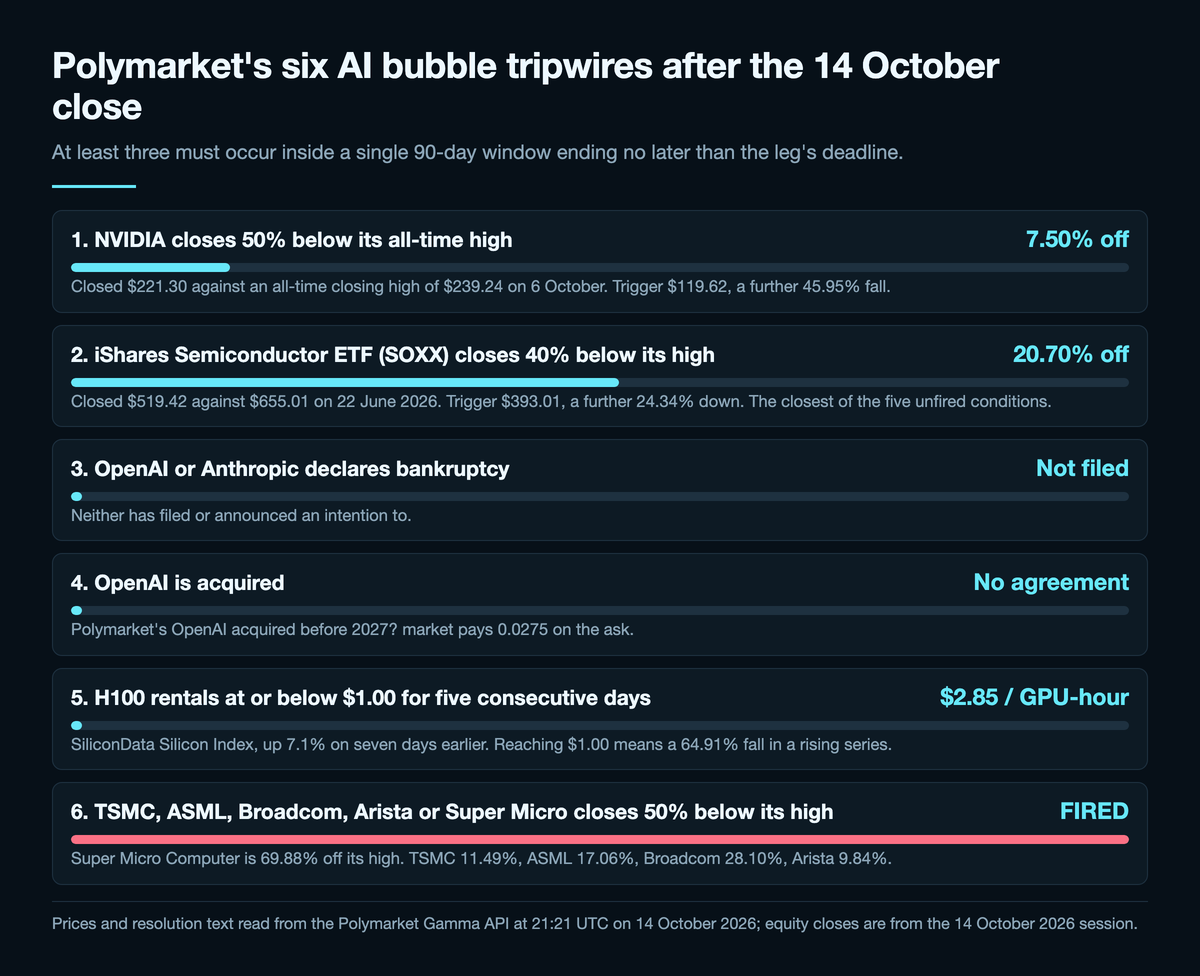
Condition 1, NVIDIA down 50%. NVDA closed at $221.30 against an all-time closing high of $239.24 set eight sessions ago on 6 October. That is a 7.50% drawdown. The trigger sits at $119.62, which needs a further 45.95% fall.
Condition 2, SOXX down 40%. The ETF closed at $519.42 against $655.01 on 22 June 2026, a 20.70% drawdown. The trigger is $393.01, a further 24.34% down. This is the closest of the five unfired conditions, and tonight's 4.50% drop moved it meaningfully for the first time in months.
Condition 3, an OpenAI or Anthropic bankruptcy. Neither has filed or announced an intention to. Section six prices this against Polymarket's own markets for it.
Condition 4, OpenAI acquired. No agreement exists. Polymarket's OpenAI acquired before 2027? market pays 0.0275 on the ask.
Condition 5, H100 rentals at or below $1.00 for five consecutive days. The SiliconData Silicon Index publishes the H100 rate at $2.85 per GPU-hour, up 7.1% against seven days earlier, with the hyperscaler rate at $7.15. Reaching $1.00 means a 64.91% fall in a series that is currently rising.
Condition 6, a major hardware supplier down 50%. TSMC is 11.49% off its high, ASML 17.06%, Arista 9.84% and Broadcom 28.10%. Super Micro Computer is 69.88% off its high, and that is the subject of the next section.
One tripwire has already fired, and nobody is counting it
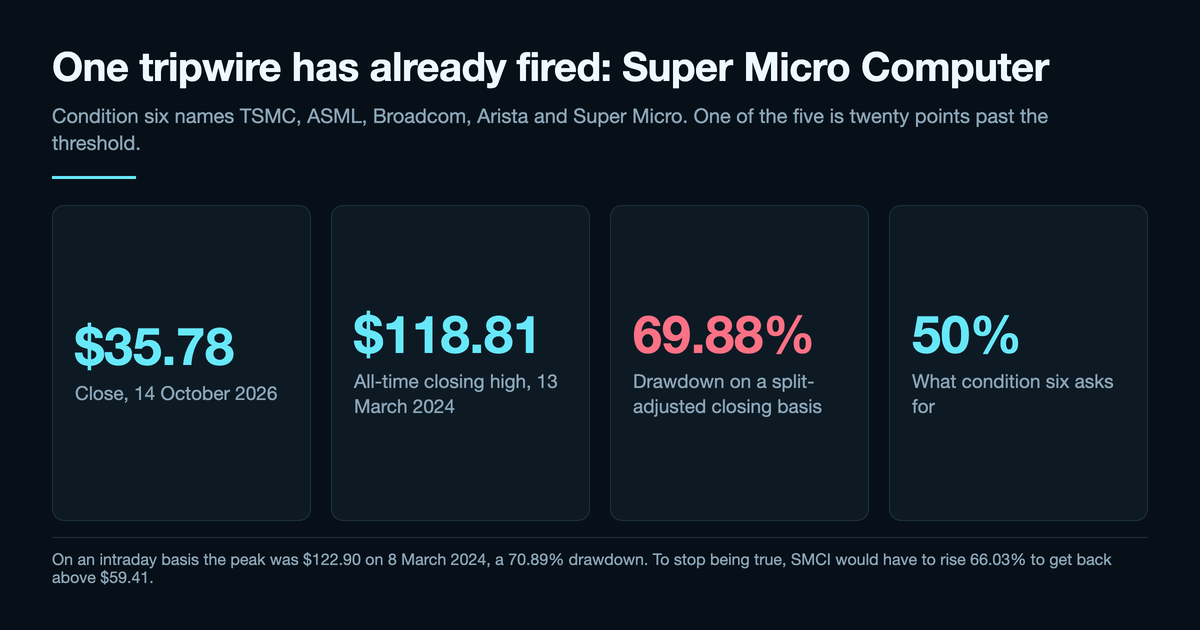
Super Micro Computer closed tonight at $35.78. Its all-time closing high is $118.81, set on 13 March 2024, seven months before the 10-for-1 split that took effect on 1 October 2024. On a split-adjusted closing basis the stock is 69.88% below that peak. On an intraday basis the peak was $122.90 on 8 March 2024, which puts the drawdown at 70.89%. Either figure clears the condition's 50% threshold by about twenty points.
SMCI is one of the five tickers the sixth condition names, alongside TSMC, ASML, Broadcom and Arista. So one of the six events this market requires is, on its face, already true, and has been true continuously for most of two years. To stop being true the stock would have to rise 66.03% to get back above $59.41.
We think this is the most under-reported fact about the contract, and it has a direct consequence for pricing: if the SMCI drawdown counts as an occurring event on any day it holds, the market needs two more conditions in the window rather than three. We flag it rather than assert it, because the rules describe conditions that occur on dates and a continuing state fits that language awkwardly. A trader taking either side should read the resolution text and the market's comment thread, which runs to 98 comments, before assuming their reading is the one the resolver will use.
It is the kind of ambiguity that decides contracts. It is also exactly what no page currently ranking for this query mentions, because none of them lists the conditions at all.
Why the odds halved while chip stocks were falling
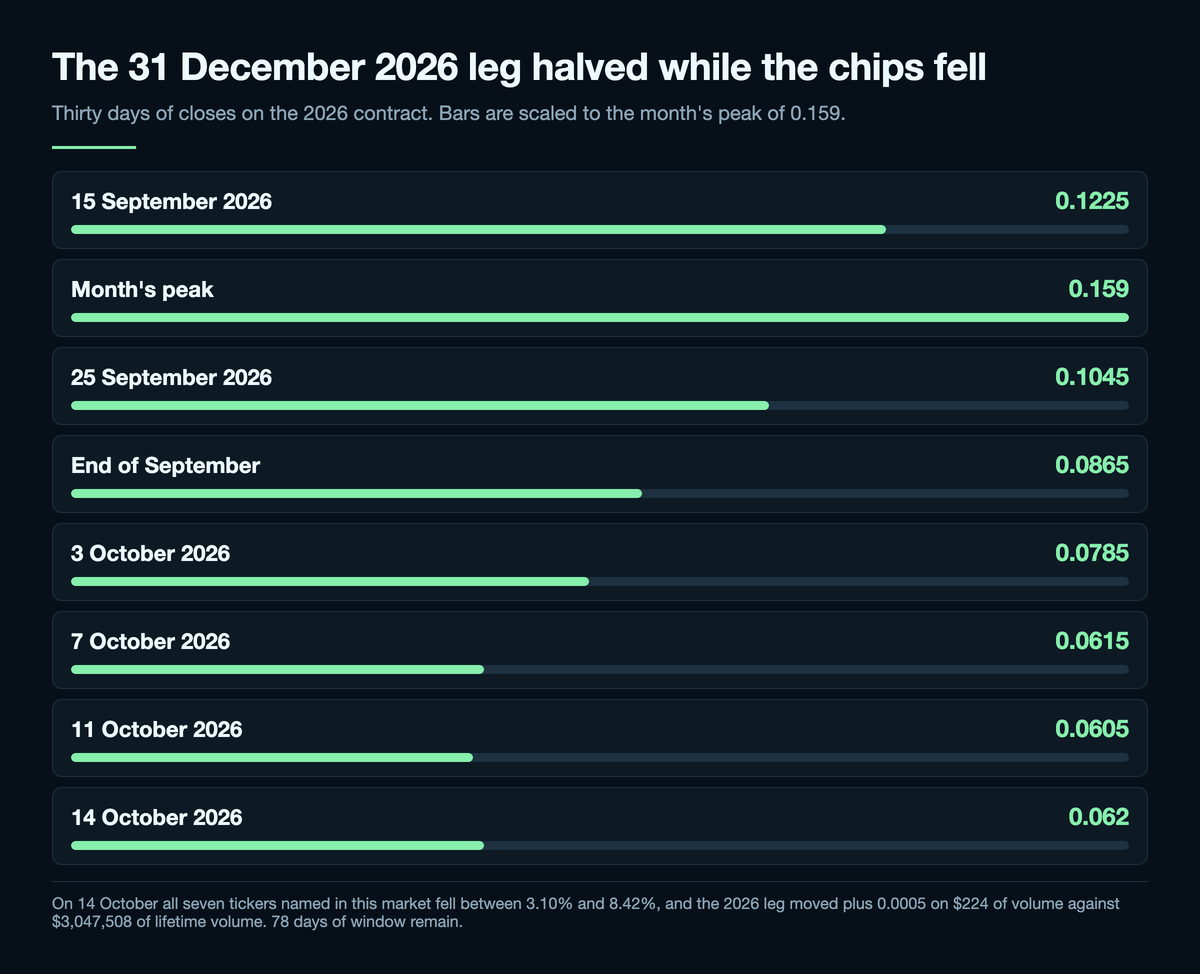
The 2026 leg's thirty-day path: 0.1225 on 15 September, 0.159 at the month's peak, 0.1045 on 25 September, 0.0865 through the end of the month, 0.0785 on 3 October, 0.0615 on 7 October, 0.0605 on 11 October and 0.062 tonight. That is a halving across a month in which the semiconductor complex went into a genuine drawdown.
Nothing about that is irrational. The 2026 leg asks for three conditions inside a 90-day window that ends on 31 December, so the earliest such window can now have begun is 3 October. There are 78 days left. Every day that passes without a second condition firing removes window, and the price decays whether or not the underlying risk rose. A 20% drawdown in SOXX is not a 40% drawdown, and the contract pays on the threshold, not on the direction.
Tonight sharpens the point. A hotter-than-expected September inflation print sent the S&P 500 down 1.1% and the Nasdaq down 1.9%, their worst session since July, and all seven tickers named in this market fell: SMCI 8.42%, ANET 4.45%, SOXX 4.50%, ASML 3.94%, TSMC 3.40%, NVDA 3.16% and AVGO 3.10%. Gamma reports the 2026 leg's one-day price change as plus 0.0005, on $224 of 24-hour volume against $3,047,508 of lifetime volume.
So the honest description of tonight is that the market did not reprice at all. Traders who hold the NO side are being paid for the calendar, and the calendar is doing more work than the tape.
The June 2027 contract is the one worth reading
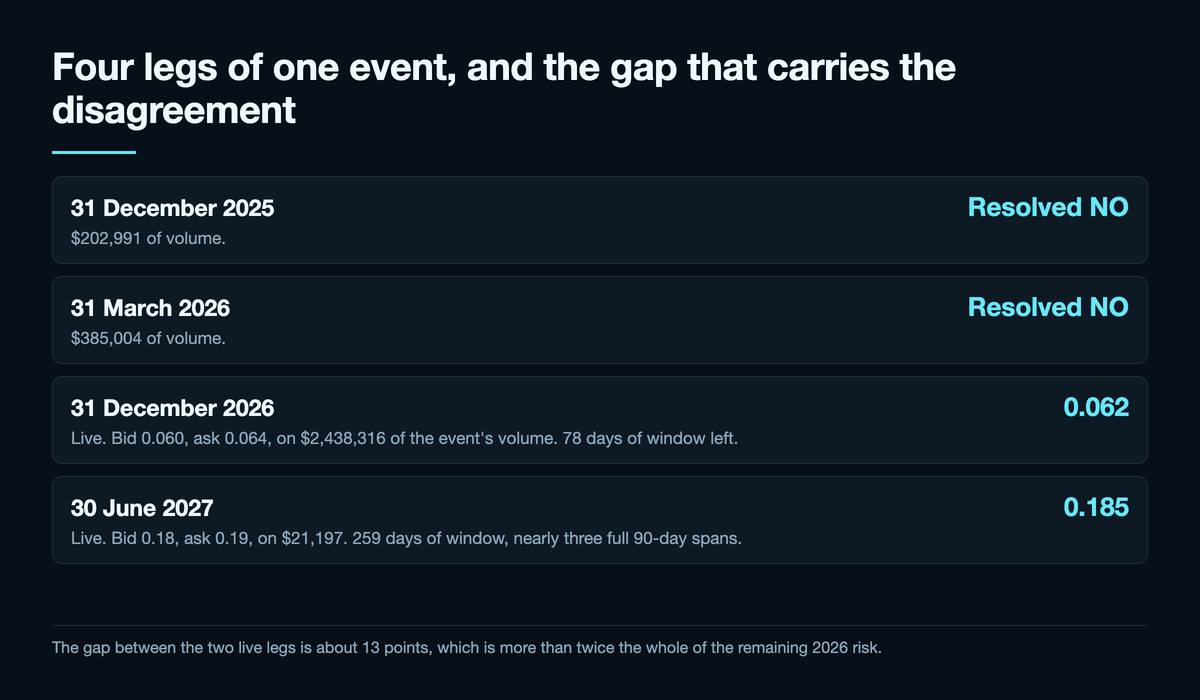
The event carries four legs and two of them are already settled. The 31 December 2025 leg resolved NO on $202,991 of volume. The 31 March 2026 leg resolved NO on $385,004. The 31 December 2026 leg is live at 0.062, with a 0.060 bid and a 0.064 ask, and carries $2,438,316 of the event's volume on its own. The 30 June 2027 leg is live at 0.185, bid 0.18 and ask 0.19, on $21,197.
The 2027 leg is where the actual disagreement sits, and it is the leg the news coverage skips. It has 259 days of window rather than 78, which is nearly three full 90-day spans, so it is far less exposed to the decay that has been grinding the 2026 price down. Its own thirty-day range has been narrow by comparison: 0.235 at the high on 27 September, 0.15 on 28 September, and 0.185 for most of the last week.
Read together, the two live legs say something specific. The market puts roughly a 6% chance on three tripwires tripping in the next 78 days and roughly a 19% chance on it happening by the end of June 2027. The gap between them is the probability traders assign to a first-half-2027 downturn, and at about 13 points it is more than twice the whole of the remaining 2026 risk. A contract priced in single digits is not a contract that thinks nothing can go wrong. It is a contract that has run out of calendar.
What Polymarket's own bankruptcy markets say about condition three
Condition three asks for an OpenAI or Anthropic bankruptcy, and Polymarket prices each of those separately, which gives us a cross-check no competitor page runs. The numbers come from the same API read at 21:21 UTC.
Anthropic announces bankruptcy by...? carries $1,788,350 of lifetime volume on $807,542 of resting book, by far the deepest of these. Its legs: 9.5% by 31 December 2027 (bid 0.09, ask 0.10), 18.5% by 2028 and 25.5% by 2029. OpenAI announces bankruptcy by...? carries $324,786 of volume and prices 7.5% by 2027, 16.5% by 2028 and 21.5% by 2029.
On the acquisition side, Anthropic acquired before 2027? trades at 0.0285 on $30,465 of volume, and OpenAI acquired before 2027? at 0.0275 on $4,912 with a wide 0.014 to 0.041 spread that tells you the book is close to empty.
Two readings follow. First, the bankruptcy condition is not a tail that traders price at zero; a combined 2027 read on either lab filing is in the mid teens, which is a real number for an event of that severity. Second, none of it helps the 2026 leg, because those markets' nearest deadline is 31 December 2027, a full year past the window the 2026 contract can use. The conditions most likely to fire inside 78 days remain the two price thresholds, and those need SOXX down another 24% and NVIDIA down another 46%.
The book is thinner than the volume suggests
A $3,047,508 lifetime figure sounds like a liquid market and the event's live book does not match it. Total liquidity across the event reads $51,411 with $119,189 of open interest, and the 2026 leg holds $41,693 of that.
On the YES side of the 2026 leg the book shows 36 bid levels against 103 ask levels. The best bid is 0.060 for 2,489.92 shares and the next four are 0.058 for 115.11, 0.057 for 455, 0.056 for 313 and 0.055 for 229. Summed across every level, the resting bids are worth roughly $4,345. The best ask is 0.064 for only 130 shares.
That asymmetry is what a market looks like when the consensus has settled. If you hold YES and want out, there is about four thousand dollars of demand beneath you and then a gap; one average-sized exit walks the price down several hundredths. Backing NO is comfortable at these levels and pays 0.938 to receive a dollar, which is a 6.6% gross return over 78 days, around 33% annualised before you account for the risk of being wrong about a contract whose resolution hinges on the reading of a continuing state.
Five checks before you trade AI bubble burst odds
First, read the six conditions and price each one separately. A headline percentage is a blend of six thresholds with wildly different distances to trip, and the blend hides which one is actually doing the work.
Second, count the window, not the deadline. With 78 days left on the 2026 leg, any qualifying window has already started, so a condition firing in March 2027 does nothing for a December 2026 contract.
Third, settle the SMCI question for yourself before sizing anything. Whether a continuing 69.88% drawdown counts as an occurring event is the difference between needing two more conditions and needing three, and the resolution text does not answer it cleanly.
Fourth, check the book and not the lifetime volume. $3.0M of cumulative turnover sits on about $4,345 of resting bids, and a position you cannot exit at a sane price is not the position you modelled.
Fifth, separate the trade from the thesis. You can believe AI capital spending is unsustainable and still think this contract resolves NO, because the contract is not asking your question. That is the single most common error we see in the comments on these markets.
Everything here is market data and context, not financial advice. Odsage is an independent information site and is not affiliated with Polymarket. The prices in this article were read at 21:21 UTC on 14 October 2026 and equity closes are from the 14 October 2026 session; all of them will have moved since.
FAQ
Frequently asked questions
What are the current AI bubble burst odds on Polymarket?
Read at 21:21 UTC on 14 October 2026, the 31 December 2026 leg pays 0.062 with a 0.060 bid and a 0.064 ask, and the 30 June 2027 leg pays 0.185 with a 0.18 bid and a 0.19 ask. The event has $3,047,508 of lifetime volume. Two earlier legs, for the ends of 2025 and the first quarter of 2026, both resolved NO.
How does the AI bubble burst market actually resolve?
It needs at least three of six named events inside a single 90-day window that ends no later than the leg's deadline. Five of the six are numerical thresholds: NVIDIA down 50% from its all-time high, SOXX down 40%, H100 rentals at or below $1.00 for five straight days, and TSMC, ASML, Broadcom, Arista or Super Micro down 50%. The sixth is an OpenAI or Anthropic bankruptcy, with an OpenAI acquisition as a separate condition. The rules state that reporting of a downturn does not count on its own.
Has any of the six conditions already been met?
Yes, on its face. Super Micro Computer closed at $35.78 on 14 October 2026 against an all-time closing high of $118.81 in March 2024, a 69.88% drawdown, and the hardware-supplier condition asks only for 50%. Whether a continuing drawdown counts as an event occurring inside a 90-day window is the open question, and the resolution text does not settle it.
Why did the odds fall while AI and chip stocks were selling off?
Mostly the calendar. The 2026 leg needs three conditions inside a 90-day window ending 31 December, and only 78 days remain, so each quiet day removes window regardless of what prices do. A 20.70% SOXX drawdown is also not the 40% the condition requires. On 14 October all seven named tickers fell between 3.10% and 8.42% and the 2026 leg moved plus 0.0005 on $224 of volume.
Will the AI bubble burst in 2027 according to the market?
The 30 June 2027 leg prices it at 18.5%, roughly three times the 2026 leg, on 259 days of window instead of 78. The gap of about 13 points is the probability traders put on a qualifying downturn in the first half of 2027 specifically. It is the leg where the real disagreement sits, and the one most coverage leaves out.
Is the AI bubble burst contract liquid enough to trade?
Not as liquid as its volume implies. The event shows $51,411 of total liquidity and $119,189 of open interest against $3,047,508 of lifetime turnover, and the 2026 leg's YES side carries roughly $4,345 of resting bids across 36 levels. Backing NO is straightforward at 0.938; exiting a YES position of any size is not.
Sources and methodology
Sources used for this guide
Odsage combines public source links with prediction-market context, related market pages, calculator workflows, and visible FAQ content. Market prices are informational and are not financial advice.