Prediction Markets
AI Data Center in Space Odds: 1.3% by End of 2026
AI data center in space odds are 1.3% for 2026, 16.5% for 2027. The contract wants 100 accelerators in orbit. The biggest launch yet carried four TPUs.
Key takeaways
- Polymarket prices an AI data center in space at 1.35% by 31 December 2026 and 16.5% by 31 December 2027, read from the Gamma API on 11 November 2026. The event has traded $85,157 in total volume since it opened on 14 May 2026.
- The threshold, not the concept, is what the contract turns on: a qualifying spacecraft must carry at least 100 data-center-grade AI accelerators. Google's Suncatcher prototype carries four TPUs and can run only one at a time. Starcloud-1 carries a single H100.
- Both rungs have fallen all year while the sector raised money and launched hardware. The 2026 rung went from 8.5% on 14 May to 1.35%; the 2027 rung went from 41% to 16.5%, a 24.5-point unwind.
- The sharpest recent move ran against the news. The 2027 rung sat at 23.5% on 3 November, then fell to 16.5% by 7 November, across the same week Elon Musk posted that data centers in space were looking appealing and teased orbital supercomputers with NVIDIA.
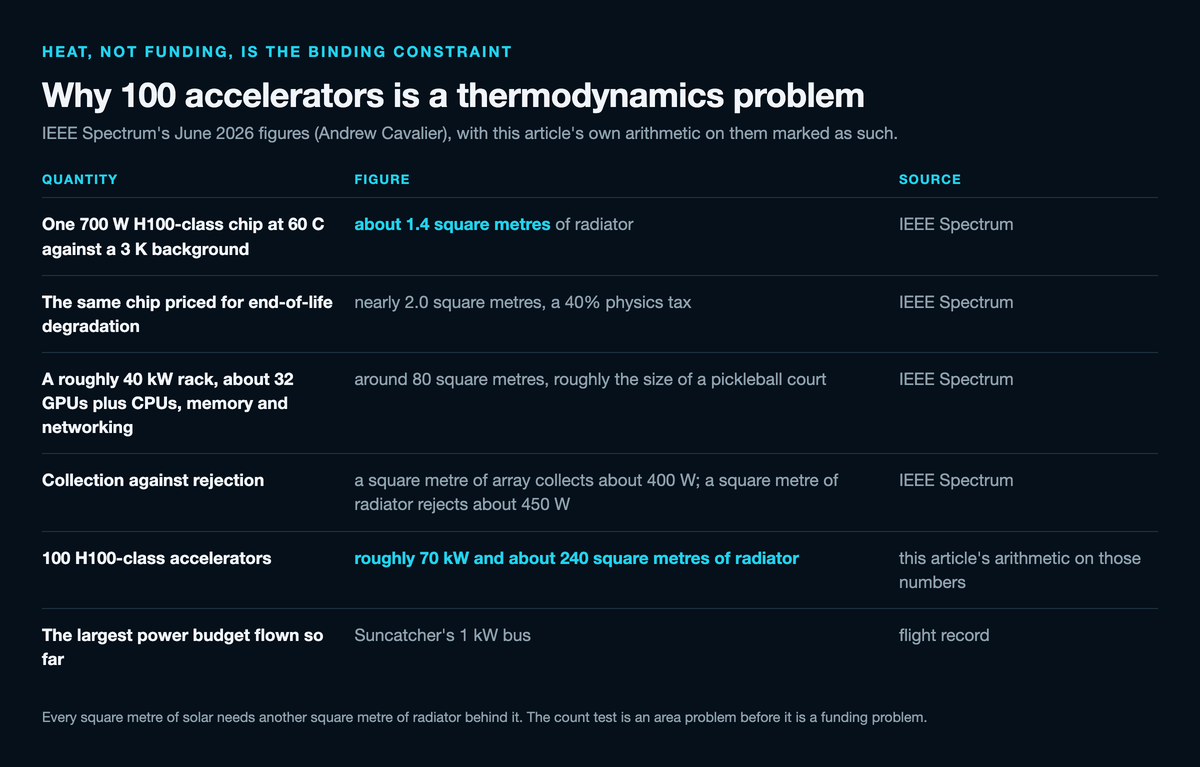
- At IEEE Spectrum's published radiator figures, 100 H100-class parts is roughly 70 kW of continuous heat and about 240 square metres of radiator. The largest power budget flown so far is Suncatcher's 1 kW bus.
On this page
Google has a satellite in orbit that has been asked to write poetry, Starcloud has had an NVIDIA H100 up there for a year, and Elon Musk spent the first week of November telling everyone that data centers in space are looking appealing. Read only the headlines and you would price an orbital data center as something that has already happened. Polymarket puts the AI data center in space odds at 1.35% for 2026 and 16.5% for 2027, and the distance between the headlines and those two numbers is not skepticism about the engineering. It is one clause in the contract.
A market this far out of line with the news flow is either mispriced or misread, and there is no third option. We pulled the event from Polymarket's Gamma API on 11 November 2026, read both rungs' resolution text in full, and rebuilt the price history from the CLOB daily series, 177 daily points for the 2026 rung and 178 for the 2027 one. Then we checked every payload that has flown against the one number that decides this market.
On this page we work through it in order:
1. What the contract actually requires, clause by clause.
2. The two rungs, their prices, their spreads and their liquidity.
3. What is genuinely in orbit today: one GPU and four TPUs.
4. The six-month unwind, from 41% to 16.5%.
5. The week the market sold the news.
6. Why 100 accelerators is a thermodynamics problem before it is a funding problem.
7. What would actually have to launch for either rung to pay.
8. Five checks to run before you trade it.
What the contract actually requires
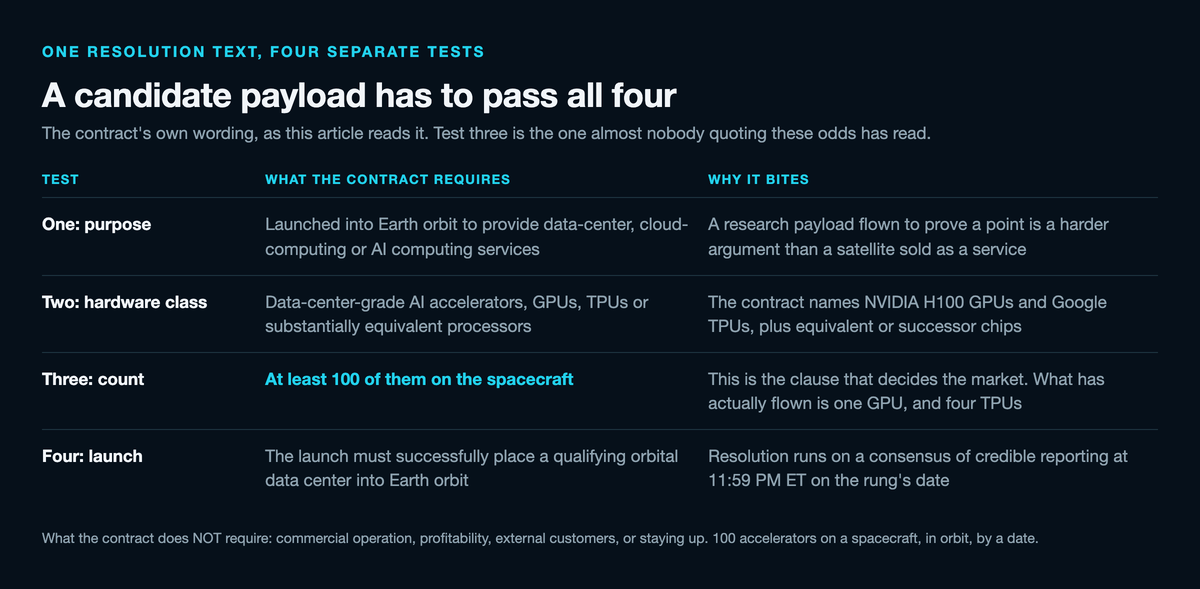
Both rungs share one resolution text, and it is unusually specific for a market about a technology this young. Read it as four separate tests, because a candidate payload has to pass all four and the coverage you will find elsewhere does not mention the third one at all.
Test one, the purpose test: the spacecraft must be launched into Earth orbit for the purpose of providing data-center, cloud-computing or artificial-intelligence computing services. A research payload flown to prove a point is a harder argument than a satellite sold as a service.
Test two, the hardware class test: the compute must be data-center-grade AI accelerators, GPUs, TPUs or substantially equivalent processors. The contract names NVIDIA H100 GPUs and Google TPUs as its examples, along with equivalent or successor chips.
Test three, the count test: the spacecraft must include at least 100 of them. This is the clause that decides the market, and it is the clause almost nobody quoting these odds has read.
Test four, the launch test: the launch must successfully place a qualifying orbital data center into Earth orbit. Resolution runs on a consensus of credible reporting, at 11:59 PM ET on the rung's date.
Notice what the contract does not say. It does not require the thing to be commercially operating, to be profitable, to serve external customers, or to stay up. It requires 100 accelerators on a spacecraft, in orbit, by a date. That is a far lower bar than a working orbital data center and a far higher bar than anything flown so far, which is why this market behaves so strangely against the news.
AI data center in space odds, rung by rung
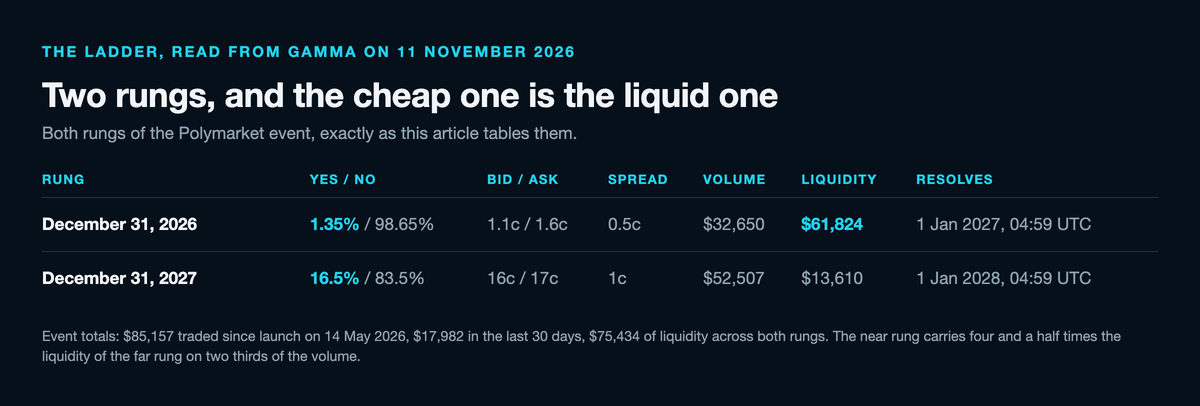
The event is a two-rung ladder rather than a single yes-or-no question, which makes it more informative than most. Here is the full state of both rungs as read from Gamma on 11 November 2026:
December 31, 2026 rung - 1.35% Yes, 98.65% No. Best bid 1.1c, best ask 1.6c, spread 0.5c. Volume $32,650, liquidity $61,824. Resolves 1 January 2027 at 04:59 UTC.
December 31, 2027 rung - 16.5% Yes, 83.5% No. Best bid 16c, best ask 17c, spread 1c. Volume $52,507, liquidity $13,610. Resolves 1 January 2028 at 04:59 UTC.
Event totals - $85,157 traded since launch on 14 May 2026, $17,982 in the last 30 days, $75,434 of total liquidity across both rungs.
Two things in that table matter more than the headline percentages. First, the near rung carries four and a half times the liquidity of the far rung on two thirds of the volume, so the cheap lottery ticket is the easier side to size and the interesting question is the harder one to trade. Second, the 2027 rung's 1c spread on a 16.5c mid is a 6% round trip, which eats a lot of a thesis that needs to be right about a launch schedule 13 months out.
Read as a conditional, the ladder says something sharper than either number alone. If 2026 is 1.35% and 2027 is 16.5%, the market is pricing roughly a 15-point chance that the first qualifying launch happens specifically in calendar 2027, and treating the remaining 83.5% as slipping to 2028 or later. That is a view about manifests and payload sizes, not about whether orbital compute is a good idea.
What is actually in orbit: one GPU and four TPUs
Two spacecraft are doing the work that generated this year's headlines, and neither is close to the count test. Both are real, both did what they claimed, and both are an order of magnitude or two below the bar.
Starcloud-1 launched on a SpaceX Falcon 9 on 2 November 2025 carrying a single NVIDIA H100. NVIDIA's own announcement describes a 60 kg satellite about the size of a small fridge and claims roughly 100 times more GPU compute than anything previously flown, which tells you how little compute had been in orbit before it. It ran Google's Gemma in December 2025 and performed in-orbit training of nanoGPT. One accelerator against a threshold of 100.
Google's Project Suncatcher prototype reached orbit in October 2026 on a Falcon 9 rideshare alongside more than 100 other spacecraft, built in partnership with Planet Labs. It carries four Google TPUs and generates up to 1 kW. TechCrunch's reporting, including its own correction, notes that only one of the four TPUs can operate at a time and that power limits it to roughly 20-minute runs. Four accelerators, one of them live, against a threshold of 100.
Neither of those is a failure. Suncatcher ran Gemma 4 in orbit and Google plans two further satellites in 2027 with higher power and optical inter-satellite links. Its published design study models an 81-satellite cluster at 650 km in a dawn-dusk sun-synchronous orbit, and reports that the Trillium v6e TPU survived a 67 MeV proton-beam test. That is a credible roadmap whose next flown step is two satellites, not 100 chips on one.
The nearest thing to a step change is Starcloud-2, announced in March 2026 and since slipped from an October 2026 target. Reported hardware is a mixed payload, multiple GPUs including an NVIDIA Blackwell part, an AWS server blade and bitcoin mining ASICs, on a bus of roughly 8 kW. Starcloud has the money for it, having raised $170M at a $1.1B valuation in March 2026 and $250M at $2.3B in August with $25M from NVIDIA. Its published accelerator count is the thing nobody has stated.
The six-month unwind: 41% down to 16.5%
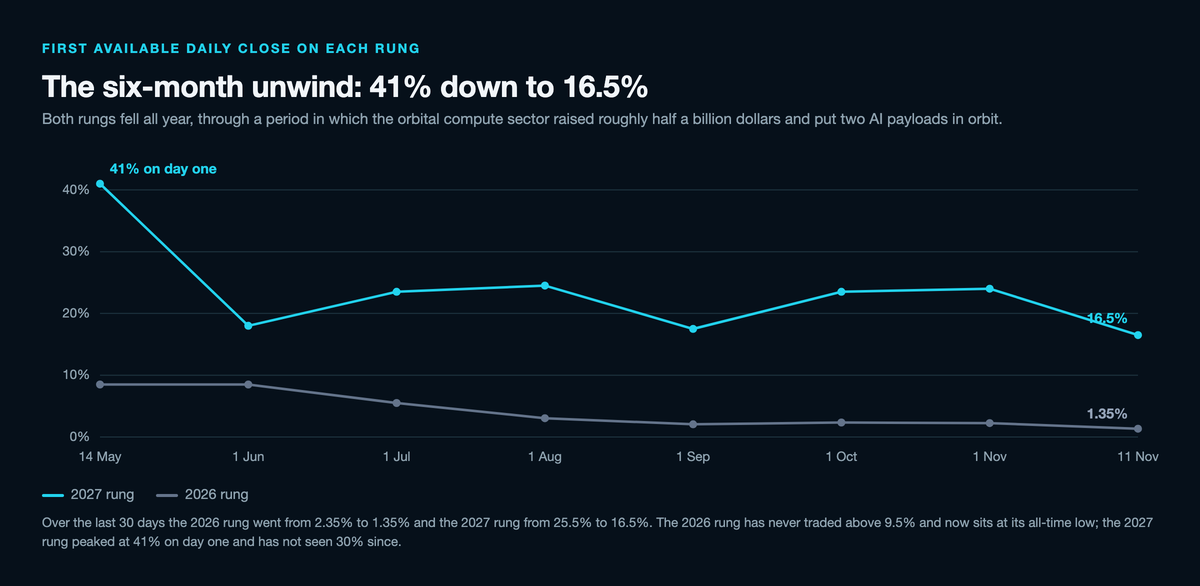
This is the part that is hard to see without the price history, and it is the strongest evidence that the market is reading the contract rather than the news. Both rungs have fallen all year, through a period in which the orbital compute sector raised roughly half a billion dollars and put two AI payloads in orbit.
Month by month, first available daily close on each rung, 2026 rung then 2027 rung:
14 May 2026, the event's first day - 8.5% and 41%.
1 June 2026 - 8.5% and 18%.
1 July 2026 - 5.5% and 23.5%.
1 August 2026 - 3.05% and 24.5%.
1 September 2026 - 2.05% and 17.5%.
1 October 2026 - 2.35% and 23.5%.
1 November 2026 - 2.25% and 24%.
11 November 2026 - 1.35% and 16.5%.
Over the last 30 days alone the 2026 rung went from 2.35% to 1.35% and the 2027 rung from 25.5% to 16.5%. Across the full history the 2026 rung has never traded above 9.5% and now sits at its all-time low; the 2027 rung peaked at 41% on day one and has not seen 30% since.
The naive reading is that traders lost faith in orbital compute. The reading that fits the data better is that each launch resolved an unknown in the bears' favour. In May the question was open: nobody knew what payload size the first serious attempt would carry. By November the answer was on the public record twice over, at one chip and at four, and a count test of 100 looks very different once you have seen what a real first-generation bus actually flies.
The week the market sold the news
The first week of November gave this market the cleanest test it will get: a burst of extremely bullish noise from the single most credible launch provider on Earth, and a price that went the other way.
On 4 November, after local voters rejected data center proposals in 40 of 41 ballot measures, Musk posted that data centers in space were looking pretty appealing right now. On 6 November he teased orbital supercomputers developed with NVIDIA, with reporting putting a 2027 target on them. SpaceX had already filed with the FCC in January 2026 for up to one million orbital compute satellites, and secondary reporting describes a first-generation design with a compute payload in the 150 to 250 kW range, which is the first number in this whole story large enough to clear the count test on a single spacecraft.
Here is what the 2027 rung did across that week, daily closes:
3 November - 23.5%. 4 November - 23.5%. 5 November - 20%. 6 November - 18.5%. 7 November - 16.5%, then flat at 16.5% through 11 November.
Seven points off the far rung in four days, while the loudest possible bull case was being made in public. The 2026 rung did the same thing a day earlier, from 2.25% on 3 November to 1.55% on the 4th and 1.35% on the 5th, where it has stayed.
There is no way to know the motive of the flow and we are not going to invent one. What the price implies is a market treating an unnamed, undated spacecraft programme as evidence the first qualifying launch is further away, not closer. If you think a SpaceX and NVIDIA orbital compute satellite genuinely flies in 2027 with a 150 kW payload, 16.5% is the cheapest that view has been since September.
Why 100 accelerators is a physics problem first
Funding is not the binding constraint on the count test. Heat is. In vacuum there is no air and nothing to conduct into, so a spacecraft can shed waste heat only by radiating it, which leaves radiator area as the only design variable you really control.
IEEE Spectrum's June 2026 analysis by Andrew Cavalier puts hard numbers on it. A single 700 W H100-class chip held at 60 C against a 3 K background needs about 1.4 square metres of radiator, rising to nearly 2.0 square metres once end-of-life degradation is priced in, a 40% physics tax. A roughly 40 kW rack, about 32 GPUs plus CPUs, memory and networking, needs around 80 square metres, which the piece describes as roughly the size of a pickleball court. And because a square metre of array collects about 400 W while a square metre of radiator rejects about 450 W, every square metre of solar needs another square metre of radiator behind it.
Run the count test through those figures. This is our arithmetic on their numbers, not a quoted result: 100 H100-class accelerators is about 70 kW of continuous load, a little under three of those 40 kW racks, and on the order of 240 square metres of radiator before the array to power it. Suncatcher's entire bus generates 1 kW. Starcloud-2 is reported at roughly 8 kW. The threshold sits around 70 times the largest power budget flown and nine times the largest announced.
That is the whole explanation for a 1.35% near rung, and it is why the count test is a better question than it first looks. A market that asked whether an orbital data center exists would be an argument about definitions. A market that asks for 100 accelerators is asking whether anyone can fly 70 kW of continuous thermal load, which is an engineering schedule rather than an opinion.
One caveat cuts the other way, and it is the strongest bull argument in the contract. The hardware clause says accelerators or substantially equivalent processors, with no power floor. A payload of many smaller inference parts rather than 700 W flagships could clear 100 units on a far smaller thermal budget. Nobody has announced that spacecraft, but the wording permits it, and it is the likeliest route to a surprise Yes.
What would have to launch for an AI data center in space to resolve Yes
Filings are not spacecraft, and this is where most sector coverage loses the thread. The New Space Economy market landscape published on 4 November 2026 counts five US FCC filings requesting up to 1,259,600 compute satellites between them: SpaceX and xAI at 1,000,000, Orbital at 100,000, Starcloud at 88,000, Blue Origin at 51,600 and Cowboy Space at 20,000. That is 1.26 million satellites of paperwork against a flown total of five accelerators.
So the honest answer to what resolves this market is a short list, and each entry carries the same missing field:
Starcloud-2, now reported for early 2027 on a Falcon 9, roughly 8 kW, mixed GPU and ASIC payload. Accelerator count not published. At 8 kW it cannot host 100 flagship parts, though the substantially-equivalent clause leaves room.
Google and Planet Labs, two Suncatcher satellites in 2027 with higher power and optical links. Per-satellite TPU count not published; the prototype flew four.
SpaceX and NVIDIA orbital compute, teased 6 November 2026 for 2027, reported payload 150 to 250 kW. No spacecraft name, no launch date, no filed mission. This is the only candidate whose reported power budget clears 70 kW comfortably.
Anything from the Chinese programmes or the remaining filings, where disclosure is thinner still and per-satellite accelerator counts are not independently verified.
That list is the case for 16.5% rather than 2% on the far rung, and also the case against 40%. One candidate is big enough and has no confirmed date; two have dates and are probably too small; the rest are filings. If you want to trade this, the thing to watch is not funding announcements or constellation filings. It is the first published per-spacecraft accelerator count that starts with a three-digit number.
Five checks before you trade this market
First, re-read the count test before you price anything. Every piece of bullish coverage you will read describes spacecraft that fail it, and most of it never mentions a chip count at all. The contract is the only document that matters here.
Second, price the spread. A 1c spread on the 2027 rung's 16.5c mid is a 6% round trip, and the far rung carries only $13,610 of liquidity. A thesis that needs 13 months to play out pays that cost up front.
Third, separate filings from manifests. A 1.26 million satellite paper trail has no bearing on whether 100 accelerators reach orbit by a date, and the market has already demonstrated that it treats the two differently.
Fourth, watch power budgets, not valuations. Kilowatts on a published bus spec translate to accelerator counts through the radiator maths above. Funding rounds do not.
Fifth, treat the near rung as what it is. At 1.35% with 36 days to run, nothing flies that is not already on a manifest, and the 1.1c bid versus 1.6c ask on a one-cent instrument is a punishing round trip for either side.
None of this is financial advice, and a 1.35% price is not a prediction that something is impossible. It is the market saying it has seen what the first generation of orbital AI hardware actually weighs, and 100 chips is not this year's problem.
FAQ
Frequently asked questions
What are the odds of an AI data center in space?
Polymarket prices it at 1.35% by 31 December 2026 and 16.5% by 31 December 2027, read from the Gamma API on 11 November 2026. Both rungs share one resolution rule that requires a spacecraft carrying at least 100 data-center-grade AI accelerators to be successfully launched into Earth orbit by the rung's date.
Why is the 2026 market at 1.3% when satellites with AI chips are already in orbit?
Because the contract needs 100 accelerators on a qualifying spacecraft, and the two AI payloads in orbit carry one and four. Starcloud-1 flew a single NVIDIA H100 in November 2025 and Google's Suncatcher prototype carries four TPUs. Both are genuine orbital AI demonstrations, and both are far below the count the market asks for.
How many TPUs does Google's Suncatcher satellite carry?
Four, on a satellite built by Planet Labs that reached orbit in October 2026 on a Falcon 9 rideshare. Reporting on the mission, including a published correction, notes only one of the four can operate at a time and that its 1 kW power budget limits runs to roughly 20 minutes. It ran Gemma 4 in orbit.
Does Starcloud-1 count as an orbital data center for this market?
No. It carries one NVIDIA H100 and the resolution text asks for at least 100. NVIDIA's announcement describes a 60 kg satellite about the size of a small fridge with roughly 100 times more GPU compute than anything previously in orbit, which says more about how empty orbit was than about clearing this threshold.
What would make the 2027 market resolve Yes?
A single spacecraft with a three-digit accelerator count reaching orbit before 31 December 2027. On reported figures the only candidate with a large enough power budget is the SpaceX and NVIDIA satellite teased in November 2026, put at 150 to 250 kW by secondary reporting, with no announced name, filed mission or launch date. Starcloud-2 at roughly 8 kW and Google's two 2027 satellites are probably too small unless they use many lower-power parts.
Why did the odds fall when Elon Musk talked up data centers in space?
The 2027 rung went from 23.5% on 3 November 2026 to 16.5% by 7 November, across the week Musk posted that data centers in space were looking appealing and teased orbital supercomputers with NVIDIA. The motive of the flow is unknowable, but the price implies traders read an unnamed, undated programme as evidence the first qualifying launch is further out.
How much does a 100-accelerator spacecraft have to shed in heat?
Roughly 70 kW of continuous load at 700 W per H100-class part. Using the radiator figures IEEE Spectrum published in June 2026, about 80 square metres per 40 kW rack, that is on the order of 240 square metres of radiator before the array needed to power it. That arithmetic is ours, applied to their published numbers.
Is this market liquid enough to trade?
It is thin. The event has traded $85,157 since 14 May 2026 and $17,982 in the last 30 days. The 2026 rung holds $61,824 of liquidity with a 1.1c bid against a 1.6c ask; the 2027 rung holds $13,610 with a 1c spread on a 16.5c mid, about a 6% round trip. Size against those numbers, not the headline probability.
Sources and methodology
Sources used for this guide
Odsage combines public source links with prediction-market context, related market pages, calculator workflows, and visible FAQ content. Market prices are informational and are not financial advice.