Prediction Markets
AI Regulation Odds 2026: 11% on a Federal AI Law
AI regulation odds price a federal AI safety law at 11% for 2026, down from 43% last November. Four provisions decide the payout, and nobody quotes them.
Key takeaways
- AI regulation odds on a federal AI safety law signed before 2027 read 11.0% mid, 10 bid against 12 ask, on $166,032 of lifetime volume and $31,218 of book liquidity. The spread is two cents, which makes this one of the few AI markets on Polymarket you can actually trade at the headline number.
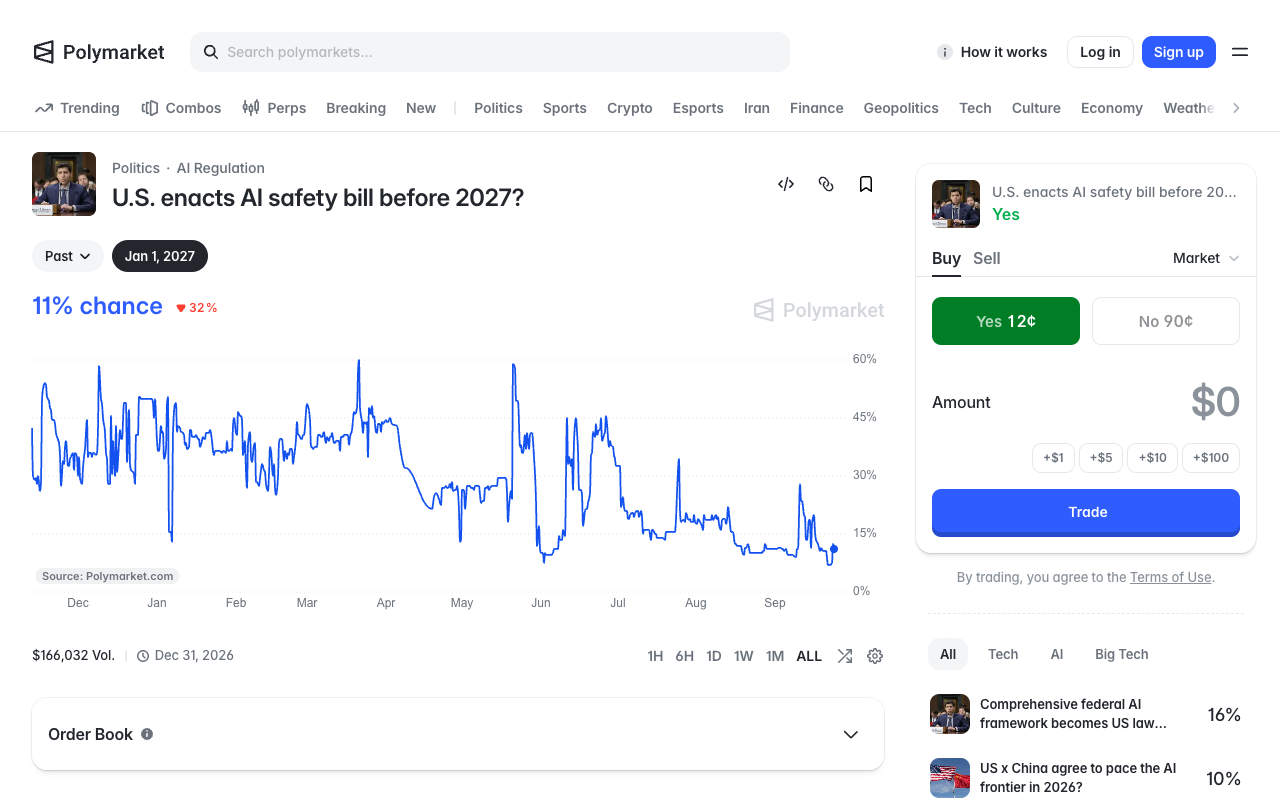
- The market has repriced from a 42.5% first print on 13 November 2025 to 11.0% today. Monthly averages fall almost without interruption: 38.9% in November, 41.9% in March, 19.2% in July, 12.3% so far in September.
- Four provisions decide the payout, and none of them is transparency or auditing. The contract needs a prohibition on creating or releasing specific models, a training restriction, a usage restriction, or a human-in-the-loop requirement signed into federal law by 31 December 2026.
- On its published contours the Great American AI Act, the only live federal vehicle, would not obviously resolve this market Yes. Its 4 June 2026 discussion draft is transparency reporting plus independent audits for developers above $500M in revenue, which is not on the list of four.
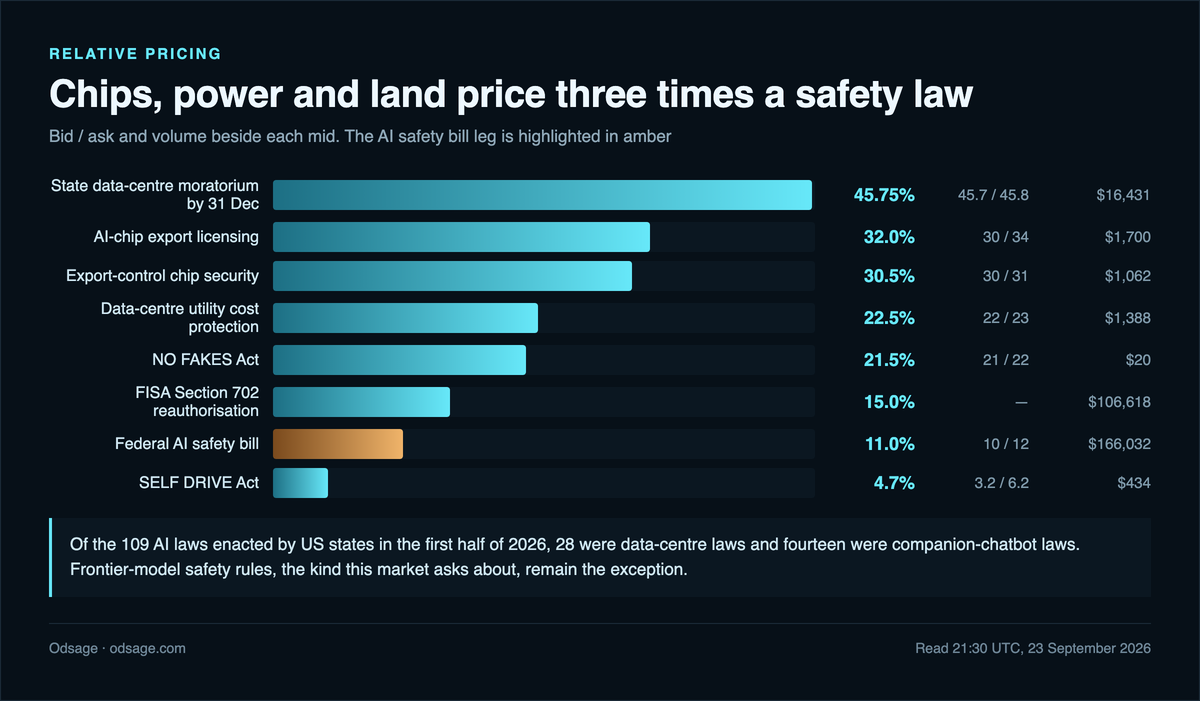
- Where the market does expect movement is chips and electricity, not safety. AI-chip export licensing prices at 32.0% to become law in 2026, export-control chip security at 30.5% and data-centre utility cost protection at 22.5%, all roughly three times the odds on a safety bill.
On this page
Every price on this page was read from the Polymarket Gamma and CLOB APIs at about 21:30 UTC on 23 September 2026, and quoted with its bid and ask rather than the midpoint alone. Here that matters less than usual: the main market has a two-cent spread, which is rare enough in this corner of the site to say up front.
1. AI regulation odds today: the federal safety-bill contract, its book, and its money.
2. The four provisions that decide the payout, straight from the resolution text.
3. Ten months of repricing, month by month, from 42.5% to 11%.
4. The June spike, the Great American AI Act, and why the market gave it all back.
5. Where the market does expect Congress to act: chips, data centres and electricity.
6. The December 2025 executive order, and why a market on statutes barely moved for it.
7. What the labs are priced to do instead of being regulated.
8. How to read these odds without getting burned, and what would move them before December.
AI regulation odds today: 11% on a federal AI safety law
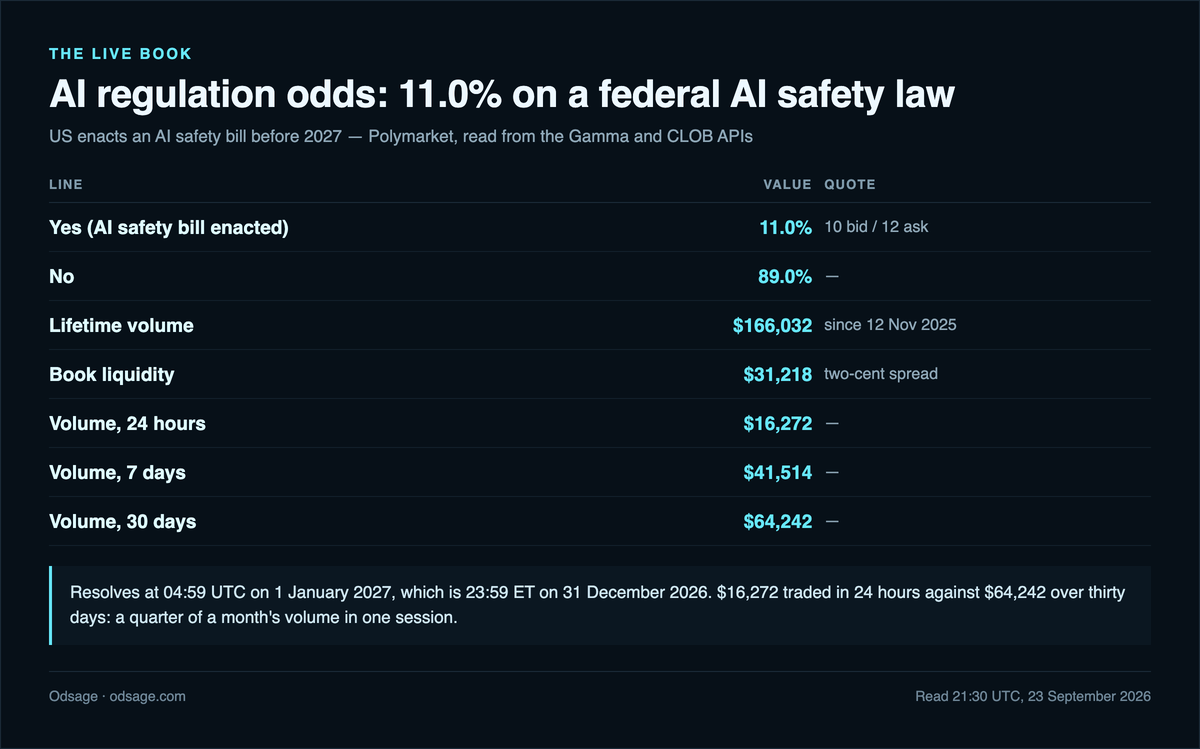
Search AI regulation odds and you will mostly find the number 13%, lifted from a late-May write-up and repeated since. It is not the live price. The contract asking whether the United States enacts an AI safety bill before 2027 trades at 11.0% this evening, on a 10 bid against a 12 ask.
Here is the whole book, read at 21:30 UTC on 23 September 2026.
Yes: 11.0% mid, 10 bid, 12 ask. No: 89.0% mid.
Lifetime volume: $166,032. Book liquidity: $31,218.
Rolling volume: $16,272 in 24 hours, $41,514 over seven days, $64,242 over thirty.
Opened 12 November 2025. Resolves at 04:59 UTC on 1 January 2027, which is 23:59 ET on 31 December 2026.
Two things in that block matter more than the headline. The first is the spread: two cents wide on a contract three months from resolution is a working book, not a marker, and it means the 11% you read is close to a price you could be filled at in size. Most AI markets we cover quote mids sitting in the middle of a thirty-point void.
The second is the $16,272 that changed hands in the last day against $64,242 in the last month. A quarter of a month's volume in one session, on a market that has drifted for weeks, is a book still being actively repriced rather than left to decay. Traders are not walking away from this question. They are agreeing on the answer.
That answer is stark against how much AI policy noise 2026 has produced. Twenty-nine states enacted AI legislation in the first half of the year, 109 laws by 1 July, and the federal government has produced an executive order, a bipartisan discussion draft and a litigation task force. The market that has to pay out on a federal statute gives it eleven cents on the dollar.
The four provisions that actually decide this market
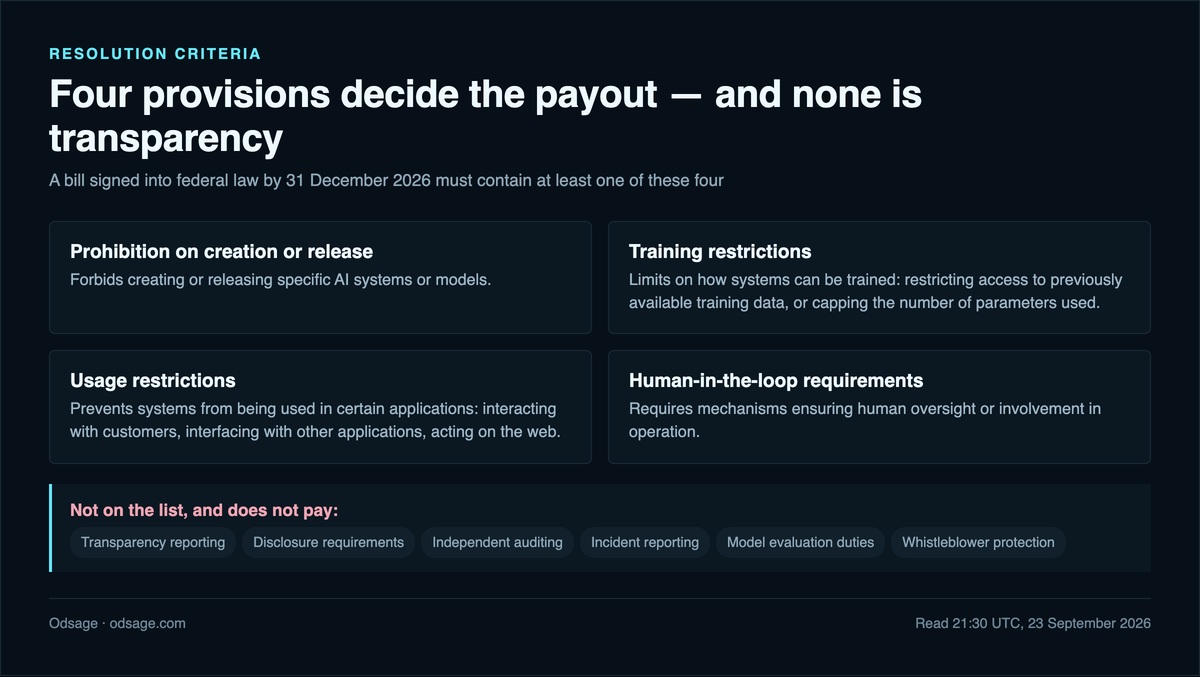
This is the part every secondhand summary skips, and it is the part that matters most. The market does not resolve Yes because Congress passes something about AI. It resolves Yes only if a bill signed into federal law by 31 December 2026 contains at least one of four specific provisions, named in the contract text.
Prohibition on creation or release: forbids creating or releasing specific AI systems or models.
Training restrictions: limits on how AI systems can be trained, such as restricting access to previously available training data, or capping the number of parameters used in training.
Usage restrictions: prevents AI systems from being used in certain applications, such as interacting with customers, interfacing with other applications, or performing actions on the web.
Human-in-the-loop requirements: requires AI systems to include mechanisms ensuring human oversight or involvement in their operation.
The resolution source is official United States federal government material, Congress.gov being the example given, though a consensus of credible reporting may also be used.
Read that list twice and notice what is missing. No transparency provision. No disclosure or reporting requirement. No auditing mandate, no incident-reporting duty, no model-evaluation obligation, no whistleblower protection. Every one of those is a live idea in American AI policy in 2026, and none of them, on its own, pays this contract.
That gap between what the market is called and what it says is the most useful thing a trader can know here. Buy Yes because you think Washington will do something on AI this year and you are not buying what you think. You are buying a bet on a restriction, not on a regime.
From 42.5% to 11%: ten months of one-way repricing
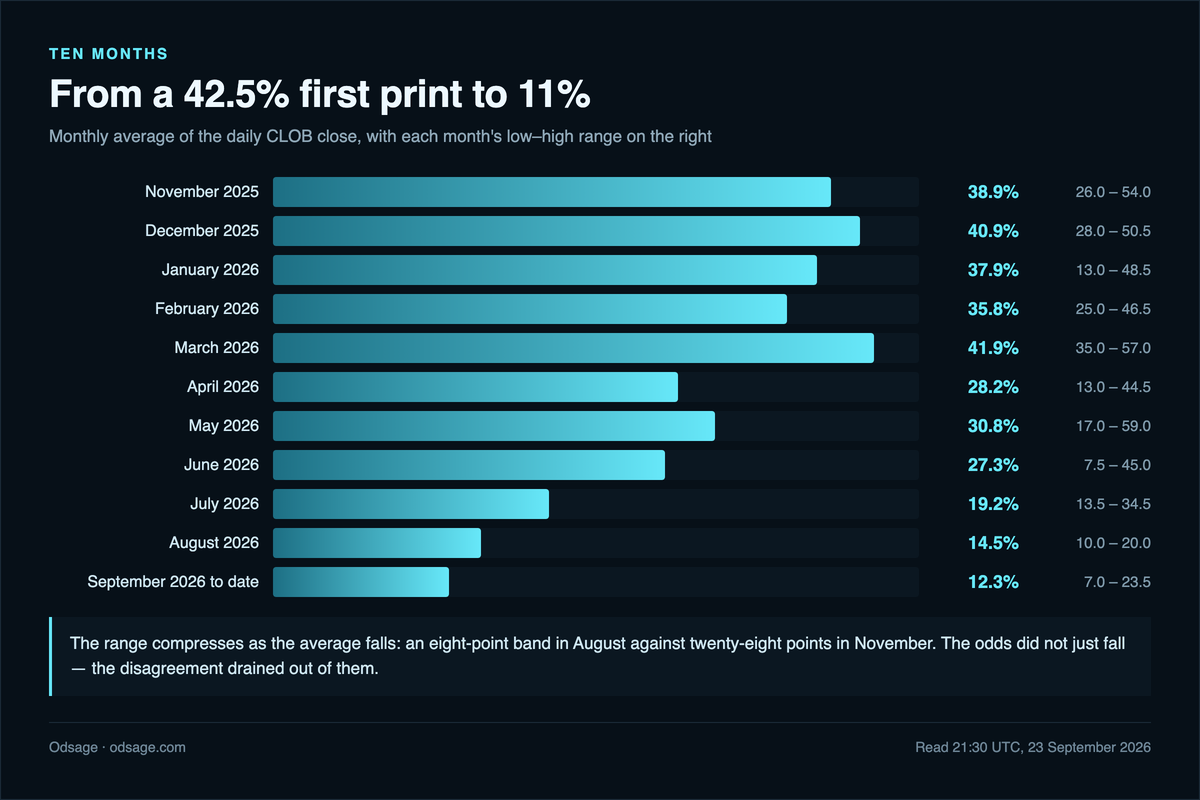
The contract opened on 12 November 2025 and printed 42.5% the following day. We pulled its full daily history from the CLOB and averaged it by month, because the day-to-day noise on a market this size hides a very clean trend.
November 2025: 38.9% average, range 26.0% to 54.0%.
December 2025: 40.9% average, range 28.0% to 50.5%.
January 2026: 37.9% average, range 13.0% to 48.5%.
February 2026: 35.8% average, range 25.0% to 46.5%.
March 2026: 41.9% average, range 35.0% to 57.0%.
April 2026: 28.2% average, range 13.0% to 44.5%.
May 2026: 30.8% average, range 17.0% to 59.0%, including the lifetime high of 59.0% on 21 May.
June 2026: 27.3% average, range 7.5% to 45.0%.
July 2026: 19.2% average, range 13.5% to 34.5%.
August 2026: 14.5% average, range 10.0% to 20.0%.
September 2026 to date: 12.3% average, range 7.0% to 23.5%.
The shape is a plateau that broke. For five months the market sat in the high thirties and low forties, wobbling but not trending, which is what a genuinely open question looks like. From April the averages fall every month bar one, and the range compresses as they fall: an eight-point band in August against twenty-eight points in November.
Compression matters as much as direction. A market that is merely pessimistic still argues with itself, and you see that in wide monthly ranges. August and September are the two narrowest months of this contract's life. The odds did not just fall. The disagreement drained out of them.
The June spike: what the Great American AI Act was worth
One episode interrupts the decline, and it is worth pulling apart because it shows what this market treats as a real catalyst and how quickly it changes its mind.
On 4 June 2026, Representatives Jay Obernolte and Lori Trahan released a discussion draft titled the Great American Artificial Intelligence Act: transparency reporting for frontier developers, independent auditing and real-time verification of safety and security procedures, and a narrow preemption of state laws specifically regulating model development, sunsetting after three years. Trahan described the scope as deliberately narrow, covering frontier model development rather than products, deployment or use. It applies to companies above $500 million in annual revenue that have trained a frontier model.
The market's reaction was not immediate. It bottomed at 7.5% in early June, then climbed through the second half of the month: 25.5% on 20 June, 40.0% on 22 June, 42.0% on 24 June, 43.5% on 27 June. Single digits to the mid-forties in roughly a week.
Then it went back. 32.5% on 1 July, 24.5% on 3 July, 19.0% on 5 July, 20.5% on 7 July, and it has never recovered. In July more than 200 state lawmakers and labour groups, including the Association of Flight Attendants, publicly urged Congress to reject the preemption provision, and the draft has not been formally introduced since.
Here is the reading I would defend, and it is a reading rather than a certainty. The draft's published contours do not obviously satisfy any of the four provisions above. Transparency reporting is not a prohibition on release. An independent audit is not a training restriction, a usage restriction or a human-in-the-loop requirement. If the Great American AI Act passed tomorrow in the shape it was published in, the likeliest outcome for this contract is that it still resolves No.
That is a warning about how the market is quoted rather than a flaw in it. The June round trip looks like traders pricing a federal AI bill, deciding it was close, then deciding it was not. It may just as well have been traders reading the resolution criteria properly and discovering that this particular bill was never the one that paid.
Where the market does expect action: chips, data centres and power
Eleven percent on a safety law is not the same as eleven percent on AI legislation. A separate Polymarket event, asking which bills become law in 2026, carries $168,520 of volume and $71,784 of liquidity across fourteen legs, and several of those legs are AI policy by another name. Their prices tell a very different story.
AI-chip export licensing: 32.0% mid, 30 bid, 34 ask, $1,700 leg volume.
Export-control chip security: 30.5% mid, 30 bid, 31 ask, $1,062 leg volume.
Data-centre utility cost protection: 22.5% mid, 22 bid, 23 ask, $1,388 leg volume.
NO FAKES Act: 21.5% mid, 21 bid, 22 ask, $20 leg volume.
SELF DRIVE Act: 4.7% mid, 3.2 bid, 6.2 ask, $434 leg volume.
For comparison, the same event prices FISA Section 702 reauthorisation at 15.0% on $106,618 of leg volume, which is where almost all of the book's money actually sits.
Alongside that, a standalone contract asking whether any US state enacts a data-centre moratorium by 31 December trades at 45.75%, on a 45.7 bid against a 45.8 ask, with $44,129 of liquidity behind $16,431 of volume. A tenth of a cent wide. That is about as confident as a prediction market book gets on a binary five weeks from resolution.
Set those numbers against 11% and the pattern is hard to miss. Chip export controls price at nearly three times the odds of a safety statute, data-centre utility protection at twice, and a state-level data-centre moratorium at more than four times on the tightest book of the lot. Traders are not saying Washington and the statehouses will do nothing about AI. They are saying the thing they do will be about semiconductors, electricity bills and land, because those are the parts of the build-out with constituents attached.
The state record backs that up. Of the 109 AI laws enacted in the first half of 2026, 28 were data-centre laws, and for the first time Republican-led states joined Democratic ones in restricting data-centre operations through ratepayer protection, oversight, tax-incentive rollbacks and moratoria. Fourteen more were companion-chatbot laws. Frontier-model safety rules, the kind this market asks about, remain the exception.
The executive order is not a statute, and this market knows it
The largest single piece of federal AI action in the window is not a bill at all. On 11 December 2025, President Trump signed an executive order titled Ensuring a National Policy Framework for Artificial Intelligence, built around a one-rule approach to AI governance and aimed squarely at state law.
It directs the Attorney General to establish an AI Litigation Task Force to challenge state AI laws in federal court, and the Commerce Secretary to issue a policy notice making states with AI laws determined contrary to federal policy ineligible for non-deployment funding under the Broadband Equity, Access and Deployment programme. It carves out state laws on child safety, on AI compute and data-centre infrastructure other than generally applicable permitting reform, and on state procurement and use of AI.
What it does not do is create any of the four provisions this contract needs. It is also, as Gibson Dunn's analysis puts it, mostly a direction for further agency action rather than a self-executing instrument, so its preemptive force depends on litigation and rulemaking that have not finished.
The price history bears that out. The order was signed on 11 December 2025, in a month that averaged 40.9% with a 28.0% to 50.5% range. January averaged 37.9%. There is no step change around the signing date at all.
That is the trap in most AI policy coverage. Headlines count activity; this contract counts one legislative outcome. An administration can run a litigation task force, condition broadband money and publish a national framework, and the number on this page need not move a cent, because none of that is a signed federal law containing a prohibition, a training restriction, a usage restriction or a human-in-the-loop mandate.
What the labs are priced to do instead
If Congress is priced out of the picture, the obvious follow-up is what the market expects the developers themselves to accept. Two live ladders answer that, and both resolve on 31 October 2026.
The third-party vetting ladder asks which AI labs commit to external vetting by that date. It carries $72,732 of volume and $40,523 of liquidity across thirteen legs, and the books are tight enough to read at the midpoint.
Google: 27.0% mid, 26 bid, 28 ask, $13,394 leg volume.
Microsoft: 19.5% mid, 19 bid, 20 ask, $6,711 leg volume.
Meta: 19.5% mid, 19 bid, 20 ask, $3,459 leg volume.
SpaceXAI: 14.5% mid, 14 bid, 15 ask, $5,697 leg volume.
Amazon: 11.0% mid, 10 bid, 12 ask, $8,168 leg volume.
ByteDance: 8.5%, Z.ai 6.5%, Baidu 6.5%, Alibaba 6.0%, DeepSeek 5.0%, Moonshot 4.5%, Meituan 4.5%, Mistral 4.3%.
Even the favourite is priced against. Google at 27% means the market sees roughly a three-in-four chance the largest of these labs makes no external vetting commitment in the next five weeks. Sum the thirteen legs and you get about 1.37, which on a ladder where several labs can qualify is not an arbitrage so much as a statement that the market expects one, maybe two, and quite possibly none.
The companion ladder, on whether any lab announces a training pause by 31 October, is smaller at $10,459 of volume and prices the idea at close to nothing: Google 7.0%, Meta 6.0%, Microsoft 5.0%, Amazon 4.5%. Its widest legs are OpenAI at 19.0% on a 10 bid against a 28 ask and Anthropic at 16.0% on 5 against 27, spreads wide enough that those midpoints are decoration rather than prices. Neither company appears as a leg on the vetting ladder at all, which is a fact about how the event was written rather than a signal about either.
Put the three clusters together and the market's view of AI governance in 2026 is consistent: no federal safety statute at 11%, no voluntary vetting wave with even the favourite at 27%, and real odds only on the chip, power and land rules that were always going to get written by somebody.
How to read these odds without getting burned
Three cautions, in the order they are likely to cost you money.
Read the resolution text before the headline, every time. This whole article turns on a four-item list buried in a market description, and the gap between AI regulation and this contract's definition of an AI safety bill is most of the value on the page. The habit generalises: on AI markets the wording usually does more work than the price.
Check the spread before you trust the mid. This market is the good case at two cents wide, the data-centre moratorium the excellent case at a tenth of a cent. The training-pause ladder is the bad case, with OpenAI quoted 10 bid against 28 ask, where the midpoint is a number the market has never agreed on. Our order-book guide covers how to tell one from the other.
Respect the calendar. This contract expires at 04:59 UTC on 1 January 2027, and the federal legislative calendar between now and then is short. Time decay on a low-probability Yes is not gentle when the only path to payout runs through a chamber that has to be in session to take it.
And an 11% price is not a prediction that nothing happens. It is a prediction that this thing does not happen, in this window, in a form satisfying four named criteria. Conflating those is how traders end up holding a contract that was never going to pay for the reason they bought it.
What would move AI regulation odds before December
Four things would genuinely reprice this market, and it is worth being specific because most AI policy news will not.
A formal introduction of the Great American AI Act with restriction language added. The draft as published is transparency and audits. If an introduced version picks up a training cap, a usage restriction or a human-oversight mandate to win votes, the path to Yes opens for the first time this year.
An AI provision attached to must-pass legislation. Nothing in the four criteria says the bill has to be an AI bill. A human-in-the-loop requirement riding on an appropriations or defence vehicle counts the same, and would be the likeliest way this resolves Yes without anyone seeing it coming.
A federal child-safety or companion-chatbot statute. Fourteen states passed companion-chatbot laws in the first half of 2026, and child safety is explicitly carved out of the preemption push. A federal version carrying a usage restriction is the nearest thing to a live legislative path.
An adverse event large enough to change the agenda. This is the unpriceable one, and it is why a contract like this rarely trades at zero even when the legislative arithmetic looks hopeless.
Absent one of those, the drift of the last five months is the base case, and the market's own compression says as much. We will keep these numbers current against the live book, and the market page linked throughout updates on its own.
FAQ
Frequently asked questions
What are the current AI regulation odds on Polymarket?
The contract on whether the United States enacts an AI safety bill before 2027 trades at 11.0%, with a 10 bid against a 12 ask, read at 21:30 UTC on 23 September 2026. It carries $166,032 of lifetime volume and $31,218 of book liquidity, and resolves at 04:59 UTC on 1 January 2027.
Why do some articles say the odds are 13%?
It comes from a late-May 2026 write-up, repeated since without being refreshed. The same articles quote a data-centre moratorium at about 93%, which refers to an earlier contract; the moratorium market open today was created in July 2026 and trades at 45.75%.
What counts as an AI safety bill for this market?
A bill signed into federal law by 31 December 2026 containing at least one of four provisions: a prohibition on creating or releasing specific AI systems, a training restriction, a usage restriction, or a human-in-the-loop requirement. Transparency, disclosure and auditing requirements are not on that list and do not resolve the market Yes on their own.
Would the Great American AI Act resolve this market Yes?
On the contours published in its 4 June 2026 discussion draft, probably not. The draft centres on transparency reporting and independent auditing for frontier developers above $500 million in revenue, plus a three-year preemption of state development rules. None of those is one of the market's four provisions.
Did the December 2025 executive order move AI regulation odds?
Barely. The order was signed on 11 December 2025, in a month that averaged 40.9%, and January averaged 37.9% with no step change around the signing. An executive order is not a statute, and this contract pays only on a signed federal law.
Which AI-related bills does the market think will actually pass?
Within the Which bills will become law in 2026 event, AI-chip export licensing prices at 32.0%, export-control chip security at 30.5% and data-centre utility cost protection at 22.5%. All three are roughly three times the odds on a federal AI safety statute, which is the market saying Congress acts on semiconductors and electricity before it acts on model safety.
Is an 11% price the same as saying AI will not be regulated?
No. It prices one federal outcome, inside one calendar year, under four named criteria. States enacted 109 AI laws in the first half of 2026 alone, and a separate market prices a state data-centre moratorium at 45.75%. The pessimism is about a federal safety statute specifically, not about AI rules in general.
Sources and methodology
Sources used for this guide
Odsage combines public source links with prediction-market context, related market pages, calculator workflows, and visible FAQ content. Market prices are informational and are not financial advice.