AI Models
AI Token Price Odds 2026: Polymarket Says Cheaper
AI token price odds run across seven Polymarket ladders and 35 legs. We checked every strike against the vendor pricing pages and found three inversions.

Key takeaways
- Seven live Polymarket events price the output token cost of named frontier models: 35 legs, $79,682 of lifetime volume, $23,214 of resting book. All seven opened on 24 September 2026 and 28 of the 35 legs opened between 0.25 and 0.30, so every number below is 23 days of trading from a near-uniform start.
- The next GPT Astra is priced 62.5% to debut below $50 per million output tokens, which is exactly where GPT-6 Astra sits today. Anthropic's next Fable is priced the other way: 80% to debut at $50 or above, with 72.5% of that sitting in the $50 to $60 band alone.
- Three of the 35 legs are inverted. Claude Opus 5.6+ prices $50 or above at 0.025 and $30 or above at 0.020, which assigns the $30 to $50 band a probability of minus 0.5 points. Two of the three inversions are on Claude Opus ladders.
- Two markets currently resolve on the same model and disagree by 9.7x. GPT Astra above $60 trades at 0.295; OpenAI's frontier above $60 trades at 0.0305. GPT-6 Astra leads OpenAI's Artificial Analysis index by one point, and that single point is carrying the whole gap.
- Three of the six strikes on the GPT Astra ladder are prices OpenAI publishes today. Batch and Flex output is $25, standard long-context output is $75, Fast mode output is $100, and the resolution text excludes every one of them. Only the $50 standard short-context rate counts.
On this page
AI token price odds are the corner of the prediction-market board nobody writes about, and right now they are saying something no pricing guide on the first page of results will tell you: OpenAI's next frontier model is likelier to launch cheaper than today's than to match it or go above. Seven live Polymarket events price the output token cost of specific named models, across 35 legs and $79,682 of lifetime volume. Every competing page we read quotes this month's rate card and stops.
We read all seven from the Polymarket Gamma API at 16:05 UTC on 17 October 2026, pulled every leg's full trade history from the CLOB, and checked each strike against the two pages the markets name as resolution sources: OpenAI's API pricing page and Anthropic's platform pricing page. We also pulled the Artificial Analysis leaderboard, because one of the seven defines its underlying model by that leaderboard rather than by name, and that choice matters more than anything else on the board.
Three findings came out of it that the headline percentages hide. The next GPT Astra is priced 62.5% to debut under $50 per million output tokens. Three of the 35 legs are inverted, meaning a cumulative ladder prices a narrow outcome above the wider one containing it. And three of the six strikes on the GPT Astra ladder are prices OpenAI already publishes, as variants the resolution text throws out.
The short version: these markets are not a bet on whether AI gets cheaper. They are a bet on one number in one column of one vendor page, and the exclusions around that number do more work than the number does.
1. What the AI token price odds markets actually measure.
2. The rate card the markets resolve against.
3. The debut ladders price the next frontier model cheaper.
4. Three inverted strikes in 35 legs.
5. Two OpenAI markets on one model, 9.7x apart.
6. Three strikes that are already live and excluded.
7. What 23 days of trading did to the tails.
8. Five checks before you trade AI token price odds.
What the AI token price odds markets actually measure
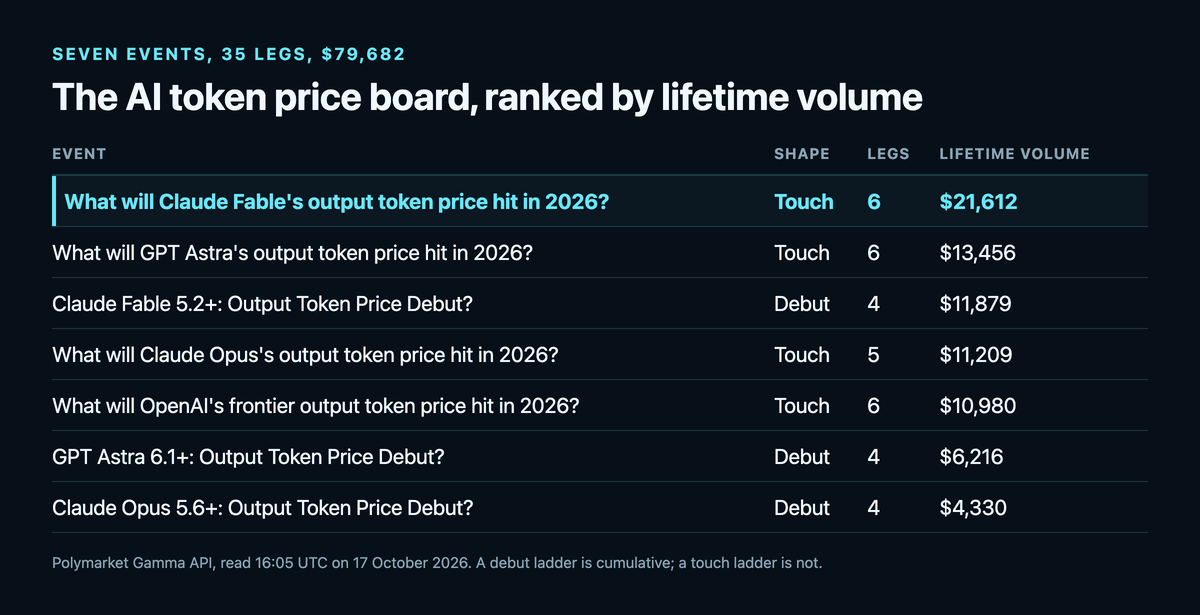
The seven events come in two shapes, and mixing them up is the first way to lose money here. Three are debut ladders, titled Output Token Price Debut?, asking what the next model in a named line charges at launch. Four are touch ladders, titled What will X's output token price hit in 2026?, asking whether the current model's price reaches a level in either direction before 31 December 2026.
A debut ladder is cumulative. Each leg is at least the stated price, so the legs must fall as the strike rises, and the gap between two adjacent legs is the probability the launch price lands in that band. A touch ladder is not: its up legs and down legs are separate one-sided questions that can both resolve YES in the same year, because a price can fall to $40 in November and rise to $60 in December.
By lifetime volume, the board ranks: What will Claude Fable's output token price hit in 2026? at $21,612 on six legs; What will GPT Astra's output token price hit in 2026? at $13,456 on six; Claude Fable 5.2+: Output Token Price Debut? at $11,879 on four; What will Claude Opus's output token price hit in 2026? at $11,209 on five; What will OpenAI's frontier output token price hit in 2026? at $10,980 on six; GPT Astra 6.1+: Output Token Price Debut? at $6,216 on four; and Claude Opus 5.6+: Output Token Price Debut? at $4,330 on four. Seven events, 35 legs, $79,682 in total.
All seven name an official vendor page as the primary resolution source, then spend a paragraph narrowing which number on that page counts: the standard short-context rate for OpenAI, the base-tokens rate for default global inference at Anthropic. Batch, Flex, Fast mode, Priority, long-context, cached, regional and data-residency prices are excluded, and so is any promotional, temporary or volume-discount pricing. That list is longer than it looks, and the section on live strikes below is what happens when you ignore it.
The rate card the markets resolve against
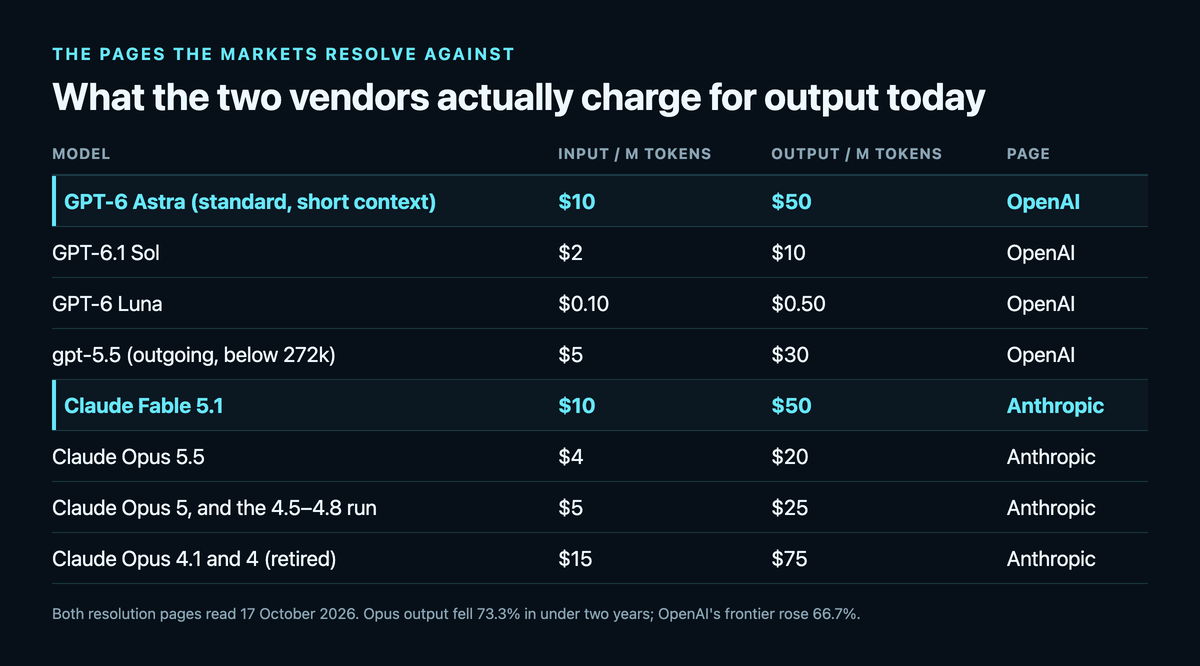
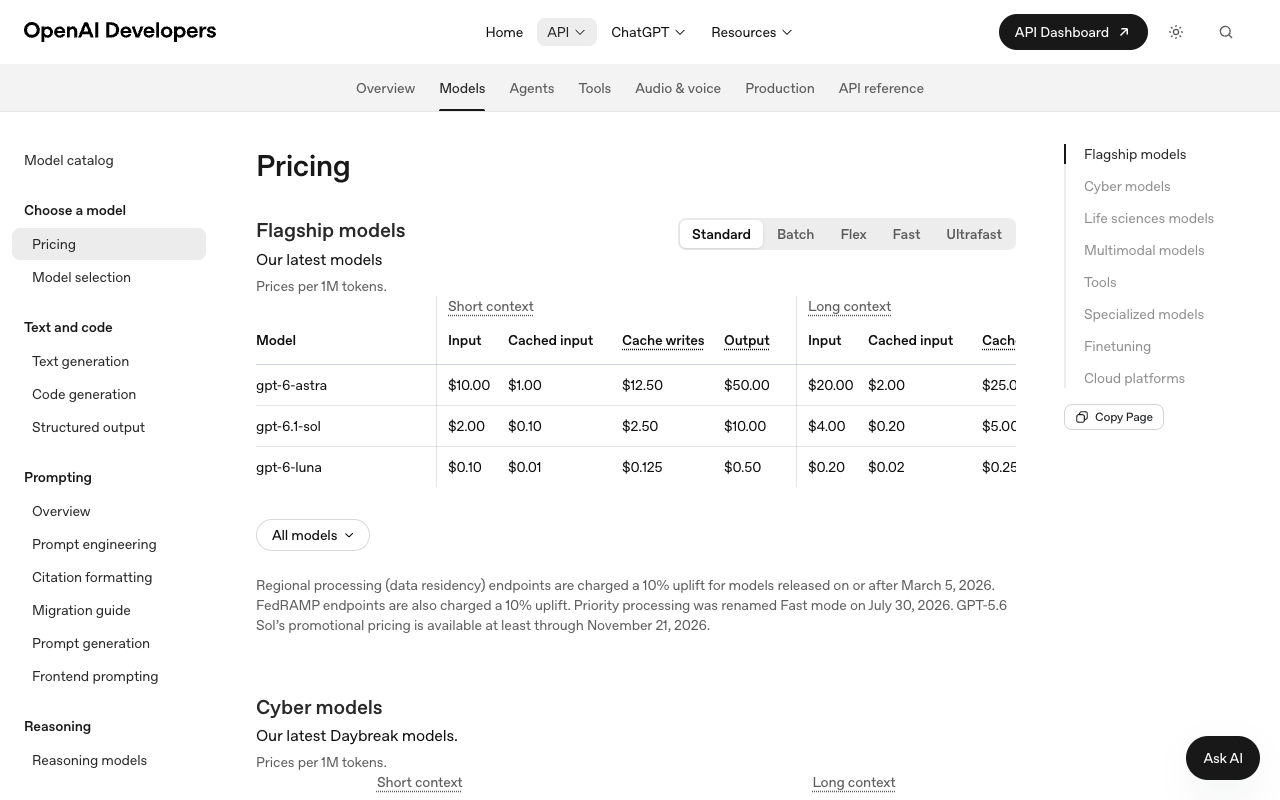
Both resolution pages were readable on 17 October 2026. On OpenAI's, GPT-6 Astra is $10 per million input tokens and $50 per million output at the standard short-context tier; GPT-6.1 Sol is $2 and $10; GPT-6 Luna is $0.10 and $0.50; the outgoing gpt-5.5 is $5 and $30 below its 272,000-token threshold.
On Anthropic's, Claude Fable 5.1 is $10 and $50; Claude Opus 5.5 is $4 and $20; Claude Opus 5 and the whole 4.5 to 4.8 run are $5 and $25; and Claude Opus 4.1 and Claude Opus 4, both retired from Anthropic's own API, were $15 and $75.
Read the Opus column downward and you get the clearest price history in the industry: $75 of output at Opus 4.1, $25 from Opus 4.5 through Opus 5, $20 at Opus 5.5. That is a 73.3% cut on the flagship line in under two years, achieved entirely through new releases rather than price edits. It is also why the Claude Opus touch ladder prices a further cut so cheaply, and why its up legs are nearly dead.
The frontier number went the other way. OpenAI's top standard output price moved from $30 at gpt-5.5 to $50 at GPT-6 Astra, a 66.7% increase, and BenchLM's Token Price Index reports exactly that: frontier prices up 66.7% year over year, mid-tier prices down 44.5%, with the index at 15.5 against a March 2023 base of 100 as of 17 October 2026. Two true sentences, pointing opposite ways. Anyone who tells you AI inference only ever gets cheaper is reading the mid-tier column.
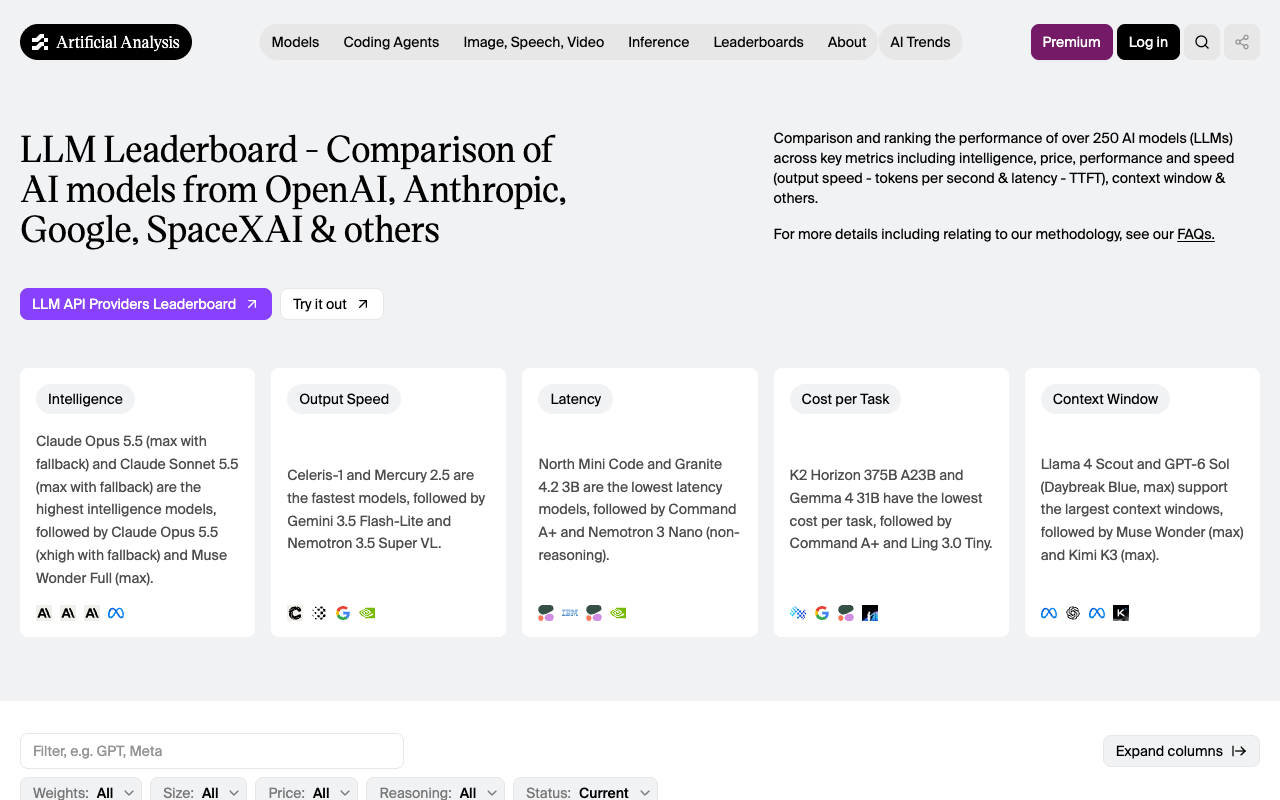
One more fact from the leaderboard, because it sets up the Fable market. Artificial Analysis scores Claude Opus 5.5 at 58 on its intelligence index, the highest entry on the board, and Claude Fable 5.1 at 53. Anthropic's $20 model outscores its $50 model by five points. The market has noticed.
The debut ladders price the next frontier model cheaper
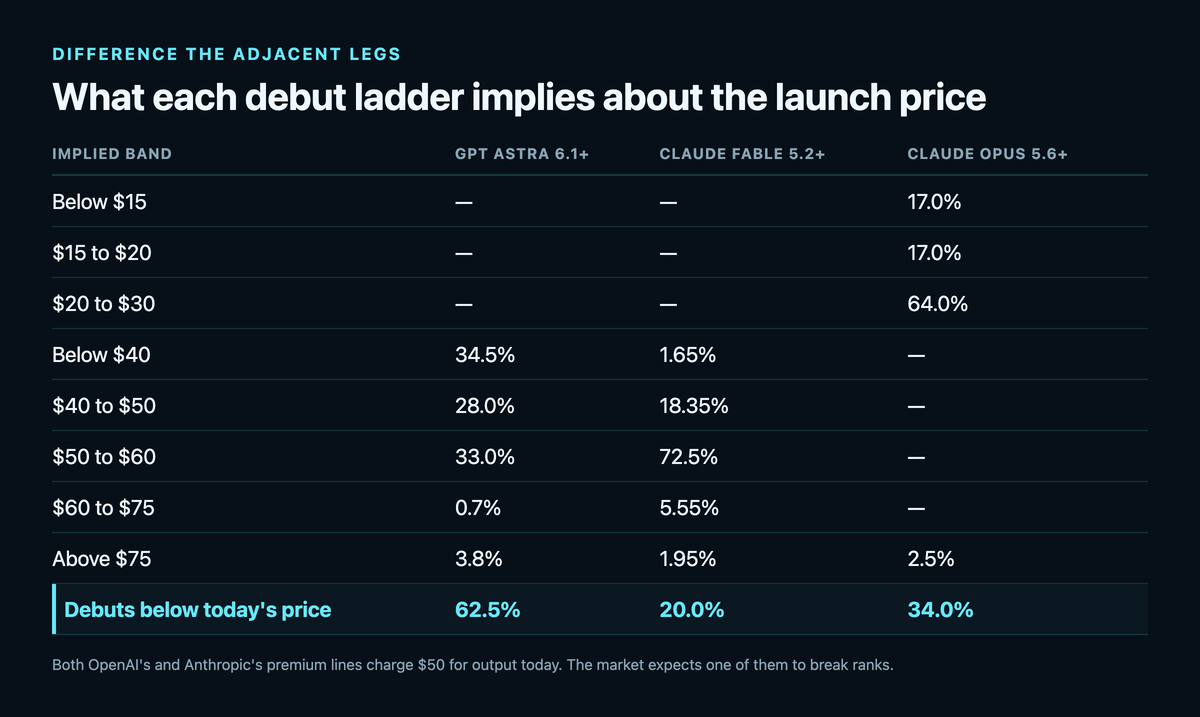
Difference the adjacent legs of each debut ladder and it turns into a distribution over the launch price. This is the part a rate-card guide cannot do, because it needs a market rather than a table.
GPT Astra 6.1 or higher prices $40+ at 0.655, $50+ at 0.375, $60+ at 0.045 and $75+ at 0.038. The implied bands: below $40 at 34.5%, $40 to $50 at 28.0%, $50 to $60 at 33.0%, $60 to $75 at 0.7%, and above $75 at 3.8%. Add the first two and the market gives 62.5% to the next Astra debuting below the $50 that GPT-6 Astra charges today. For a line whose last step went up 66.7%, that is a real statement.
Claude Fable 5.2 or higher prices $40+ at 0.9835, $50+ at 0.80, $60+ at 0.075 and $75+ at 0.0195. Bands: below $40 at 1.65%, $40 to $50 at 18.35%, $50 to $60 at 72.5%, $60 to $75 at 5.55%, above $75 at 1.95%. Nearly three quarters of the whole distribution sits in a single $10 band, which is the tightest consensus anywhere on this board, and it holds the current $50 rather than cutting it.
Claude Opus 5.6 or higher prices $15+ at 0.83, $20+ at 0.66, $30+ at 0.020 and $50+ at 0.025. Bands: below $15 at 17.0%, $15 to $20 at 17.0%, $20 to $30 at 64.0%, and above $50 at 2.5%. The $30 to $50 band comes out at minus 0.5 points, which is the first of the inversions.
Put the two labs side by side and the divergence is the story. OpenAI's next premium model is 62.5% to come in under today's price; Anthropic's is 80% to hold today's price or beat it upward. Both lines currently charge $50 for output. The market expects one of them to break ranks within nine months, and it has picked which.
Three inverted strikes in 35 legs
A cumulative ladder has one property you can check without any opinion about AI: a higher strike can never be more likely than a lower one, because reaching the higher price means you have already reached the lower one. Three legs on this board break it.
Claude Opus 5.6+ prices $50+ at 0.025 against $30+ at 0.020, a half-point inversion. The Claude Opus touch ladder prices up $30 at 0.265 against up $25 at 0.260, another half point. And the OpenAI frontier touch ladder prices up $70 at 0.0310 against up $60 at 0.0305, a five-hundredths-of-a-point inversion. A fourth leg is degenerate rather than inverted: the frontier ladder prices down $30 and down $40 at exactly 0.385 apiece, which assigns zero probability to the price stopping anywhere between the two.
None of these is an arbitrage, and we checked all three. On the Opus debut pair, selling $50+ at its 0.01 bid and buying $30+ at its 0.035 ask costs 2.5 cents for a payoff of zero or a dollar, which is buying the band rather than harvesting a free spread, and running it the other way loses in every state. What you have is a measurement failure, not a trade.
The common thread is where they sit. All three inversions are on legs whose midpoint is under 3%, where one cent of quoting noise is a third of the price, and two of the three are on Claude Opus ladders, which carry the thinnest books on the board. This is the mirror image of what we found on the release ladders two weeks ago, where all four cumulative date ladders were perfectly monotonic across a $253 market. Cumulative structure survives a thin book when the strikes are far apart and fails when they are crowded into the tail, so ignore the top two strikes of any ladder here unless you can see real size behind them.
Two OpenAI markets on one model, 9.7x apart
Two of the seven events price OpenAI's output token cost, and they define their subject differently. The GPT Astra market names the model: the highest-versioned OpenAI model with Astra in its identifier. The frontier market does not name anything. It points at the Artificial Analysis Intelligence Index and takes whichever OpenAI entry scores highest, with Status set to Current and every other filter set to All.
Today those two definitions select the same model. GPT-6 Astra at max reasoning effort scores 53 on that leaderboard, the highest OpenAI entry on it, so both markets currently resolve against the same $50 figure on the same page. They do not price alike. GPT Astra above $60 trades at 0.295; OpenAI's frontier above $60 trades at 0.0305. That is a 9.7x gap on an identical underlying number.
The gap is not a quoting artifact, which was our first guess. At the bids it is 0.25 against 0.002, a factor of 125. At the asks it is 0.34 against 0.059, a factor of 5.8. Whichever quote you pick, the disagreement survives, so something structural is being priced.
The something is one point. GPT-6.1 Sol at max effort scores 52, a single index point behind Astra, and Sol charges $10 for output rather than $50. If Sol gains a point, or Astra loses one, the frontier market's underlying price drops by 80% overnight and every up leg on it goes to zero while every down leg resolves YES. Traders are pricing that handover, and the frontier ladder's down $40 leg at 0.385 against the Astra ladder's 0.555 on the same threshold, a 17-point gap in the other direction, is the same bet seen from behind. On a market defined by a third-party leaderboard, read the leaderboard before the price.
Three strikes that are already live and excluded
GPT-6 Astra does not have one output price. It has ten. Standard short context is $50; standard long context, above 272,000 input tokens, is $75. Batch and Flex are $25 short, $37.50 long. Fast mode, renamed from Priority on 30 July 2026, is $100 short, $150 long. Ultrafast is $300 short, $450 long. Regional and FedRAMP endpoints add a 10% uplift, which prints $55 for standard short context.
Now set that against the six strikes on the GPT Astra touch ladder: down $25, down $30, down $40, up $60, up $75, up $100. Three of the six are prices OpenAI publishes right now. The $25 strike is the Batch and Flex rate exactly. The $75 strike is the standard long-context rate exactly. The $100 strike is the Fast mode rate exactly. Every one of them is named in the exclusion list, so none of them can resolve anything.
The pattern repeats on the other side of the board. OpenAI's frontier ladder has an up $55 leg trading at 0.135, and $55 is precisely what the regional and FedRAMP uplift already charges for Astra output. Anthropic's Fable ladder has an up $55 leg at 0.22, and Anthropic's own US-only inference parameter applies a 1.1x multiplier to Claude 4.6 and later models, which makes Fable 5.1 output $55 today for anyone who sets it. Both are excluded as data-residency variants.
We cannot tell you whether whoever drew these strikes was reading the vendor tables, but the coincidences are hard to explain otherwise, and the trap they set is real. A trader who opens the pricing page, sees $75 and $100 printed in black and white, and buys up $75 at 0.11 has bought a contract that those printed numbers cannot settle. The only figure that counts is the $50 in the standard short-context row. Resolution text is not boilerplate on these markets. It is the product.
What 23 days of trading did to the tails
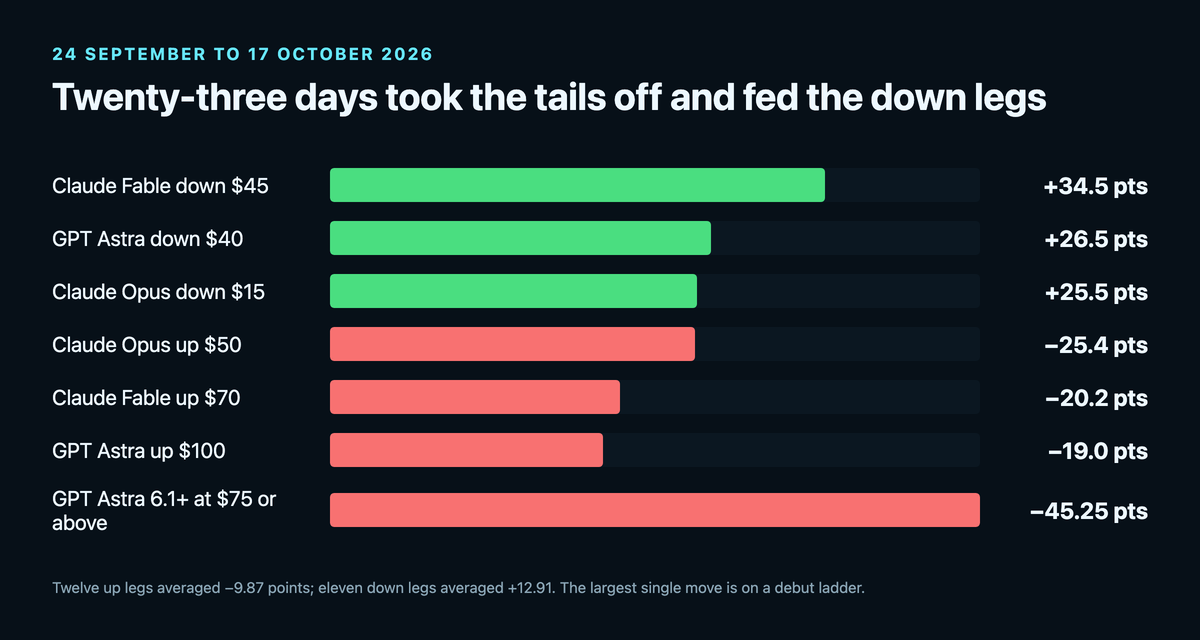
All seven events opened on 24 September 2026, and 28 of the 35 legs opened between 0.25 and 0.30, which is what a book looks like before anyone has an opinion. Twenty-three days later the midpoints span 0.006 to 0.9835, and the direction of that spread is the cleanest signal on the board.
The far tails collapsed, all four of them. Claude Fable up $70 went from 0.255 to 0.053. Claude Opus up $50 went from 0.260 to 0.006. GPT Astra up $100 went from 0.255 to 0.065. OpenAI frontier up $70 went from 0.260 to 0.031. Those are the highest strike on each touch ladder, and between 19.0 and 25.4 points came out of each in three weeks.
The down legs went the other way. Claude Fable down $45 rose from 0.270 to 0.615, a 34.5-point gain and the largest on any leg. GPT Astra down $40 rose from 0.280 to 0.545. Claude Opus down $15 rose from 0.290 to 0.545. Across all 35 legs the twelve up legs averaged minus 9.87 points and the eleven down legs averaged plus 12.91 points.
The biggest mover of the 35 is on a debut ladder: GPT Astra 6.1+ at $75 or above fell from 0.490 to 0.0375, a 45.25-point collapse, while the same ladder's $50+ leg rose from 0.275 to 0.465. Together those two moves are the market relocating its whole expectation from above $75 into the $40 to $60 corridor in three weeks, with no announcement from OpenAI.
One caveat on the arithmetic. The opening and closing figures in this section are CLOB last-trade prices in six-hour buckets, so the final bucket is a few hours behind the Gamma midpoints quoted everywhere else in this article. The GPT Astra $50+ leg is the widest case, 0.465 last traded against a 0.375 midpoint. Use the midpoints for levels and the history only for direction.
Five checks before you trade AI token price odds
First, work out which shape you are buying. A debut ladder pays on one launch price; a touch ladder pays if a level is reached at any point. Both can be right at once, so a position sized as though they are the same bet is mis-sized.
Second, read the exclusion paragraph before the price. Three of six GPT Astra strikes are live, published prices that cannot resolve the market, and two separate up $55 legs sit on numbers that the vendors' own residency surcharges already print today. The exclusions are the contract.
Third, check the definition of the underlying, not just the number. One of these markets selects its model from a third-party leaderboard where OpenAI's top two entries are one point apart and charge $50 and $10 respectively. That is an 80% price gap hanging on a ranking nobody controls.
Fourth, throw out the top two strikes of any ladder unless you can see size behind them. All three inversions we found sit below a 3% midpoint, and the widest spread on the board is 41 cents, on the Claude Opus down $15 leg, against a 51.5% midpoint. A market quoted 0.31 bid against 0.72 ask is not telling you a probability.
Fifth, separate the trend from the headline. Frontier output is up 66.7% year over year and mid-tier output is down 44.5%, both true, both on the same index. If your thesis is that inference gets cheaper, check that the leg you are buying sits on the column actually falling.
Everything here is market data and context, not financial advice. Odsage is an independent information site and is not affiliated with Polymarket, OpenAI, Anthropic or Artificial Analysis. Market prices were read from the Gamma API at 16:05 UTC on 17 October 2026 and vendor prices from the two official pricing pages the same day; all of them will have moved since.
FAQ
Frequently asked questions
What are AI token price odds on Polymarket?
They are seven live markets pricing what a named frontier model charges per million output tokens. Three are debut ladders, asking what the next model in a line will charge at launch; four are touch ladders, asking whether the current model's price reaches a level in either direction before 31 December 2026. Together they carry 35 legs and $79,682 of lifetime volume, read on 17 October 2026.
Does the market think AI API prices will fall?
On OpenAI's premium line, yes. The GPT Astra debut ladder gives 62.5% to the next Astra launching below the $50 per million output tokens that GPT-6 Astra charges today, with 34.5% of that below $40. On Anthropic's Fable line, no: that ladder gives 80% to a debut at $50 or above, and 72.5% to the $50 to $60 band specifically.
Which prices count for resolution?
Only the standard rate at the short-context tier on OpenAI's API pricing page, and the base-tokens rate for default global inference on Anthropic's pricing page. Batch, Flex, Fast mode, Priority, long-context, cached, regional and data-residency prices are all excluded, as is any promotional, temporary or volume-discount pricing. That exclusion list rules out three of the six strikes on the GPT Astra ladder, which match published Batch, long-context and Fast mode rates exactly.
Why do two OpenAI price markets disagree so much?
Because one is defined by name and the other by a leaderboard. GPT Astra above $60 trades at 0.295 while OpenAI's frontier above $60 trades at 0.0305, a 9.7x gap, though both currently resolve on GPT-6 Astra at $50. The frontier market takes whichever OpenAI model tops the Artificial Analysis index, and GPT-6.1 Sol sits one point behind Astra while charging $10 for output. Traders are pricing that handover.
What is an inverted strike and how many are there?
It is a cumulative leg priced above the wider leg that contains it, which is logically impossible: reaching $50 means you have already reached $30. Three of the 35 legs are inverted. Claude Opus 5.6+ prices $50+ at 0.025 against $30+ at 0.020; the Claude Opus touch ladder prices up $30 at 0.265 against up $25 at 0.260; and the OpenAI frontier ladder prices up $70 at 0.0310 against up $60 at 0.0305. All three sit below a 3% midpoint, so they are thin-book noise rather than tradable.
How liquid are these markets?
Thin. The resting book across all seven events totals $23,214 against $79,682 of lifetime turnover. The deepest event is the Claude Fable 5.2+ debut ladder at $11,896; the shallowest is the Claude Opus 5.6+ debut at $890 across four legs. Spreads run from 2 cents on the Fable $50+ leg to 41 cents on the Claude Opus down $15 leg, quoted 0.31 bid against 0.72 ask on a 51.5% midpoint.
Sources and methodology
Sources used for this guide
Odsage combines public source links with prediction-market context, related market pages, calculator workflows, and visible FAQ content. Market prices are informational and are not financial advice.