AI Benchmarks
Millennium Prize AI Odds 2026: A 50-Point Unwind
Millennium Prize AI odds fell 50 points in 25 days. We summed all four live Polymarket markets: one ladder adds up to a dollar, another is 4 points off.
Key takeaways
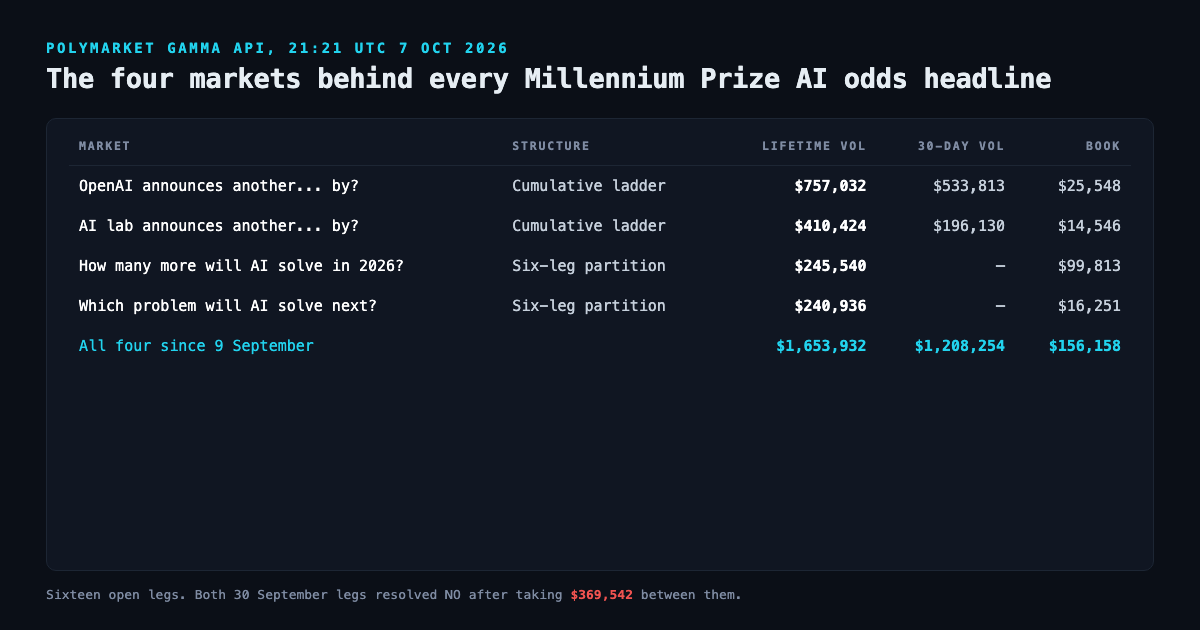
- Four live Polymarket markets price whether an AI lab announces another Millennium Prize solution: $1,653,932 traded since 9 September, $1,208,254 of it in the last thirty days, on $156,158 of resting book across sixteen open legs.
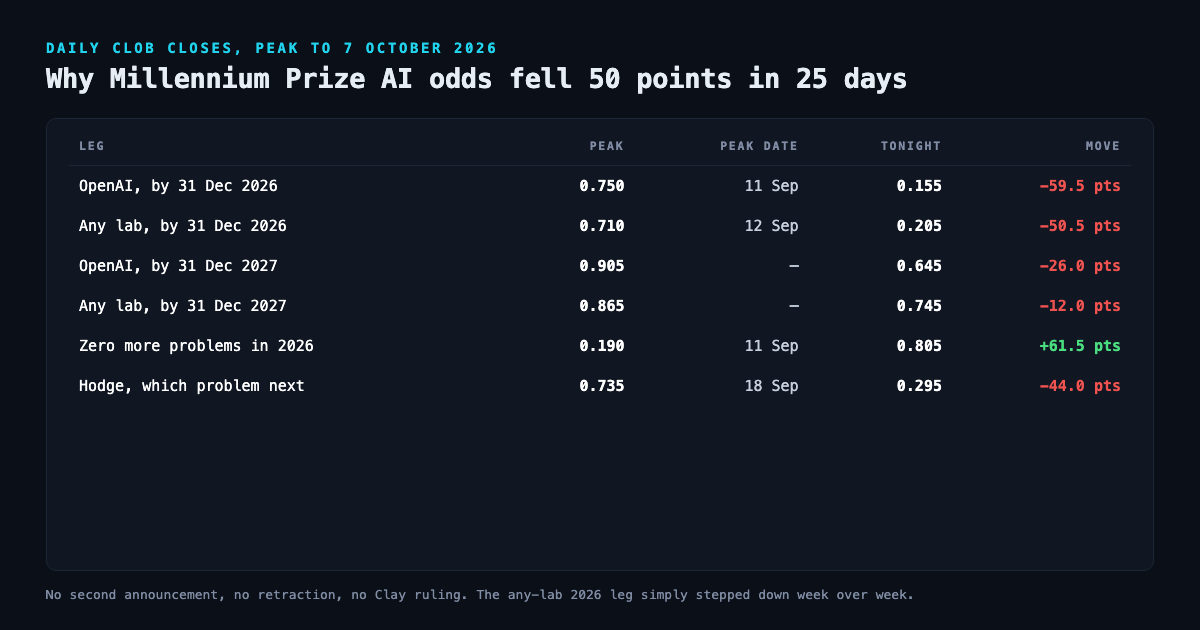
- The headline number has collapsed. OpenAI's 2026 leg peaked at 0.750 on 11 September and trades at 0.155 tonight, down 59.5 points; the any-lab 2026 leg went 0.710 to 0.205, and its mirror, zero more problems in 2026, went 0.190 to 0.805.
- Of the two partition ladders, one is honest and one is not. The count ladder brackets $1.00 from 0.963 at the bids to 1.025 at the asks. The which-problem-next ladder brackets 0.898 to 0.988: nine cents wide and entirely below the dollar it must pay.
- Two markets price the same event, same deadline, same five problems, and disagree by 4.0 points: the any-lab 2027 leg at 0.745 against its exact complement at 0.295. Over 28 days that pair averages 1.0018, so this is noise at its wide end, not a standing edge.
- Every one of these markets resolves on an announcement. The rules say in as many words that no confirmation from the Clay Mathematics Institute is required, and all four exclude Navier-Stokes. The qualifying five are exactly the five Clay files under Unsolved problems.
On this page
Millennium Prize AI odds are the most quotable number in AI this autumn and among the least stable, because the same question is priced in four separate Polymarket markets and tonight they do not agree with each other. Since 9 September those four have taken $1,653,932, including $1,208,254 in the last thirty days, against $156,158 of resting orders spread over sixteen open legs. The figure most people are quoting peaked at 0.750 on 11 September and reads 0.155 tonight, and nothing in particular happened on any single day in between.
We read all four events from the Polymarket Gamma API at 21:21 UTC on 7 October 2026, summed every ladder from the raw book rather than from midpoints, pulled twenty-eight days of CLOB closes, and checked the qualifying-problem list against the Clay Mathematics Institute's own page. One partition ladder adds up. The other is nine cents wide and sits entirely under a dollar.
The short version: these markets are not asking what you think. They do not price whether a Millennium Prize Problem gets solved, still less whether one gets verified. They price whether a company on a 46-name list says it solved one.
1. The four markets behind every Millennium Prize AI odds headline.
2. The word doing all the work is another.
3. Why Millennium Prize AI odds fell 50 points in 25 days.
4. One ladder adds up to a dollar and one does not.
5. A 4-point seam between two markets that must agree.
6. Hodge and Birch over Riemann and P versus NP.
7. Who counts as a lab, and who does not.
8. Five checks before you trade any of this.
The four markets behind every Millennium Prize AI odds headline
Polymarket runs four open events on this question, and they are structured differently enough that quoting one as the odds is already a mistake. Two are cumulative deadline ladders. Two are partitions that must price to a dollar.
OpenAI announces another Millennium Prize solution by...? is the biggest, with $757,032 of lifetime volume, $533,813 of it in the last month, on $25,548 of book. Three legs: 30 September 2026, which has already resolved NO, then 31 December 2026 at 0.155 and 31 December 2027 at 0.645.
AI lab announces another Millennium Prize solution by...? is the same shape with a wider field: $410,424 lifetime, $196,130 in thirty days, $14,546 of book. Its 30 September leg also resolved NO, and its remaining legs sit at 0.205 for 2026 and 0.745 for 2027.
How many more Millennium Prize Problems will AI solve in 2026? is a six-leg partition on the count, zero through five, with $245,540 of volume and $99,813 of book. The zero leg is the whole story at 0.805.
Which Millennium Prize Problem will AI solve next? is a six-leg partition across the five eligible problems plus a no-solution leg, with $240,936 of volume and $16,251 of book. Hodge leads at 0.295, tied with no-solution at 0.295.
Note what has already happened. Both 30 September legs resolved NO after taking $369,542 of volume between them. The first deadline in this complex came and went without a second announcement, and the market has been re-pricing around that ever since.
The word doing all the work is another
Every one of these four markets says another, and that single word carries the whole contract. It presupposes a first, and the first is OpenAI's 8 September 2026 claim on the Navier-Stokes equations: a finite-time singularity for the three-dimensional system with a smooth external force, published with a formalisation in the Lean proof assistant.
Read what that result actually is. The Clay problem lists four statements: (A) smoothness in three-dimensional space with zero external force and (B) its torus version, then (C) breakdown in three dimensions where some initial conditions and a smooth external force admit no smooth solution, and (D) its torus version. OpenAI's claim lands on the forced side, and OpenAI said itself that it would not claim the $1 million Clay prize for it. The problem's Wikipedia page records that statement (C) had not been independently verified as of 18 September 2026, and that Clay still considers the problem active as of October 2026.
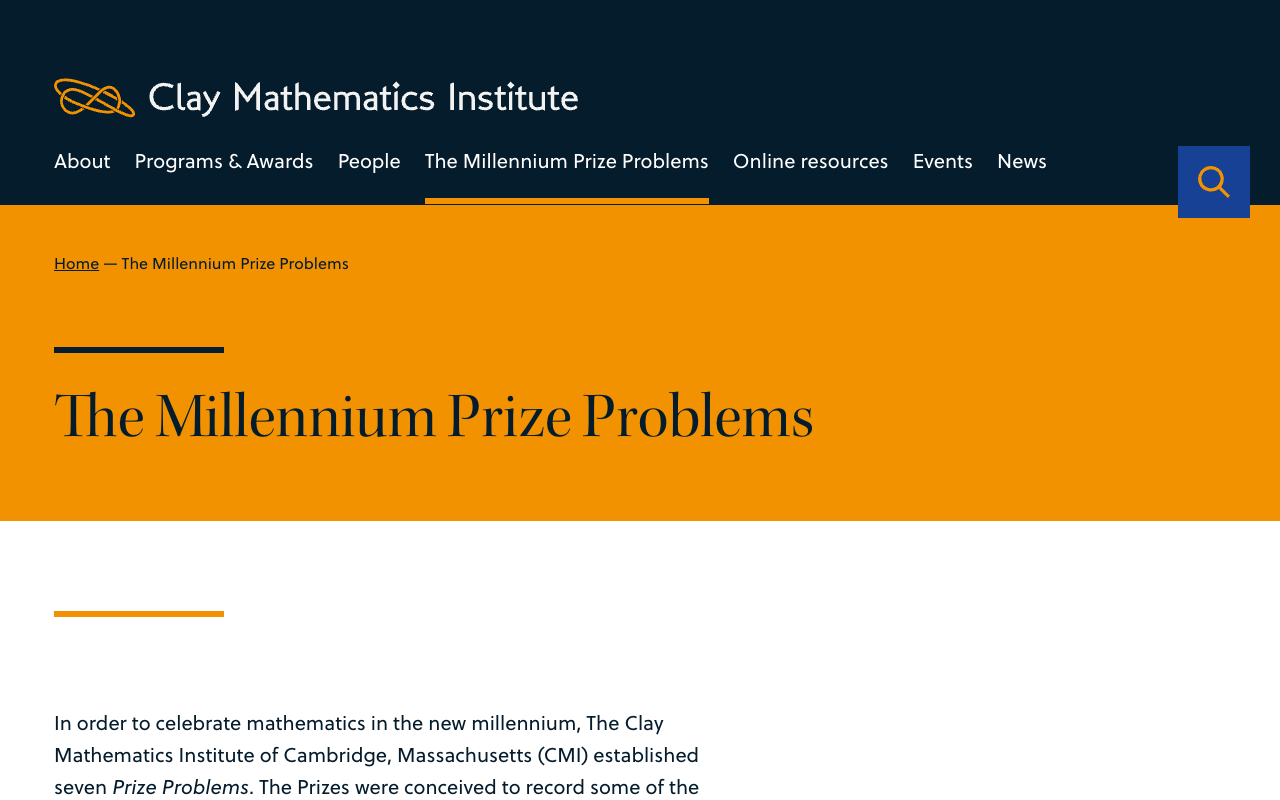
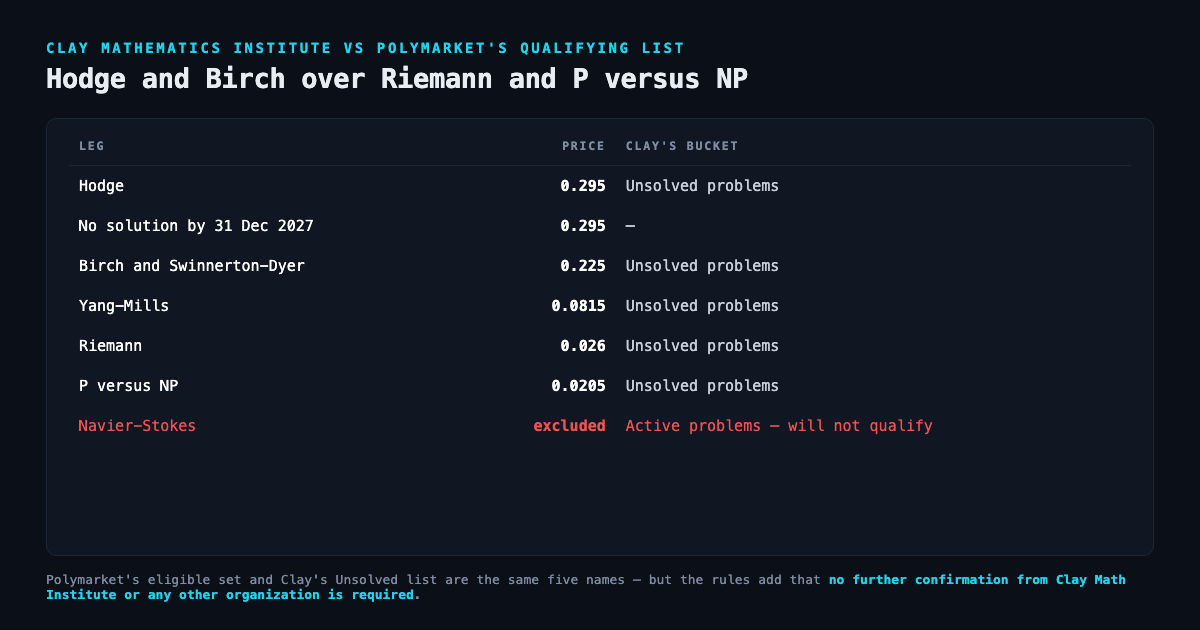
Active is a precise word here, and it is Clay's own. Its Millennium Problems page sorts the seven into three buckets. Solved problems holds the Poincare Conjecture alone. Active problems holds Navier-Stokes alone. Unsolved problems holds the other five: Birch and Swinnerton-Dyer, Hodge, P versus NP, Riemann, and Yang-Mills.
Now look at Polymarket's qualifying list. All four markets name the same five problems, and all four add a sentence excluding Navier-Stokes: announcements concerning the Navier-Stokes existence and smoothness problem will not qualify. Polymarket's eligible set and Clay's Unsolved problems list are the same five names.
That alignment is worth sitting with, because the rules say the opposite thing one sentence later: no further confirmation from Clay Math Institute or any other organization is required. The market borrowed Clay's problem list and dropped Clay's judgement. The five problems are the ones mathematics has not settled; the trigger is a press release.
Why Millennium Prize AI odds fell 50 points in 25 days
The days after 8 September were the top. Daily CLOB closes put OpenAI's 2026 leg at 0.750 on 11 September and the any-lab 2026 leg at 0.710 on 12 September. The 2027 legs peaked higher still, 0.905 and 0.865. The count ladder's zero leg, which is the same bet upside down, bottomed at 0.190 on 11 September.
Tonight those five numbers read 0.155, 0.205, 0.645, 0.745 and 0.805. OpenAI's 2026 leg is down 59.5 points from its peak, the any-lab 2026 leg down 50.5, the 2027 legs down 26.0 and 12.0, and the zero leg up 61.5. In the which-problem-next market, Hodge peaked at 0.735 on 18 September and trades at 0.295, a 44-point fall, while its no-solution leg climbed from 0.110 to 0.295.
What makes this interesting is the shape of the decline rather than its size. There was no second announcement to disprove, no retraction, no Clay ruling. The any-lab 2026 leg simply stepped down, week over week: 0.615 on 18 September, 0.525 on 23 September, 0.425 on 24 September, 0.355 on 28 September, 0.315 on 1 October, 0.275 on 2 October, 0.245 on 4 October, 0.225 on 6 October, 0.205 now. That is a cascade thesis being unwound by the calendar.
Read it that way and the move is rational. In mid-September the market was pricing a sequence: if agents can run at a Millennium problem for eighty-eight hours and produce something, the next one is weeks away. Twenty-nine days later nothing has followed, and the cheapest explanation is that the first result attacked a specific forced-blowup construction rather than opening a general method.
The 2027 legs holding up far better than the 2026 legs says the same thing in prices. Conditional on nothing landing this year, the any-lab market still gives 67.9% to 2027 and the OpenAI market 58.0%. The market has not stopped believing; it has stopped believing in the timetable.
One ladder adds up to a dollar and one does not
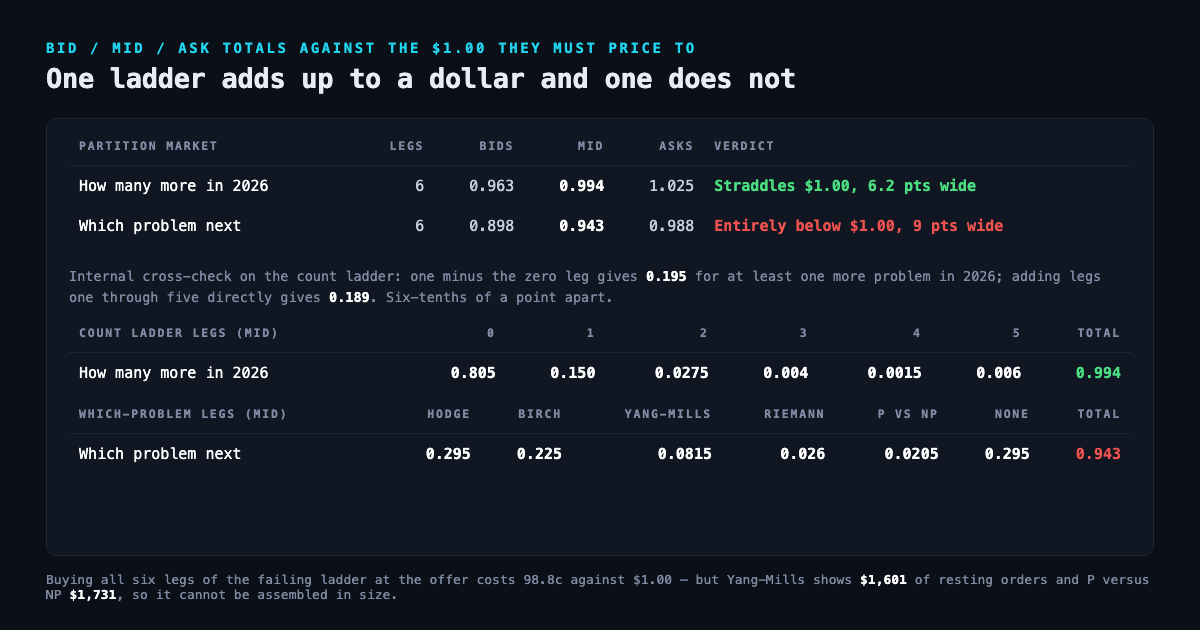
Both partition markets here are negative-risk sets: the legs are mutually exclusive, exactly one resolves YES, and the prices therefore have to sum to about $1.00. That constraint is the only free measurement of a market's quality you ever get, and it separates these two cleanly.
The count ladder passes. Its six legs read 0.805, 0.150, 0.0275, 0.004, 0.0015 and 0.006 at the midpoint, summing to 0.994. Summed at the bids the set is 0.963; at the asks, 1.025. A 6.2-point window straddling the dollar is what a working partition looks like, and the internal cross-check agrees: one minus the zero leg gives 0.195 for at least one more problem in 2026, while adding legs one through five directly gives 0.189. Six-tenths of a point apart.
The which-problem-next ladder fails. Its six legs are 0.225 for Birch and Swinnerton-Dyer, 0.295 for Hodge, 0.0205 for P versus NP, 0.026 for Riemann, 0.0815 for Yang-Mills and 0.295 for no solution by 31 December 2027. Midpoints total 0.943. At the bids the set is 0.898 and at the asks 0.988, so the entire nine-point window sits below the dollar the set must pay out.
Taken literally that is a negative-risk arbitrage: buy all six legs at the offer for 98.8 cents, collect $1.00 at settlement. We would not call it an opportunity. The gross edge is 1.2 cents against a 31 December 2027 resolution, under 1% annualised, and the book binds first: Yang-Mills shows $1,601 of resting orders and P versus NP $1,731, so the set cannot be assembled in size at these prices.
The honest reading is that a nine-point window is the market reporting its own precision. Three of those six legs carry spreads as wide as their prices, and a sum that misses by six points is a measurement error rather than a signal. Our 3 October release-ladder piece found the same failure in the other direction.
A 4-point seam between two markets that must agree
Here is the cleanest inconsistency in the complex, and it survives the spread. The any-lab ladder's 31 December 2027 leg asks whether an eligible lab announces a solution to a qualifying problem by 11:59 PM ET that day. The which-problem-next market's last leg asks whether no eligible lab does. Same five problems, same 46-name list, same deadline, same 1 January 2028 04:59 UTC end date on both events. They are exact complements, so their prices must sum to $1.00.
They sum to 1.040. The any-lab leg is 0.745 with a 0.74 bid and a 0.75 ask; the no-solution leg is 0.295 with a 0.29 bid and a 0.30 ask. The lowest sum the two books allow is 1.03 and the highest is 1.05, so the whole bracket sits three to five cents above where it has to be. That is not a midpoint artefact.
Before treating that as money, we pulled the pair's twenty-eight daily closes. The sum averages 1.0018 with a mean absolute deviation of 2.57 points, ranging from 0.960 to 1.135, closing above a dollar on nine days, below on thirteen and exactly on six. Tonight's 4.0 points is the wide end of a distribution centred where the arithmetic says it should be.
So the seam is noise, not edge, and that distinction is the whole point. A trader who sells the pair tonight is not exploiting a mispricing; they are being paid 3 cents to supply liquidity across two thin books and to carry the position for almost fifteen months.
The 6 October closes show the mechanism at its worst. Hodge printed 0.205 while Birch printed 0.335 and no-solution printed 0.380, three legs summing to 0.920 on their own, which puts the full set near $1.05 if the other three held their current 12.8 cents. Every leg moved double digits that day, in different directions, in a market whose twenty-four-hour volume tonight is $3,579. A book that thin does not produce day-level forecasts.
Hodge and Birch over Riemann and P versus NP
Strip out the no-solution leg and normalise the five problems against their own 0.648 total, and the which-problem-next market says this: Hodge 45.5%, Birch and Swinnerton-Dyer 34.7%, Yang-Mills 12.6%, Riemann 4.0%, P versus NP 3.2%. Conditional on any of the five falling to a lab by the end of 2027, the two problems almost nobody outside mathematics can state carry a combined 80.2%, and the two everybody has heard of carry 7.2%.
That ordering is defensible rather than perverse. Hodge and Birch are statements about structured algebraic objects, where a search over candidate constructions can be posed concretely and a result formalised and machine-checked the way OpenAI's Navier-Stokes work was. P versus NP is the opposite case: decades of work have established barriers to whole families of proof technique, so the obstacle is not search effort. The market is ranking tractability, not fame.
The spreads say the same thing more bluntly. Hodge and Birch are quoted a penny wide, 3.4% and 4.4% of their own prices. Yang-Mills is 2.5 cents wide, 31% of its price. Riemann is 1.8 cents wide against a 2.6-cent midpoint, 69%. P versus NP is 1.7 cents wide against 2.05 cents, 83%.
Those last two numbers are the reading note. A 2.6% probability on the Riemann Hypothesis is not a forecast anyone made; it is the midpoint between a 1.7-cent bid and a 3.5-cent ask in a book holding $3,031. Quote it as the market's view and you have invented the view. Only three legs here are quoted a penny wide, and they hold 81.5 cents of the set's 94.3: those three are the ones worth quoting.
One structural detail nobody is paid for. If two labs announce solutions to different problems on the same calendar day, the market resolves to whichever problem comes first alphabetically, and that is Birch and Swinnerton-Dyer. It is a small free option attached to the 0.225 leg and not to the 0.295 one.
Who counts as a lab, and who does not
The resolution text is where this complex stops being a question about mathematics. A qualifying announcement must come from an eligible AI lab or its official representative, must say the problem has been solved rather than report progress, and must present the solution as the work of the lab, its researchers, or its models, alone or jointly with outside researchers.
Read the exclusion that follows carefully, because it is the one most likely to cost someone money. An announcement that only credits or congratulates outside researchers, including researchers who used the lab's models, compute, or research credits, will not qualify. So if a university group proves the Hodge Conjecture next spring using a frontier model on donated compute, and the lab posts a congratulatory note, every one of these markets resolves NO. Announcements by any other company, organisation, or individual do not qualify either, which rules out the single most likely author of a Millennium Prize proof: a mathematician.
The eligible field is wide but finite: forty-six named labs, from the obvious ones through Harmonic, Axiom Math, Math Inc, Safe Superintelligence and Thinking Machines Lab, plus their subsidiaries. Then an open clause, any other company with a model listed on the MMLU-Pro leaderboard at the time of the announcement, which delegates part of eligibility to a community-maintained Hugging Face page. That is an unusual dependency for a market with $1.65 million through it.
This is what makes the OpenAI-versus-everyone split readable. The any-lab 2026 leg at 0.205 against OpenAI's 0.155 leaves 5.0 points for the case where some lab announces and OpenAI does not; the 2027 legs leave 10.0. Quoted conservatively off opposite sides of each book, those residuals bracket 4 to 6 points and 9 to 11 points. OpenAI carries 75.6% of the 2026 probability and 86.6% of the 2027 probability.
That is a strong claim about concentration: across 46 named labs and an open leaderboard clause, the chance that anyone but OpenAI claims a Millennium problem first by the end of 2027 is about one in ten.
Five checks before you trade any of this
First, sum the partition. If a negative-risk set does not bracket $1.00 at the bids and asks, you do not have a probability, you have a range. The count ladder brackets 0.963 to 1.025 and is usable. The which-problem-next ladder brackets 0.898 to 0.988 and is not.
Second, quote the bid and the ask, never the midpoint alone. Three of the six legs in the which-problem-next market carry spreads between 31% and 83% of their own price. A midpoint drawn across a gap that wide is an average of two numbers nobody traded.
Third, check the book before the price. Of the count ladder's $99,813 of resting orders, $69,638 sits on the three legs priced at a combined 1.15 cents, against 31.1% of the volume. That is makers farming a tail, and the prices they leave behind are inventory rather than opinion.
Fourth, cross-check every market against its complement elsewhere on the board. The any-lab 2027 leg and the no-solution leg must sum to a dollar and sum to 1.040 tonight; a pair that has averaged 1.0018 over 28 days tells you the gap is a thin-book wobble rather than a view you can take the other side of.
Fifth, and the one that decides whether any of the above matters, read the resolution text rather than the title. These markets do not pay on a solved Millennium problem. They pay on a named company claiming one, with no verification required and Navier-Stokes carved out. A headline that reads 20% chance AI solves a Millennium Prize problem this year is describing a different and much likelier event than the contract it is quoting.
Related reading on Odsage
The release-ladder audit from 3 October runs this same partition test across ten markets and finds one of six date ladders summing correctly. The resolution-rules and implied-probability guides cover the two reading errors this piece keeps returning to, and the FrontierMath guide tracks the benchmark market closest to this one.
FAQ
Frequently asked questions
Has AI solved a Millennium Prize Problem?
No Millennium Prize has been awarded for an AI result. OpenAI announced on 8 September 2026 a finite-time singularity for the three-dimensional Navier-Stokes equations with a smooth external force, published with a Lean formalisation, and said it would not claim the $1 million Clay prize. Clay's own page still files Navier-Stokes under Active problems, apart from the five under Unsolved and the Poincare Conjecture under Solved.
What are the current Millennium Prize AI odds on Polymarket?
Read at 21:21 UTC on 7 October 2026: an AI lab announcing another solution by 31 December 2026 is 0.205 and by 31 December 2027 is 0.745. The OpenAI-specific legs are 0.155 and 0.645. The count market gives 0.805 to zero more in 2026, implying 0.195 for at least one. These move; the market pages carry the live book.
Which Millennium Prize Problem do markets think AI will solve next?
Hodge leads at 0.295, level with the no-solution-by-2027 leg, then Birch and Swinnerton-Dyer at 0.225, Yang-Mills at 0.0815, Riemann at 0.026 and P versus NP at 0.0205. Normalised against the five problems alone, that is Hodge 45.5% and Birch 34.7%, with Riemann and P versus NP sharing 7.2% between them.
Why are Riemann and P versus NP priced so low?
Partly because the market thinks they are harder to attack with search and formalisation, and partly because almost nobody is trading them. P versus NP is quoted 0.012 bid against 0.029 ask, a spread worth 83% of its own midpoint, and Riemann is 0.017 against 0.035. A number drawn from the middle of a gap that wide is not a forecast, and should not be quoted as one.
Do these markets need the Clay Institute to confirm a solution?
No, and all four say so explicitly: no further confirmation from Clay Math Institute or any other organization is required. They resolve on an announcement by an eligible lab that a qualifying problem has been solved. That makes them markets on corporate claims rather than on mathematical facts, which is the single most important thing to know before trading them.
Does Navier-Stokes count for these markets?
No. All four markets carry the sentence that announcements concerning the Navier-Stokes existence and smoothness problem will not qualify. The five qualifying problems are Birch and Swinnerton-Dyer, Hodge, P versus NP, Riemann and Yang-Mills, which is exactly the set the Clay Mathematics Institute lists under Unsolved problems.
Is there an arbitrage in the Millennium Prize markets?
Two gaps are measurable tonight: the which-problem-next partition sums to 0.988 at the asks, below the dollar it pays, and the any-lab 2027 leg plus its exact complement sums to 1.040 against a required 1.000. Both are capped by very thin books, and the second pair has averaged 1.0018 over 28 days, so treat it as noise rather than a durable edge.
What would make these odds move sharply again?
A qualifying announcement, obviously, but also anything that changes the perceived timetable: independent verification or refutation of the Navier-Stokes result, or a second lab publishing a formalised attack on Hodge or Birch. Absent either, the pattern since 11 September has been steady daily decay rather than jumps.
Sources and methodology
Sources used for this guide
Odsage combines public source links with prediction-market context, related market pages, calculator workflows, and visible FAQ content. Market prices are informational and are not financial advice.